

Personalized email marketing continues to redefine how brands engage audiences, with data-driven strategies outperforming generic campaigns across every key metric. From open rates to conversions and ROI, personalization shapes the inbox experience and directly affects revenue growth for businesses of all sizes. In the retail sector, personalized abandoned‑cart reminders can recover lost sales, while B2B marketers leverage tailored content to nurture long sales cycles and boost engagement.
As inbox expectations rise, understanding the latest statistics is essential for marketers seeking measurable impact. Dive deeper into the numbers shaping personalized email marketing today.
Editor’s Choice
- Personalized emails yield about a 29% open rate and 41% CTR, topping generic campaigns in relevance and engagement.
- Emails with personalized subject lines get opened about 50% more than non‑personalized ones.
- Personalized email campaigns can drive six times higher transaction rates than basic sends.
- 54% of marketers personalize email content as a core strategy in 2026.
- Segmented, personalized emails generate up to 58% of total email revenue.
- Personalized calls‑to‑action deliver 202% better conversion rates than default CTAs.
- Nearly 72% of shoppers respond only when messages feel tailored to them.
- 63% of people say they never respond to non‑personalized emails.
Recent Developments
- AI adoption in email marketing continues to grow, with 63% of marketers using AI tools to enhance personalization.
- 87% of AI adopters apply AI specifically for email campaigns, signaling mainstream acceptance.
- AI‑powered personalization is helping increase CTRs by up to 13‑30% in modern campaigns.
- Marketers now allocate roughly 40% of marketing budgets to personalization efforts, up from 22% in 2023.
- Stricter inbox filtering and privacy changes push marketers to refine content relevance, not just frequency, in 2026.
- Personalized, behavior‑triggered emails outperform generic campaigns in engagement benchmarks.
- Mobile engagement continues shifting strategy, as responsive personalized content drives higher interaction across devices.
- AI predictions show real‑time personalization will become table stakes for inbox success by late 2026.
Overview of Personalized Email Marketing
- Email marketing remains widely used globally, with nearly 4.5 billion users in 2025 and expected growth into 2027.
- 376 billion emails are sent daily worldwide, and personalization helps these stand out amid inbox noise.
- 78% of marketers actively leverage email within multichannel strategies.
- Personalization involves tailoring messages based on purchase history, behavior, and preferences.
- Modern personalization extends beyond name tokens to dynamic content and predictive sending times.
- Email remains a primary channel for building customer relationships and lifecycle engagement.
- Email marketing’s effectiveness is enhanced when data and automation align.
- Personalized email campaigns frequently outperform social and paid search on ROI.
Top Email Marketing Personalization Strategies
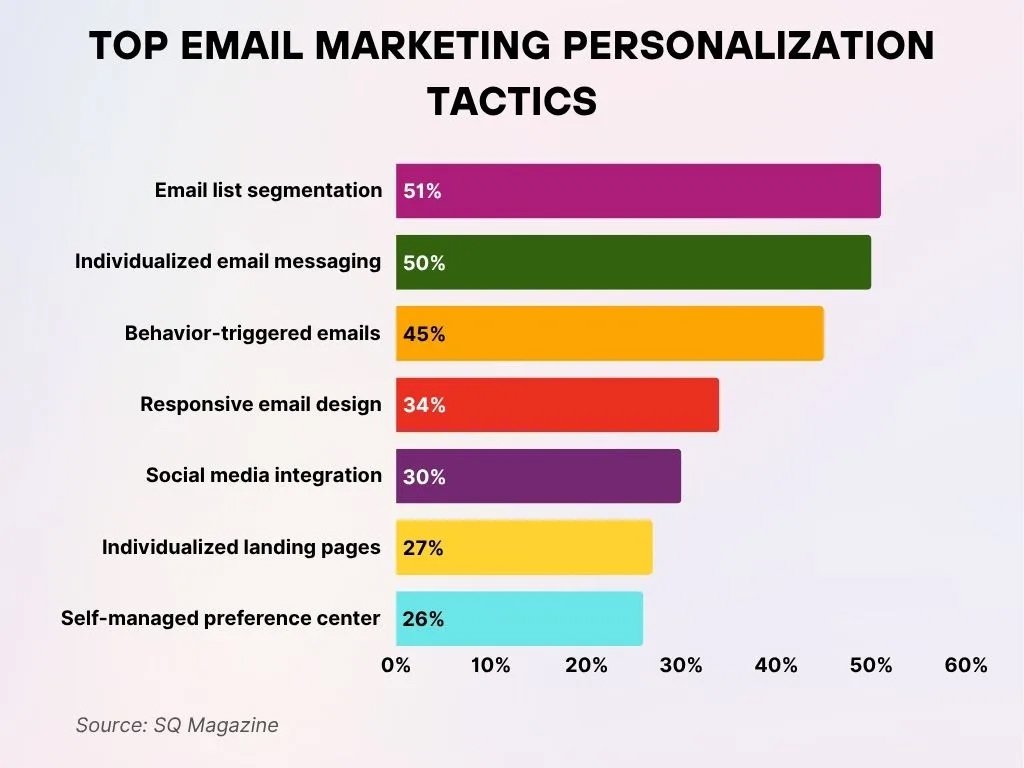
- Email list segmentation remains the leading personalization tactic, adopted by 51% of marketers to enhance campaign relevance and deliver more targeted communication.
- Individualized email messaging closely follows at 50%, highlighting the growing importance of highly tailored and personalized customer interactions.
- Behavior-triggered emails are used by 45% of marketers, enabling real-time responses to user actions and significantly improving engagement levels.
- Responsive email design is implemented by 34%, ensuring marketing emails display optimally across all devices and screen sizes.
- Social media integration forms a key part of personalization strategies for 30% of marketers, helping connect email campaigns with social platforms.
- Individualized landing pages are adopted by 27%, allowing brands to deliver a seamless, personalized, and customized user journey.
- Self-managed preference centers are provided by 26%, empowering users to control the type and frequency of content they receive.

Personalized Email Open Rate Statistics
- Personalized emails can achieve ~29% open rates industry‑wide.
- Personalized subject lines boost open rates by about 26%–50%.
- The industry average open rate (across all emails) hovers near 35–36% in 2025.
- Retail segments report ~33% engagement rates in personalized sends.
- Weekly newsletter personalization shows 48.31% open rates in some segments.
- Highly relevant personalized welcome emails can exceed 80% open rates.
- Respondents are more likely to open emails optimized for their behavior patterns.
- Mobile‑optimized, personalized emails see greater opens than non‑responsive ones.
Personalized Click‑Through and Conversion Rate Statistics
- Personalized campaigns can drive 41% higher click‑through rates than generic versions.
- Specific AI‑enhanced personalization shows CTR increases up to 13–30%.
- Segmented emails historically drive 50% more CTR than unsegmented ones.
- Personalized content delivers six times more transactions than generic emails.
- Conversion boosts often align with tailored subject lines and product recommendations.
- Dynamic product suggestions can increase purchase actions from email.
- Personalized offers increase repeat purchase probability.
- Higher CTR in personalized emails often correlates with increased sales revenue.
Leading Motivations for Personalised Email Campaigns
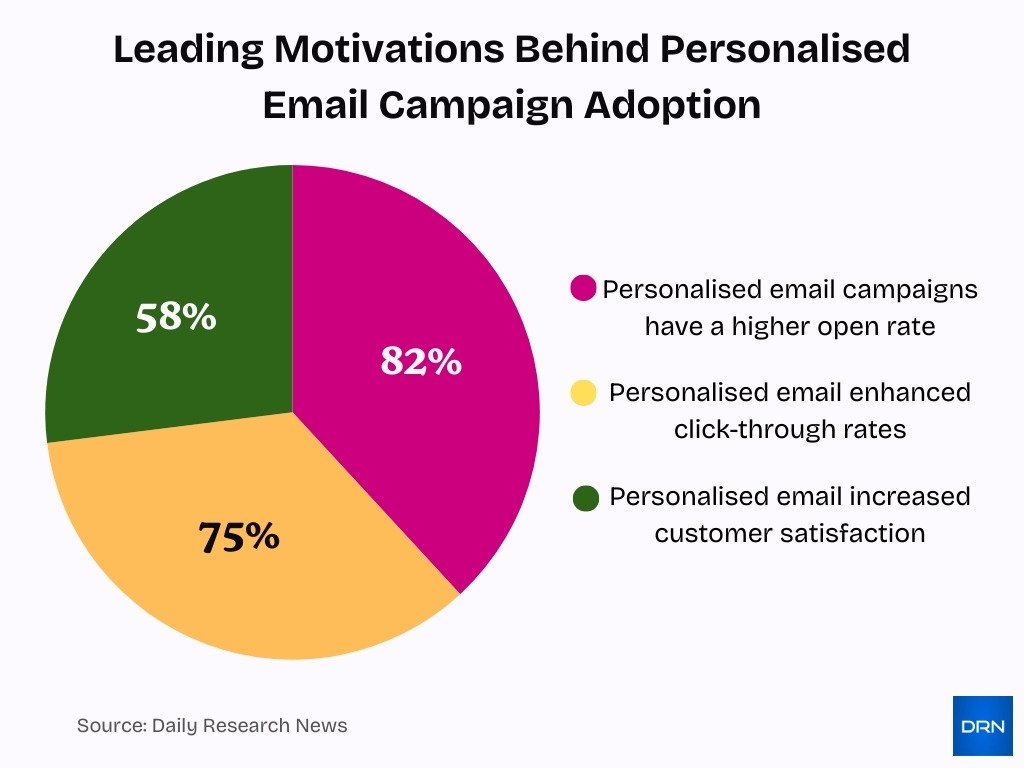
- 82% of marketers report that personalised email campaigns achieve higher open rates, making improved inbox visibility and engagement a primary motivation for adopting personalisation strategies.
- 75% of businesses confirm that personalised emails enhance click-through rates, highlighting the importance of relevant content and targeted messaging in driving user actions.
- 58% of brands experience increased customer satisfaction through personalised email marketing, reinforcing its role in building trust, loyalty, and long-term relationships.
Impact of Personalized Subject Lines
- Emails with personalized subject lines show ~29.6% open rates vs ~18% for non‑personalized ones.
- Including a recipient’s first name still boosts open rates by ~14% on average.
- Personalized subject lines can increase CTR by ~14% and conversions by up to 10%.
- Customers are 26% more likely to open emails with subject lines tailored to them.
- CTA elements influenced by subject line relevance can increase click rates by ~28%.
- Shorter subject lines optimized for personalization (under 60 characters) are used by ~82% of marketers.
- Personalized urgency cues in subject lines, e.g., time‑sensitive words, outperform neutral lines in open rates.
- Subject line personalization remains a top strategy for driving initial engagement before deeper content is even seen.
Behavior‑Triggered and Automated Personalization Stats
- Behaviour‑triggered emails can generate ~10× more revenue than standard promotional campaigns.
- Predictive behavioural targeting improves CTRs by as much as 40%.
- Automated emails produce approximately 41% of total email orders while often representing a small slice of overall sends.
- Automated, behavior‑driven emails can have ~2.5× higher conversions vs regular bulk sends.
- Emails triggered by specific user actions, e.g., cart abandonment or browsing behavior, typically outperform batch campaigns in engagement.
- Approximately 82% of marketers use email automation to enhance personalization and segmentation.
- Behavior‑triggered sequences often yield more timely relevance, increasing overall campaign impact.
- Dynamic flows based on user action contribute disproportionately to revenue vs standard sends.
Top Email Personalization Marketing Elements Used by Marketers
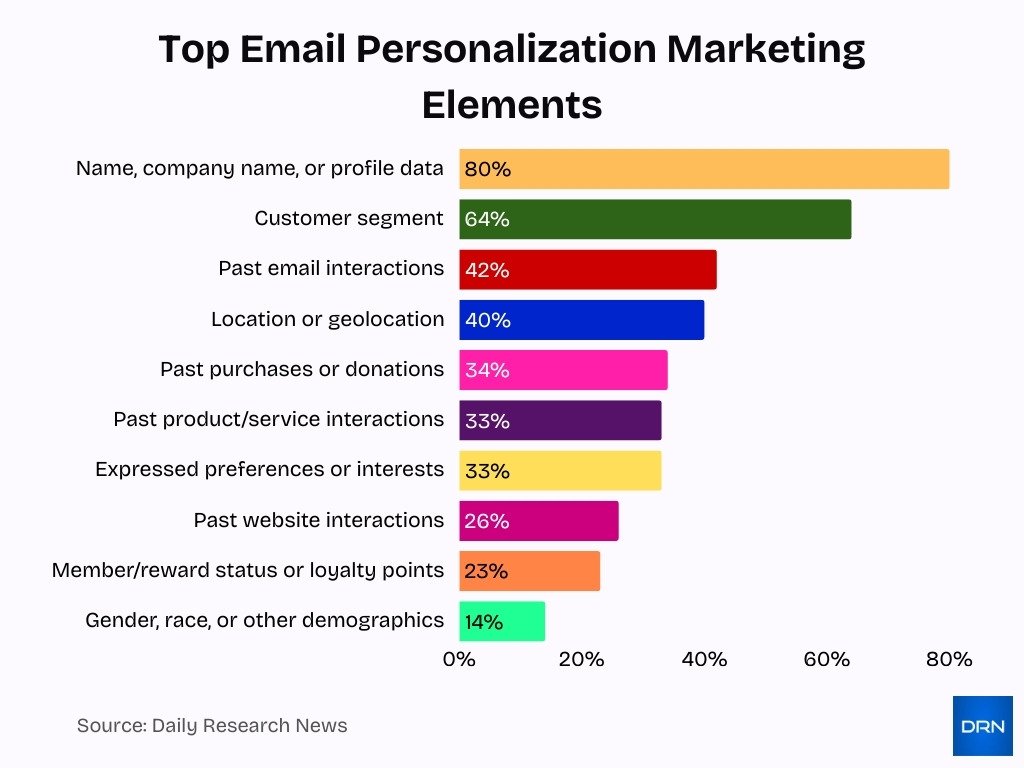
- 80% of marketers use name, company name, or profile data, making it the most widely adopted personalization method in email campaigns.
- 64% rely on customer segmentation to deliver targeted and audience-specific messaging.
- 42% personalize emails using past email interactions, such as opens, clicks, and engagement history.
- 40% leverage location or geolocation data to send region-based and locally relevant content.
- 34% use past purchases or donations to create product recommendations and upsell campaigns.
- 33% personalize based on past product or service interactions, improving relevance and customer experience.
- 33% also rely on expressed preferences and interests to align emails with user intent and behavior.
- 26% use past website interactions to customize content based on browsing and visit history.
- 23% incorporate member or reward status and loyalty points to boost retention and repeat engagement.
- Only 14% use demographic data such as gender, race, or other personal attributes, indicating limited reliance on sensitive information.
Segmentation and Audience Targeting Statistics
- Segmented campaigns can generate up to ~760% more revenue than non‑segmented emails.
- Segmentation increases open rates by ~30% and CTR by ~50% vs unsegmented lists.
- 78% of marketers consider subscriber segmentation the most effective email marketing strategy.
- Nearly 53% of small business owners use email marketing, often tied to segmentation for retention strategies.
- Interest‑based segmentation boosts dwell time in emails by ~44%.
- Segmented campaigns often outperform generic sends across industries and list sizes.
- Audience targeting using behavioral and preference data feeds richer personalization downstream.
- Modern segmentation strategies use demographic, behavioral, and lifecycle criteria to refine reach.
Dynamic Content and Product Recommendation Statistics
- Interest‑based content segmentation yields longer dwell times and more clicks than static messages.
- Personalized recommendations based on browsing or purchase behavior increase CTR and conversions.
- Tailored content blocks in emails resonate more with segments than generic layouts.
- Dynamic pricing or offer suggestions can improve overall revenue capture compared to one‑size‑fits‑all deals.
- Product recommendation blocks tailored to user history reduce friction in purchase journeys.
- Dynamic content also adapts CTAs to reflect individual user intent better.
- Personalized layout architecture increases relevance and performance in optimized campaigns.
- Live elements, like stock levels or real‑time countdowns, have been shown to boost engagement.
Personalization by Industry and Use Case
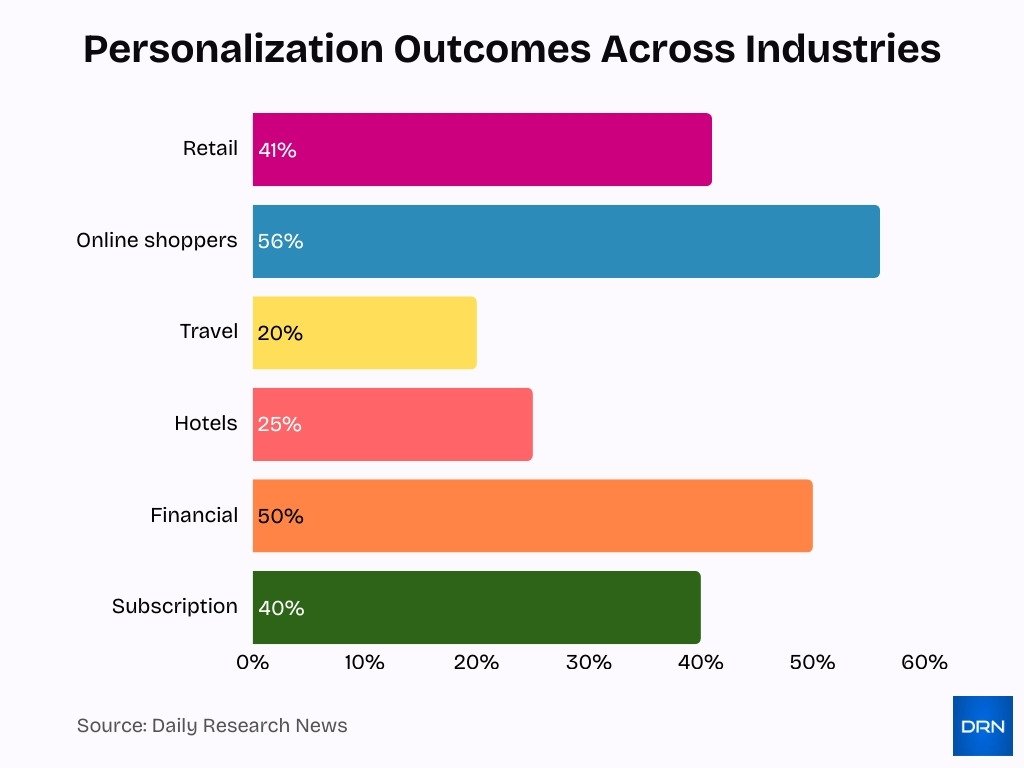
- Ecommerce brands achieve 6x higher transaction rates with personalized emails than generic ones.
- Retail personalization boosts open rates by 29% and click-through rates by 41%.
- 56% of online shoppers prefer repeat business with retailers offering personalized recommendations.
- B2B personalized nurturing generates 320% more revenue than non-personalized campaigns.
- Nurtured B2B leads make 47% larger purchases and convert 23% faster.
- Software personalized onboarding increases activation rates by 30–50%.
- Travel personalized experiences drive up to 20% revenue increase.
- Hotels with personalized offers see 15–25% upsell revenue growth.
- Financial personalized subject lines lift open rates by 50%.
- Subscription personalized support reduces churn by up to 40%.
Personalized Calls‑to‑Action Performance Stats
- Personalized CTAs convert 202% better than generic versions.
- Custom CTAs tailored to industry or buyer stage convert 42% more visitors into leads.
- 68% of marketers report that dynamic personalized CTAs boost campaign performance.
- Personalized display ads achieve ~10x higher click-through rates than non-personalized ones.
- Dynamic message personalization leads to ~27% uplift in conversions.
- Tailored CTAs based on user context increase click-through rates by up to 200%.
- Personalized CTAs in abandoned cart emails improve open rates by 26%.
- User segmentation for CTAs makes users 3x more likely to interact.
- Lifecycle stage-targeted CTAs contribute to 5-15% revenue increases.
- Optimized personalized CTAs drive up to 25% of total revenue from personalized marketing.
Revenue and ROI Impact of Personalization
- Email marketing still delivers a strong ROI of $36–$45 for every $1 spent in 2026.
- Personalized emails drive transaction rates up to ~6× higher than generic sends.
- Email remains one of the most profitable channels for both B2B and B2C revenue performance.
- Dynamic behavior‑triggered campaigns contribute disproportionately to email revenue vs volume.
- E‑commerce brands often depend on email for ~25–30% of total revenue.
- Personalization helps preserve email’s ROI edge compared to other digital media.
- Every day revenue per email continues to outperform many paid channels when personalization is applied.
- Email LTV increases when personalization supports repeat purchase behavior.
Email Campaign Frequency: How Often Brands Reach Inboxes
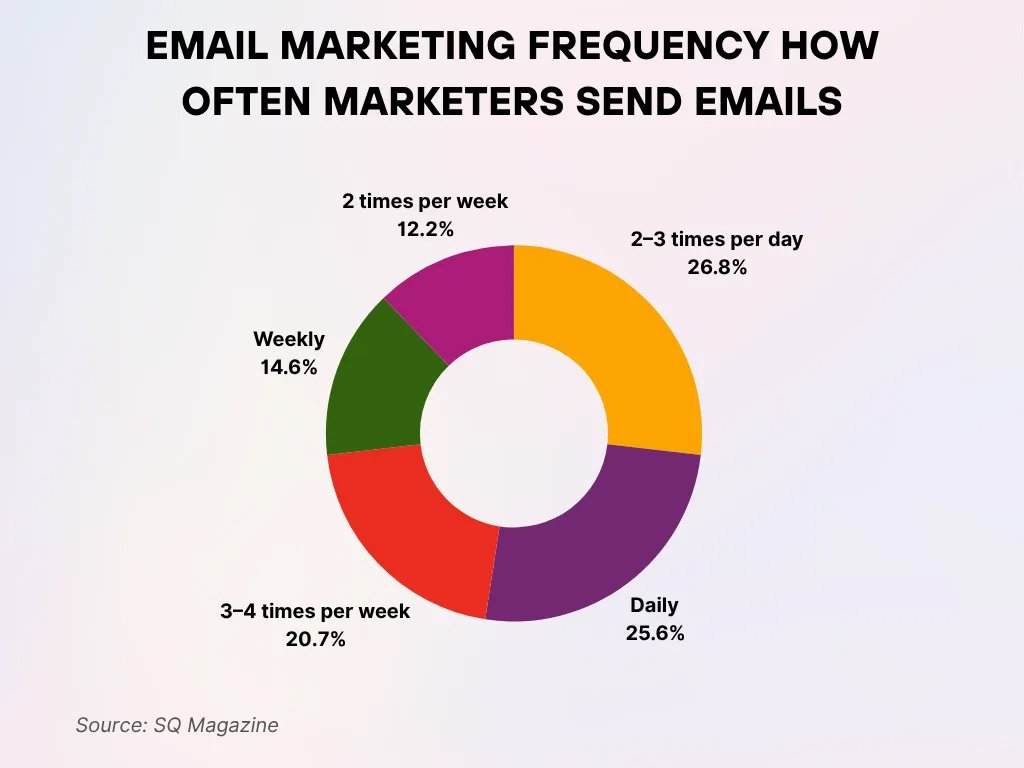
- Around 22% of marketers send emails 2–3 times per day, reflecting an aggressive engagement strategy aimed at maximizing audience interaction.
- Nearly 21% of marketers send emails daily, ensuring a consistent brand presence in subscribers’ inboxes.
- About 17% of marketers choose 3–4 times per week, carefully balancing email frequency with content quality.
- Approximately 12% of marketers prefer a weekly schedule, delivering regular updates without overwhelming their audience.
- Close to 10% of marketers send marketing emails 2 times per week, targeting a moderate outreach approach for sustained engagement.
Customer Preference for Personalized Emails
- Personalized emails achieve a 29% higher open rate and 41% higher click-through rate than generic campaigns.
- 82% of marketers confirm that personalized campaigns boost open rates significantly.
- 65% of consumers prefer buying from brands with strong personalization.
- Emails using personalized subject lines see 50% more opens.
- 72% of shoppers engage only with personal-feeling messages.
- 62% of business leaders see personalization as vital for customer retention.
- Personalized emails yield 6x higher transaction rates and conversions.
- 88% of consumers view tailored emails more positively.
- 80% of shoppers purchase more from contextually relevant brands.
- 74% of consumers dislike irrelevant emails, favoring personalized ones.
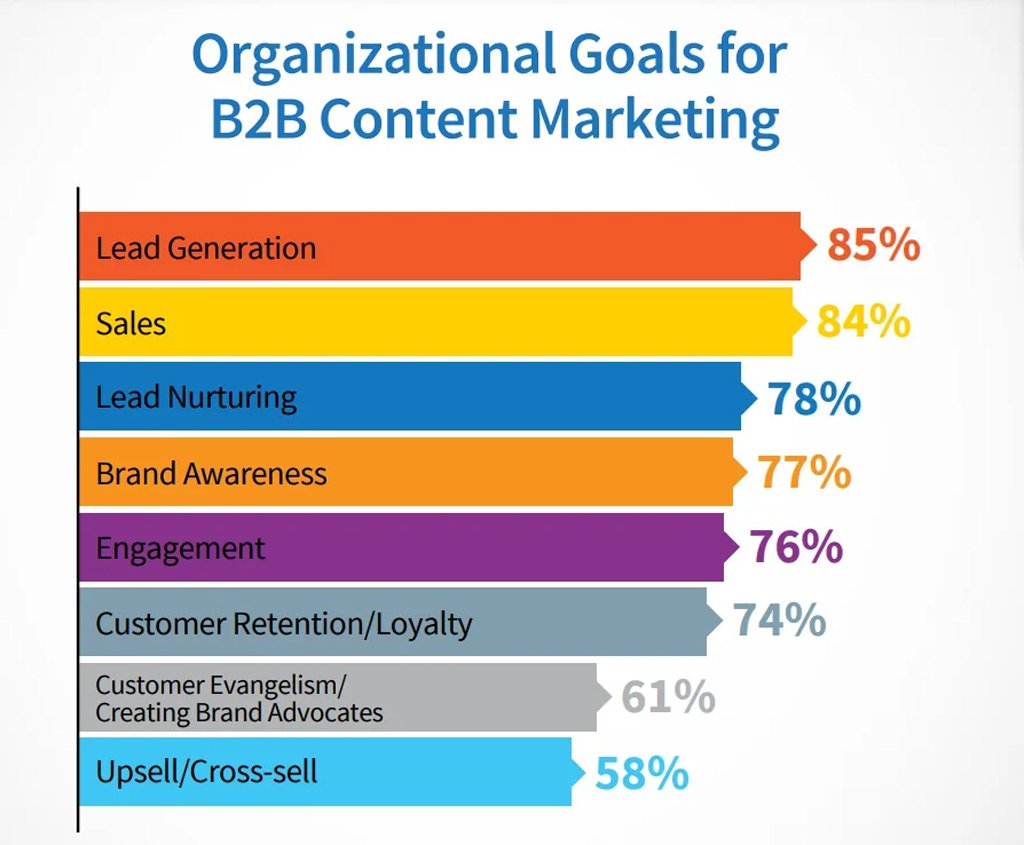
Top Organizational Objectives for B2B Content Marketing
- Lead Generation remains the primary goal for 85% of organizations, emphasizing its critical role in driving sustained business growth.
- Sales ranks second at 84%, demonstrating the strong connection between content marketing efforts and revenue generation.
- Lead Nurturing is prioritized by 78%, focusing on effectively guiding prospects through the complete buying journey.
- Brand Awareness is vital for 77% of businesses, supporting the establishment of strong market presence and long-term credibility.
- Engagement is a key focus for 76%, aiming to build meaningful, consistent, and valuable customer interactions.
- Customer Retention and Loyalty is targeted by 74%, highlighting the importance of developing long-term relationships with existing customers.
- Customer Evangelism and Brand Advocacy matter to 61%, utilizing satisfied customers to generate positive word-of-mouth promotion.
- Upsell and Cross-Sell Opportunities are pursued by 58%, with the goal of increasing overall customer lifetime value and revenue potential.
AI and Machine Learning in Email Personalization
- 63% of marketers now use AI tools in their email marketing efforts, highlighting mainstream adoption.
- Among AI‑adopters, 87% apply AI specifically to email campaigns to drive personalization and relevance.
- AI‑driven segmentation and personalization can boost revenue by ~41% for email campaigns.
- Use of AI has shown ~13.44% increases in click‑through rates when integrated into personalization workflows.
- AI tools also help optimize send times, audience segments, and predicted engagement patterns.
- AI‑enabled automation often saves teams time, with some reporting up to 90% reductions in production time for email content.
- Smarter AI systems analyze large customer datasets faster than traditional methods, enabling real‑time personalization.
- AI tools are increasingly used not just for personalization but as integral workflow copilots, suggesting improvements and optimization strategies.
Customer Engagement and Retention Statistics
- Personalized emails deliver 6 times higher transaction rates than non-personalized ones.
- 76% of consumers say personalized messages enhance brand consideration.
- 60% of shoppers complete purchases after personalized abandoned cart emails.
- Personalized emails increase customer lifetime value by up to 15%.
- Segmented campaigns boost revenue by up to 760%.
- Personalized emails achieve 29% higher open rates and 41% higher click rates.
- Email segmentation reduces unsubscribe rates by 50%.
- Behavioral triggers deliver 74% higher open rates than batch emails.
- 62% of leaders see personalization driving customer retention.
- 49% of consumers become repeat buyers after personalized experiences.
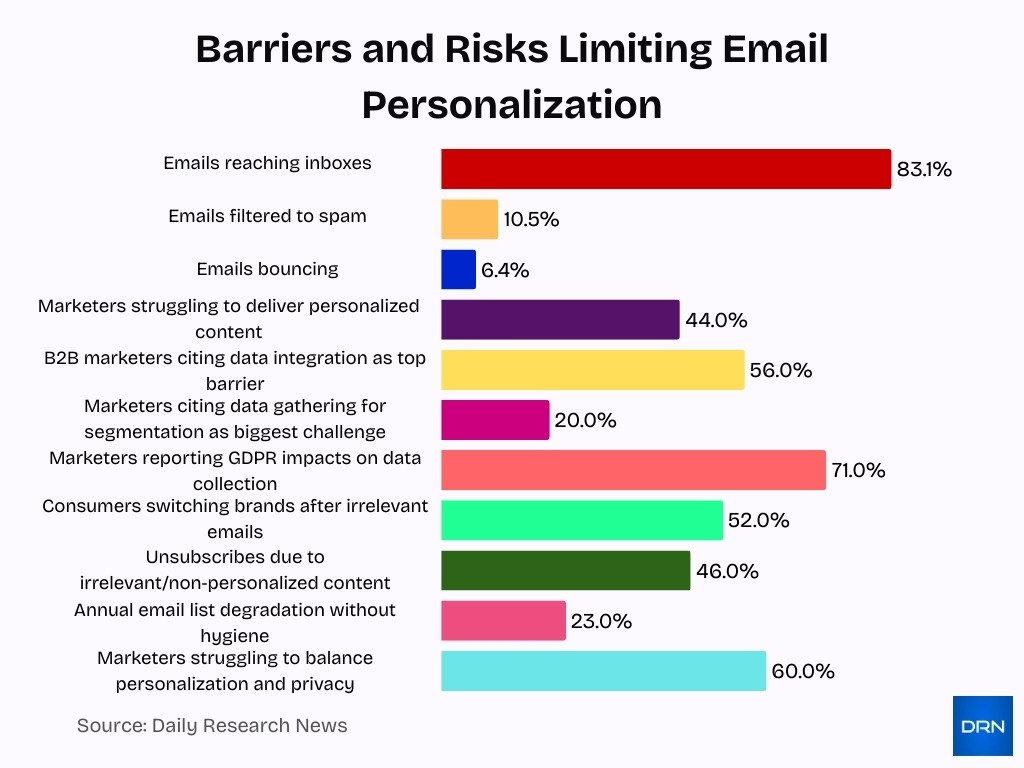
Challenges and Barriers to Email Personalization
- Marketing data quality issues cost organizations an average of $12.9 million annually.
- 83.1% of marketing emails reach inboxes, with 10.5% filtered to spam and 6.4% bouncing.
- 44% of marketers struggle to deliver personalized content in automation efforts.
- 56% of B2B marketers cite integrating data from different systems as the top automation barrier.
- 20% of marketers identify gathering data for segmentation as the biggest challenge.
- 71% of marketers report that GDPR influences their data collection practices.
- 52% of consumers switch brands after irrelevant emails lacking personalization.
- 46% of unsubscribes result from irrelevant or non-personalized content.
- Email lists degrade by 23% annually without active hygiene, hurting personalization.
- 60% of marketers struggle to balance personalization and privacy in campaigns.
Privacy, Consent, and Data Security Statistics
- 93% of marketers view first-party data collection as more critical than ever for personalization.
- 55% of marketers expect zero-party data to grow in importance over the next two years.
- 80% of customers engage more with brands transparent about data practices.
- Apple’s Mail Privacy Protection has nearly doubled average open rates to 40.5%.
- 78% of businesses faced email security breaches in the past 12 months.
- 65% of customers stop doing business with companies after data breaches.
- 83% of consumers worry about sharing personal data online.
- 67% of subscribers expect more personalized experiences from brands.
Future Trends in Personalized Email Marketing
- By 2026, around 89% of marketers expect up to 75% of email strategy operations to be AI‑driven, making large‑scale hyper‑personalization standard across campaigns.
- AI‑driven personalization is projected to lift email revenue by about 41% and boost click‑through rates by 13.44% versus non‑personalized campaigns.
- Segmented and behavior‑triggered emails can generate up to 760% higher revenue than generic blasts, underscoring the shift to hyper‑segmentation.
- Personalized emails are opened 82% more and deliver 6x higher transaction rates than generic emails, reinforcing lifecycle‑based personalization.
- Mobile devices already drive about 78% of email opens, and mobile‑first optimization is expected to push this share beyond 80% by 2026.
- Interactive email elements can increase click‑to‑open rates by up to 73% and drive over 50% more engagement than static content, powering richer in‑email experiences.
- Around 80% of shoppers say they are more likely to buy when the email experience feels tailored, making ethical, data‑driven personalization a core expectation.
- Roughly 78% of marketers rate subscriber segmentation as their most effective tactic, with 72% citing message personalization and 71% automated campaigns as key to omnichannel journeys.
- Personalized CTAs in emails can convert 202% better than standard CTAs, showing how predictive, micro‑level tweaks will compound performance gains.
- About 24% of marketers cite insufficient data, and 55% cite data integration as a major barrier to deeper personalization, driving demand for smarter AI and analytics tools.
Frequently Asked Questions (FAQs)
Personalized emails achieve about a 29% open rate and 41% click‑through rate, significantly higher than generic emails.
Brands that use personalization increase email ROI by nearly 260% (43:1) versus 12:1 for those that rarely personalize.
More than 54% of marketers personalize their email content to tailor messages to individual recipients.
Segmenting email lists can lead to up to a 760% increase in email revenue in some cases.
Conclusion
As we move through, personalized email marketing continues evolving into a sophisticated blend of data intelligence, automation, and consumer trust. From AI‑driven insights that tailor experiences at scale to privacy‑aware strategies that respect consent and security, the statistics show the enduring value and measurable impact of personalization. Integrating evolving technologies and industry best practices will be essential for marketers aiming to maintain relevance, engagement, and revenue growth.
By embracing these trends and addressing associated challenges, brands can deliver highly personalized and effective email experiences that resonate with audiences now and in the future.