


Shopify stands as one of the most influential ecommerce platforms globally, powering millions of online stores and serving merchants ranging from solo founders to enterprise brands. Shopify continued expanding its ecosystem, shaping how businesses sell online and how customers shop. Retailers and direct‑to‑consumer brands rely on Shopify for scalable infrastructure, and marketing platforms integrate seamlessly with its checkout system.
In real‑world commerce, Shopify drives revenue growth for small and mid‑sized businesses, and powers enterprise implementations at brands such as Estée Lauder and Gymshark. With this backdrop, explore the key statistics that define Shopify’s trajectory.
Editor’s Choice
- Shopify reached an estimated 6.52 million active stores worldwide in late 2025.
- The platform supports merchants across 175+ countries.
- Shopify processed over $1 trillion cumulative GMV (gross merchandise volume) by the end of 2024.
- Shopify recorded 30% market share of US ecommerce businesses in 2025.
- Over 875 million shoppers purchased from Shopify merchants in 2024.
- Shopify Q3 2025 GMV hit $92.01 billion, up ~32% year‑over‑year.
- Merchant Solutions revenue jumped 38.2% in Q3 2025.
- Shopify Plus boasts 52,757+ active high‑volume stores as of 2025.
Recent Developments
- Shopify launched the Universal Commerce Protocol (UCP) for AI‑driven shopping experiences with partners such as Google and Microsoft Copilot.
- Policy changes in 2025 altered app developer revenue share, impacting payouts after a lifetime $1M threshold.
- Shopify enhanced integrations with AI and agent‑based commerce tools for 2026.
- Expansion of Shop Pay functionality increased conversion and retention across mobile and web channels.
- The platform reported ongoing improvements in checkout velocity and merchant tools through late 2025 and into 2026.
- Migration data shows 20,675 new merchants switched to Shopify from competitors recently.
- Shopify saw 11,136 merchants leave the platform for alternatives in the same period.
- The ecosystem continues evolving toward enterprise and B2B commerce segments.
Shopify Revenue Growth by Year
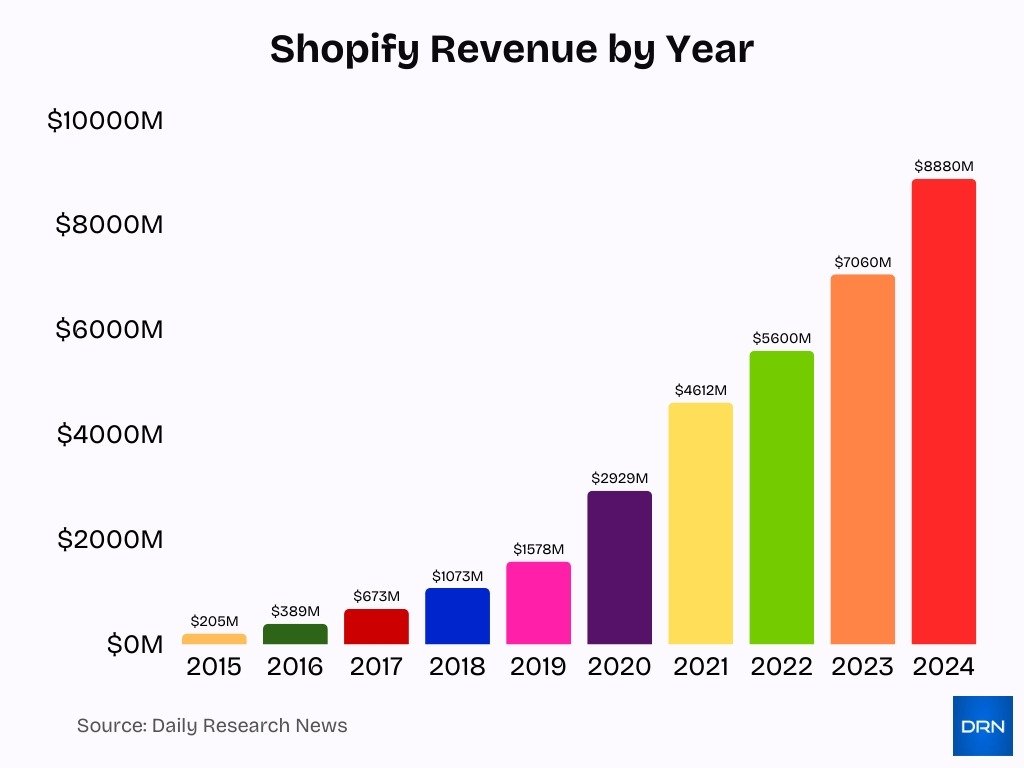
- Shopify’s revenue increased from $205 million in 2015 to $389 million in 2016, reflecting strong early-stage platform adoption and merchant onboarding.
- In 2017, Shopify generated $673 million in revenue, marking steady year-over-year growth as its ecosystem expanded globally.
- Revenue crossed the $1 billion mark in 2018, reaching $1,073 million, highlighting Shopify’s transition into a large-scale commerce platform.
- Shopify reported $1,578 million in revenue in 2019, driven by rising merchant activity and higher subscription and merchant solutions revenue.
- In 2020, revenue surged to $2,929 million, as e-commerce adoption accelerated significantly during the global shift to online retail.
- Shopify’s revenue jumped to $4,612 million in 2021, benefiting from sustained digital commerce demand and expanded enterprise adoption.
- In 2022, Shopify recorded $5,600 million in revenue, maintaining strong growth despite normalization in e-commerce trends.
- Revenue climbed to $7,060 million in 2023, supported by higher GMV, improved monetization, and broader international reach.
- Shopify achieved $8,880 million in revenue in 2024, underscoring its continued dominance and long-term scalability in the global e-commerce market.
Gross Merchandise Volume (GMV)
- Shopify’s GMV for the full year 2024 was $292.27 billion, up 24%+ from 2023.
- Q3 2025 GMV reached $92.01 billion, indicating strong ongoing sales activity.
- Merchants with annual GMV under $25M contributed the majority of platform volume.
- International GMV grew ~41% YoY in Q3.
- B2B segment GMV almost doubled (98% growth) in Q3 2025.
- Shopify’s cumulative GMV remains above $1 trillion.
- Shopify’s GMV acceleration reflects macro ecommerce growth globally.
- Seasonal spikes, notably during Black Friday and Cyber Monday, contribute significantly to annual GMV totals.

Number of Active Shopify Stores
- Shopify had roughly 6.52 million active stores by late 2025.
- Historical platform estimates noted 5.8 million live stores earlier in 2025.
- Total stores built historically exceed 9.7 million.
- Many new merchants switch to Shopify from competitors like WooCommerce and Wix.
- A smaller segment of stores migrated from Shopify to other platforms.
- North America remains Shopify’s largest regional base for active stores.
- Continued merchant growth suggests a rising global footprint into 2026.
- Active store counts reflect entrepreneurship and ecommerce adoption trends worldwide.
Most Installed Shopify Apps by Popularity
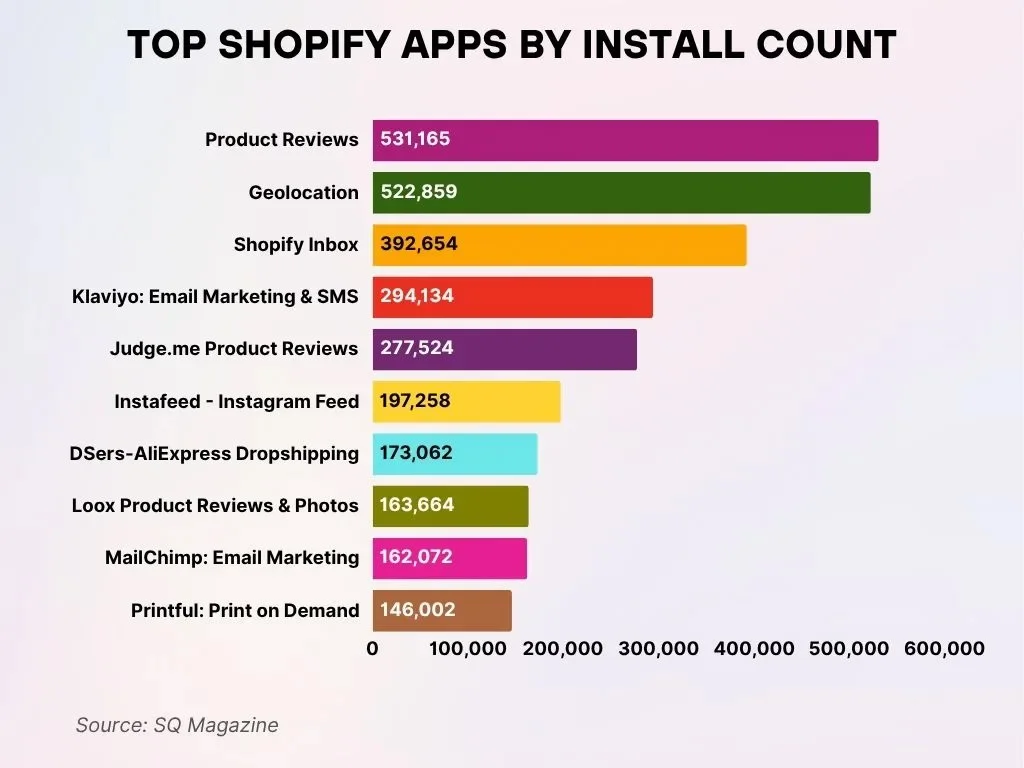
- Product Reviews dominates adoption with 531,165 installs, positioning it as the most widely used Shopify app across merchant stores.
- Geolocation follows very closely with 522,859 installs, enabling stores to automatically detect customer locations for localized experiences.
- Shopify Inbox secures the third position with 392,654 installs, helping merchants streamline direct customer communication on their storefronts.
- Klaviyo: Email Marketing & SMS records 294,134 installs, standing out as a leading solution for marketing automation on Shopify.
- Judge.me Product Reviews is relied upon by 277,524 stores, making it a popular tool for gathering customer feedback and reviews.
- Instafeed – Instagram Feed reaches 197,258 installs, allowing merchants to seamlessly integrate Instagram content into their stores.
- DSers-AliExpress Dropshipping supports 173,062 stores, playing a key role in efficient dropshipping operations.
- Loox Product Reviews & Photos is adopted by 163,664 merchants, using visual reviews to enhance trust and conversions.
- MailChimp: Email Marketing remains active on 162,072 stores, continuing its reputation as a long-standing email campaign favorite.
- Printful: Print on Demand rounds out the list with 146,002 installs, favored by merchants for custom product fulfillment solutions.
Orders Processed Monthly
- Shopify stores processed an average of 199 million orders monthly in 2023.
- 199 million orders per month marked a 20.4% YoY increase for Shopify in 2023.
- Shopify’s Q3 2024 GMV hit $69.7 billion, signaling robust monthly order values.
- Q4 2024 GMV reached $94.46 billion, up 26% YoY in order volume growth.
- Annual 2024 GMV totaled $292 billion, averaging about $24.3 billion monthly.
- BFCM 2024 generated $11.5 billion in sales over 4 days, eclipsing regular months.
- Shopify hit a peak of $4.2 million in sales per minute during Black Friday.
- Average Shopify store processes around 879 orders monthly.
- Shopify Payments handled $41.1 billion GPV in Q2 2024, 61% of GMV.
- 90% of merchants now use multi-channel sales, boosting monthly order volumes.
Average Order Value (AOV)
- The global average order value for Shopify stores ranges between $85–$92 as of 2025, reflecting typical customer spend per transaction.
- Top‑performing merchants exceed this with AOVs of $109 or more, while elite stores surpass $120 per order.
- Industry surveys suggest the median Shopify AOV centers around $92, based on active store data.
- AOV varies significantly by product niche and price point; luxury and high‑ticket categories generally see higher order values.
- Geographic differences also affect AOV: North America tends to show stronger order values than other regions.
- Desktop transactions often yield higher AOVs compared to mobile, owing to easier browsing and checkout flows.
- Bundling and upselling tactics directly contribute to lifting average order size across Shopify stores.
- AOV is a closely watched metric because improving it increases revenue without necessarily increasing traffic.
Conversion Rates
- The average Shopify store conversion rate sits around 1.4% to 1.8%, based on broad industry benchmarks.
- Shopify stores converting above 3.2% are ranked in the top 20%, indicating higher sales efficiency.
- Exceptional performers achieving 4.7% or higher sit in the top 10% of all Shopify merchants.
- Mobile conversion rates typically lag desktop at around 1.2% versus 1.9% on desktop devices.
- Certain niches, such as fashion and food & beverage, have conversion rates above the overall averages.
- Optimization efforts like streamlined checkout, personalized offers, and social proof can raise conversion performance.
- Conversion rates fluctuate seasonally, often peaking during major sales events when buying intent rises.
- High‑quality traffic sources, such as email and organic search, commonly convert at higher rates compared to social media.
Merchant Distribution by Country
- Shopify merchants operate in 175 countries worldwide.
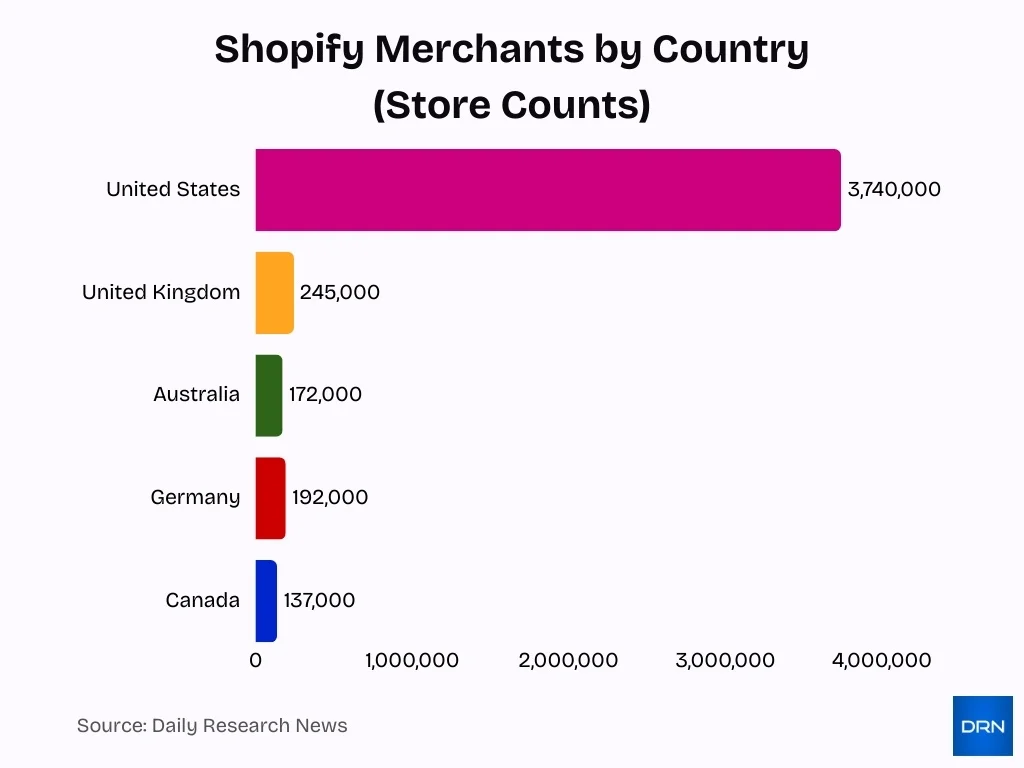
- The United States hosts 3.74 million Shopify stores, the largest market.
- The United Kingdom has 245,000 active Shopify merchants.
- Australia ranks with 172,000 Shopify stores.
- Germany features 192,000 Shopify-powered stores.
- Canada counts 137,000 Shopify merchants.
- North America dominates with 54% of all Shopify stores.
- The EMEA region holds 27% of global Shopify merchants.
- APAC accounts for 14% of Shopify’s merchant base.
- Latin America represents 5% of active Shopify stores.
Cart Abandonment Rates
- Shopify stores experience cart abandonment rates of roughly 70.19%, aligning with wider ecommerce industry benchmarks.
- Unexpected extra costs (like shipping) contribute to nearly 48% of abandonment cases.
- Mobile abandonment rates can reach 78%, higher than desktop counterparts.
- Email recovery campaigns can recover 10–20% of abandoned carts, aiding revenue recapture.
- Abandoned cart emails show an open rate above 41% and a click rate nearing 9.5%.
- Friction points in checkout and payment options remain key focus areas to reduce abandonment.
- Understanding device‑specific behavior helps merchants tailor resilience strategies for cart recovery.
- Reducing abandonment is a priority because even small improvements can translate to significant revenue gains.
Shopify Payments Usage
- Shopify Payments now processes a significant portion of transactions on the platform, with usage growing year over year as merchants adopt native payment handling.
- In the U.S. market, Shopify Payments accounted for over 12% of the total ecommerce market share via Shop Pay users as of 2024–2025.
- Shop Pay, Shopify’s accelerated checkout powered by Shopify Payments, has exceeded 200 million users globally, highlighting its adoption rate.
- Shop Pay contributed approximately 38% of gross payment volume (GPV) on Shopify’s platform, up from around 33% the previous year.
- Growth in Shopify Payments adoption reflects merchant preference for integrated payments and reduced reliance on third‑party processors.
- Shopify Payments offers multiple local payment options, which help reduce cart abandonment and support conversion improvements.
- The rising share of transactions through Shopify Payments underscores the platform’s shift toward merchant solutions revenue growth.
- Integration with Shop Pay continues to increase customer loyalty and repeat purchases, making Shopify Payments an essential tool for merchants.
- Adoption is particularly strong among U.S. sellers, where ease of setup and payment reconciliation attract both small and large merchants.
Top Product Categories
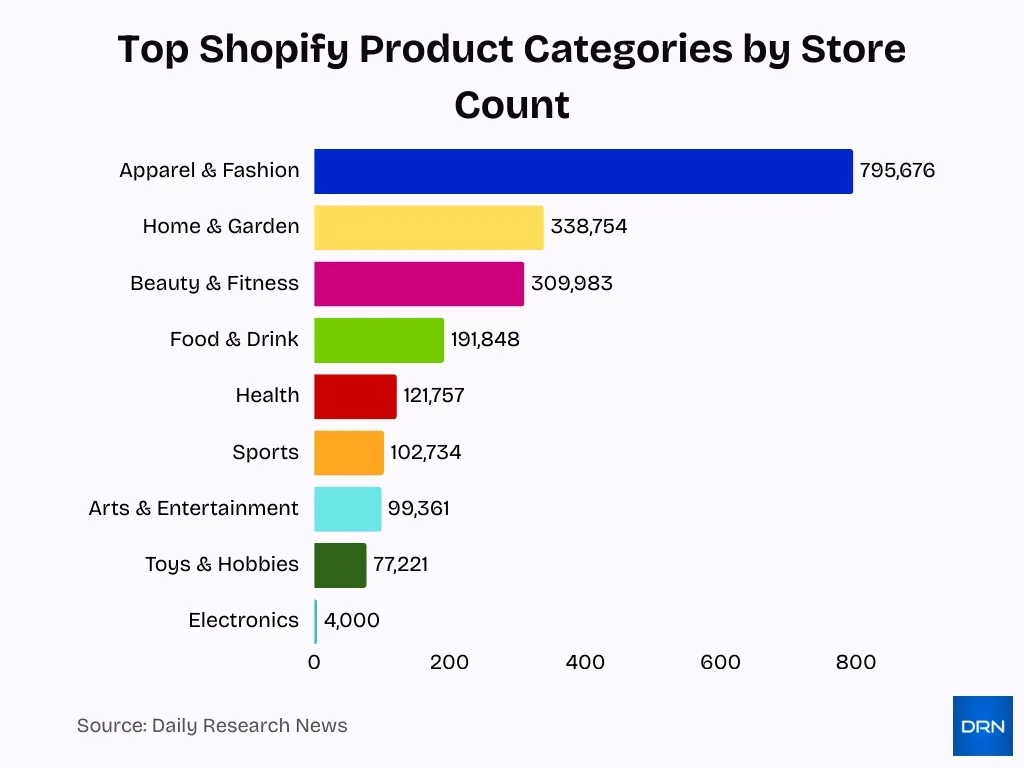
- Apparel & Fashion holds the largest share of Shopify merchant niches with 795,676 active stores.
- Home & Garden ranks second with 338,754 live Shopify stores.
- Beauty & Fitness follows with 309,983 stores in the category.
- Food & Drink accounts for 191,848 active listings.
- Health category features 121,757 Shopify merchants.
- Sports niches include 102,734 stores.
- Arts & Entertainment has 99,361 active Shopify stores.
- Toys & Hobbies continue growing with 77,221 stores.
- Electronics stores number over 4,000, often with higher average order values.
Black Friday Cyber Monday Sales
- Shopify merchants achieved a record‑breaking $14.6 billion in global sales over Black Friday Cyber Monday (BFCM) 2025, a 27% increase year‑over‑year.
- During the 2025 BFCM period, 81+ million customers worldwide purchased from Shopify‑powered brands.
- At peak on Black Friday, sales hit $5.1 million per minute, indicating intense buying activity.
- More than 94,900 merchants recorded their highest‑ever sales day during the 2025 BFCM weekend.
- The average cart price during the event was approximately $114.70, showcasing high‑value transactions.
- Cross‑border orders made up about 16% of all global orders over the BFCM weekend.
- Sales through Shop Pay accounted for a 39% year‑over‑year increase, with 32% of orders placed using Shop Pay.
- BFCM continues to represent a major revenue opportunity for Shopify merchants of all sizes.
- The U.S., U.K., Canada, Germany, and Australia ranked among the top-selling countries during the 2025 event.
Traffic and Visitor Statistics
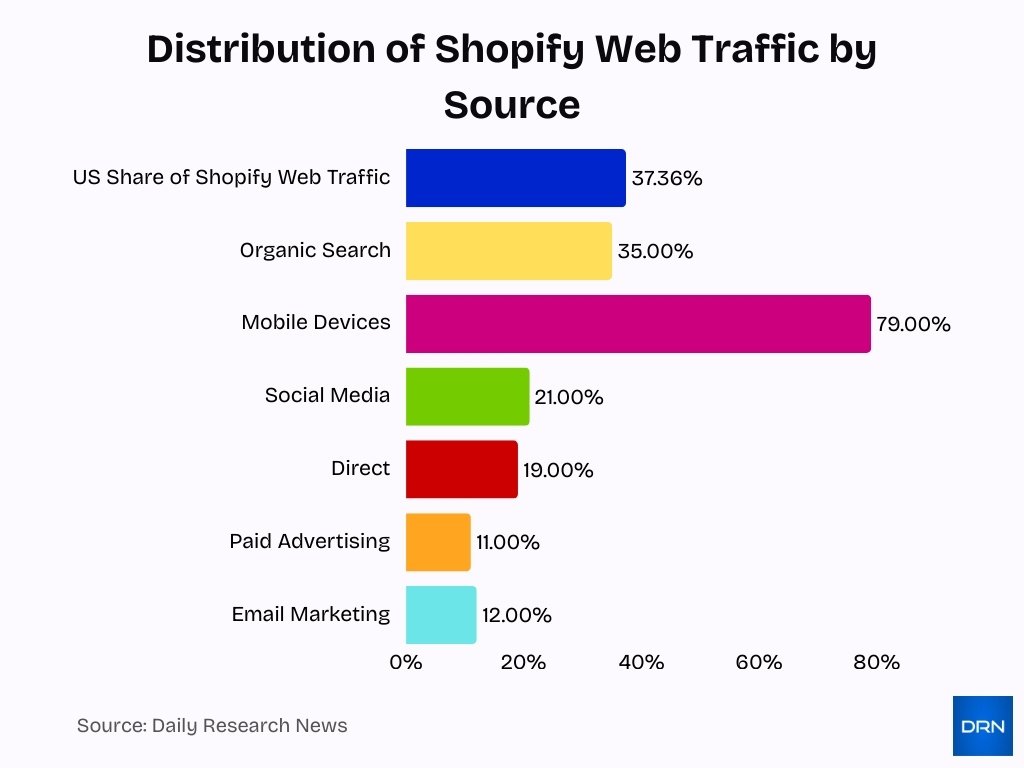
- Shopify recorded approximately 158.3 million monthly visits in June 2025.
- The United States accounts for 37.36% of Shopify’s total web traffic.
- Organic search drives 35% of traffic to Shopify stores.
- 79% of Shopify traffic originates from mobile devices.
- Social media contributes 21% to Shopify store visits.
- Direct traffic represents 19% of visits to Shopify sites.
- Paid advertising accounts for 11% of Shopify traffic.
- Email marketing generates 12% of store traffic with 2.7% conversion.
- During Black Friday/Cyber Monday 2024, Shopify processed $4.2 million in sales per minute.
- Shopify stores average 1,200 monthly visitors, with the top 10% exceeding 15,000.
Subscription Revenue
- Shopify’s Q3 2025 subscription revenue reached $699 million, up 14.6% YoY.
- Subscription solutions accounted for 24.6% of total Q3 2025 revenues.
- In 2023, annual subscription revenue hit $1.837 billion.
- Shopify Plus contributed 35% to monthly recurring revenue (MRR).
- Q2 2025 subscription revenue grew 17% YoY to $656 million.
- Subscription revenue increased 27% YoY in Q2 2024 to $563 million.
- For nine months of 2025, subscriptions were 25% of total revenue.
- MRR rose 10.3% YoY in Q3 2025, driven by Plus expansion.
- Subscription gross margins stayed high at 81.7% in Q3 2025.
Average Revenue Generated per Shopify Customer
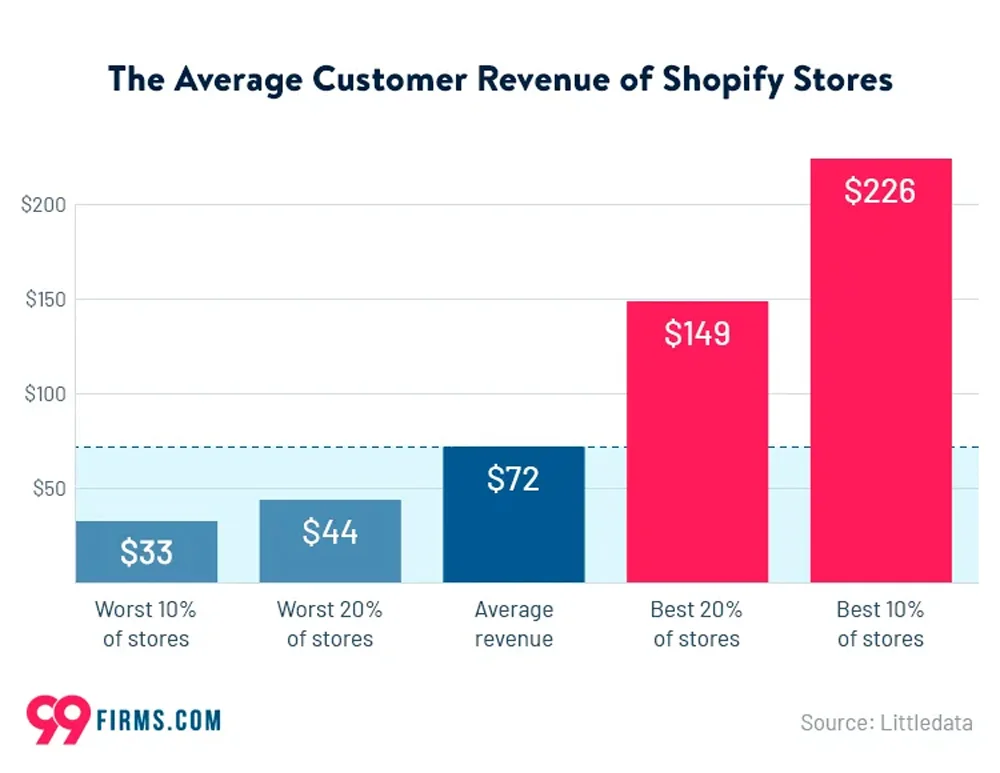
- Across all Shopify stores, the average revenue per customer stands at $72, serving as a broad industry benchmark.
- The lowest-performing 10% of stores generate only $33 per customer, highlighting the bottom end of performance.
- The bottom 20% of Shopify stores record an average of $44 per customer, which remains well below the overall average.
- The top 20% of stores achieve $149 per customer, delivering more than double the platform-wide average.
- The top 10% of Shopify stores reach a remarkable $226 per customer, representing over 3x higher revenue than the average.
App Store Statistics
- The Shopify App Store has seen significant ecosystem growth, with 18,373+ apps published by over 11,000 vendors as of mid‑2025.
- App store expansion provides merchants with tools spanning marketing, SEO, fulfillment, analytics, and more.
- The average Shopify merchant installs approximately six apps to enhance store performance.
- Independent reports noted 12,320 apps available on the Shopify App Store early in 2025, reflecting rapid ecosystem growth.
- A substantial portion of apps offer free plans or trials, enabling merchants to test tools with lower upfront costs.
- Merchants increasingly rely on apps for conversion optimization and customer retention strategies.
- The robust app ecosystem supports niche business needs, from subscription management to international selling features.
- App developers remain vital to Shopify’s platform value, fostering innovation and third‑party integrations.
- The App Store’s growth underscores Shopify’s role as a flexible platform for diverse ecommerce strategies.
Shopify Plus Merchants
- Shopify Plus boasts 66,084 live stores as of late 2025, up 47% year-over-year.
- 22.7% of Shopify Plus merchants sell 250-999 products, indicating robust catalog management.
- The US hosts 48.2% of global Shopify Plus stores, around 25,166 active sites.
- Shopify Plus supports up to 10,000 checkouts per minute during peak events like BFCM.
- Shopify Plus merchants drive 126% average YoY revenue growth, from $1M to $500M annually.
- 31% of Shopify’s monthly recurring revenue stems from Plus merchants despite smaller numbers.
- Shopify Plus stores represent 9% of the top one million websites globally.
- 67,507 Shopify Plus stores were active earlier in 2026, with 99.99% uptime for scalability.
- US leads with 29,144 Shopify Plus stores, followed by the UK at 3,828.
E-commerce Platform Market Share Comparison
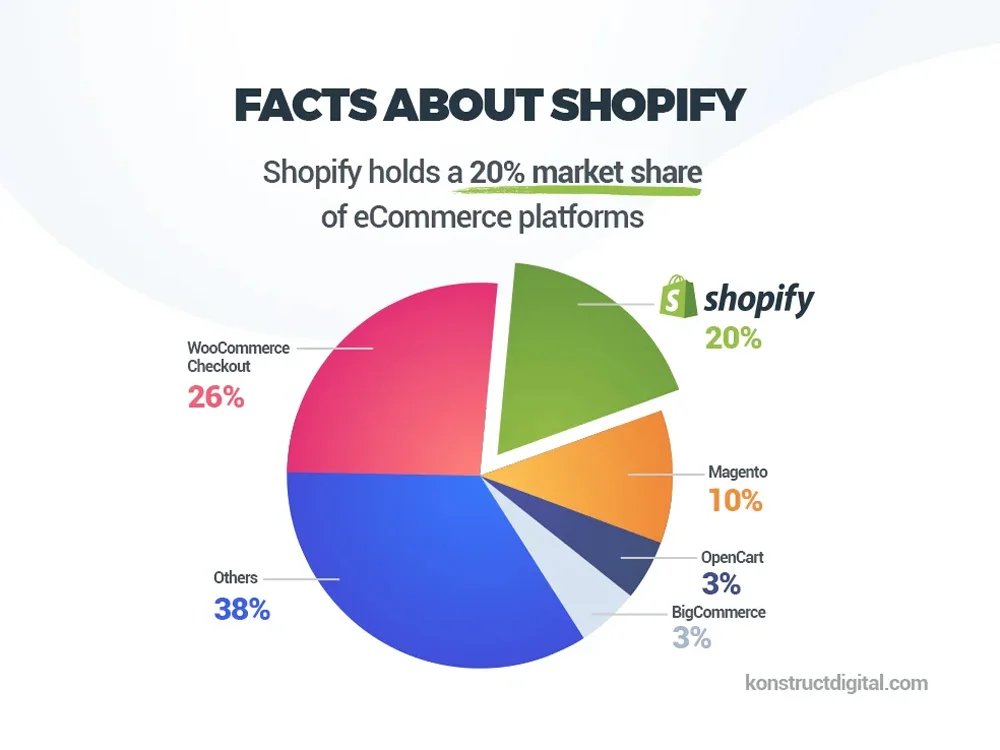
- Shopify commands a 20% market share, positioning it as one of the leading global eCommerce platforms worldwide.
- WooCommerce Checkout dominates with a 26% share, clearly outpacing Shopify in overall user adoption.
- Magento sustains a 10% market share, remaining a preferred solution for enterprise-level stores.
- BigCommerce and OpenCart each secure 3%, reflecting niche yet consistent platform usage.
- Other platforms collectively account for the remaining 38%, underscoring a highly fragmented e-commerce ecosystem.
Shop Pay Performance
- Shop Pay accounts for a growing share of orders, with up to 32% of Shopify transactions placed through the accelerated checkout feature during peak events.
- Use of Shop Pay increased year‑over‑year, with 39% higher sales made via Shop Pay during major shopping events.
- Shop Pay’s user base reflects adoption beyond traditional ecommerce checkout flows.
- Accelerated checkout options have been shown to improve conversion, especially on mobile devices.
- Integration with the Shop App enables package tracking and enhanced post‑purchase engagement.
- Merchants using Shop Pay often see higher average order values and repeat purchase rates.
- Shop Pay’s integration with sustainability goals (e.g., carbon‑neutral checkout) resonates with environmentally conscious customers.
- Growth in Shop Pay usage reflects consumer preference for fast, secure, and familiar checkout experiences.
- Shopify’s investment in the Shop ecosystem reiterates its focus on customer‑centric commerce tools.
Frequently Asked Questions (FAQs)
Shopify merchants achieved $14.6 billion in global sales, marking a 27 % increase year‑over‑year during Black Friday–Cyber Monday 2025.
Shopify’s GMV reached $292.27 billion in 2024, reflecting a 24 % year‑over‑year increase from 2023.
As of 2025, Shopify powered over 5.8 million live stores and served 875 million unique shoppers globally.
In 2025, 30% of ecommerce businesses in the United States were selling through the Shopify platform.
Conclusion
Shopify continued strengthening its position as a leading ecommerce platform with broad merchant adoption, innovative payment solutions, and compelling growth metrics. Its payments ecosystem and Shop Pay adoption are rising, while platform traffic and global market share show sustained expansion. Black Friday Cyber Monday sales data underscores how Shopify merchants capitalize on peak shopping events, and Shopify Plus growth reflects deeper engagement at the enterprise level.
As subscription revenue, app store engagement, and infrastructure performance continue improving, Shopify’s role in shaping online commerce remains robust. With ongoing innovations, Shopify’s trajectory looks set to influence ecommerce strategies well and beyond.