

Social media advertising continues to reshape how brands reach audiences worldwide. With billions of users spending hours daily on social platforms, advertisers now view social media as a central channel for marketing and commerce. From consumer brands launching global campaigns to small businesses targeting niche markets, these shifts are already influencing how companies allocate ad budgets and measure returns. Explore the detailed statistics below to understand the scale and trends of social media advertising.
Editor’s Choice
- 5.41 billion people globally, or about 65.7% of the world’s population, now use social media.
- The global social media market size is projected to grow from $234 billion in 2024 to $276 billion in 2025.
- Digital channels accounted for 72.7% of all advertising spending worldwide in 2024.
- In 2024, total digital ad revenue reached $259 billion globally, a steep rise from previous years.
- Global social media ad spend grew by 10.9% YoY, and is now projected to surpass $276.72 billion in 2025.
- The global ad spending market remains on an upward trajectory, with forecasts showing strong growth through the rest of the decade.
- For many marketers, social media advertising now surpasses traditional media as the primary channel for audience reach and engagement, a shift reflected in rising budgets and expanding platform capabilities.
Recent Developments
- In 2025, more platforms will emphasize short-form video, social commerce, and creator-driven ads as core components of social advertising.
- Advertisers increasingly treat creators and influencers as a distinct channel, “creator economy ad spend” jumped from $13.9 billion in 2021 to $29.5 billion in 2024, with a forecast of $37 billion in 2025.
- The shift to digital ad spend continues, and many brands re-allocate budgets from offline media (print, TV) to online platforms, especially social media.
- Many marketers now prioritize social media as a key growth channel; over 90% say social remains a top focus heading into 2025.
- Short-form video content, especially on mobile, is becoming a dominant ad format, thanks to changing user behavior and higher engagement rates.
- Regulatory and privacy changes continue influencing ad delivery and targeting methods, and advertisers search for a balance between effectiveness and compliance.
- E-commerce integration into social platforms strengthens, as more users now discover and purchase products directly through social ads and in-app stores.
- As digital media adapts, traditional ad formats face headwinds, reinforcing social media’s dominance in global ad spend.
Global Social Media Usage & Reach
- Roughly 5.41 billion people use social media in 2025, representing 65.7% of the global population, an increase of about 241 million users compared to 2024.
- Some sources estimate slightly differently, about 5.66 billion social media “user identities” as of October 2025.
- The daily average time spent on social platforms is about 2 hours and 21 minutes globally.
- On average, a typical user engages with around 6–7 different social platforms per month worldwide.
- Social media adoption continues trending upward, and usage has more than doubled since 2017, from roughly 2.73 billion users to over 5 billion in 2024.
- For many users, social media serves multiple roles: communication, news consumption, entertainment, and increasingly, product discovery.
- The growth reflects deeper internet penetration and smartphone access, especially in emerging markets, pushing global reach well beyond previous forecasts.
- As more people interact on platforms daily, social networks become gateways for advertisers to reach huge, diverse audiences across demographics and geographies.
Global Social Media Advertising Market Size & Growth
- The social media advertising market size is projected to rise from $228 billion in 2024 to $406.64 billion by 2029, signifying robust global expansion.
- In 2025, the market is anticipated to hit $256.5 billion, showcasing strong year-over-year growth across the sector.
- The market is expected to advance at a CAGR of 12.2% throughout the 2024–2029 period, highlighting sustained industry acceleration.
- By 2026, the market size is forecast to surpass $280 billion, maintaining its upward momentum.
- Growth is set to intensify further in 2027 and 2028, with continuous increases in ad spend propelling the market toward the 2029 peak.


Digital Advertising Share
- Digital channels claimed 72.7% of global ad spend in 2024, totaling over $790 billion.
- Social media took 30.8% of digital ad spend in 2024, up from 24.9% in 2019.
- Global ad revenues hit $1.04 trillion in 2024, with digital growing at 9.5% YoY.
- In 2018, digital ad spend was under 50% of total, surging post-pandemic.
- Retail media captured 21.2% of global digital ad spend in 2024, nearly double 2019’s 10.9%.
- Brands allocate over 60% of media budgets to digital channels, led by social media.
- Paid social grew 13.7% in 2024, claiming a major share of digital expansion.
- US digital video ad spend reached $63 billion in 2024, 52% of the total video market.
- Meta platforms dominated 63.8% of US social ad spend H1 2024 at $74.7 billion.
Social Media Advertising Spend
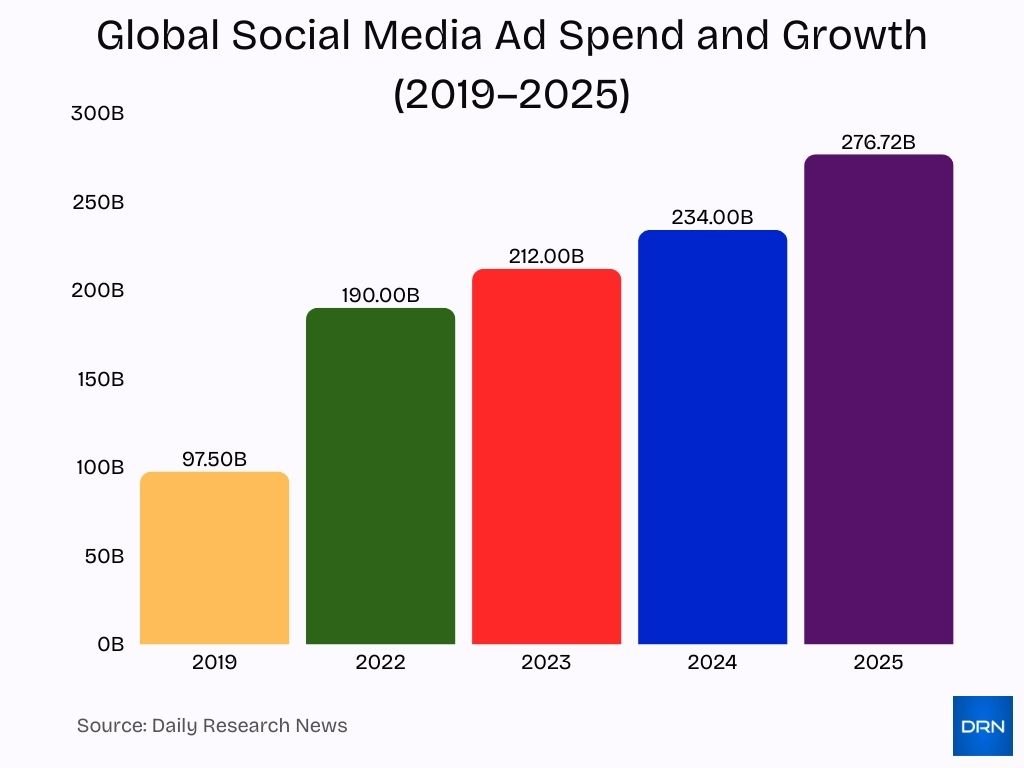
- Global social media ad spend reached approximately $234 billion in 2024, up 15.1% from 2023.
- That marked a consistent upward trend; in 2023, the spend was $212 billion, and in 2022 it stood at $190 billion.
- The increase between 2019 ($97.5 billion) and 2024 ($234 billion) represents a growth of 150% over five years.
- As of 2025, projections estimate global social ad spend may surpass $276.72 billion, reflecting a 10.9% YoY increase.
- Many businesses now treat social media as their primary ad channel, with spending increasing even as economic conditions tighten globally.
- Brands are reallocating from traditional display and print ads toward social media, given its higher reach and better targeting capabilities.
- The rise in mobile use and video content has amplified spending on social video ads and in-app advertising on social platforms.
- The growth in social ad spend reflects both expanding ad budgets and the increasing value advertisers find in social media’s reach, targeting, and measurement capabilities.
Global Ad Spending Projections
- Worldwide digital advertising spending is forecast to reach $870.85 billion by 2027.
- By 2030, global social media ad spend is projected to hit $433.28 billion.
- As of 2024, digital channels accounted for 72.7% of all global ad investment, underscoring online media’s central role.
- Many firms report allocating over 60% of their total media budget to digital formats in 2024, reflecting platform-agnostic shifts in ad strategies.
- The in-app advertising market alone is expected to reach $390.04 billion in 2025, indicating strong growth in mobile-first ad environments.
- Projections suggest digital advertising will account for 73% of total global ad spending by 2028.
- In the U.S., digital ad spending is on track to reach roughly $324.9 billion in 2025.
Ad Spending Growth Rates
- Global social media ad spend is projected to grow by 13.6% in 2025, reaching around $277 billion.
- The overall digital ad market size is expected to hit approximately $294 billion in 2025, growing at a CAGR of 10.6% through 2030.
- Mobile advertising accounts for 56% of the total digital ad market in 2025, with a market size of about $262 billion.
- Social media ad spend has increased by 150% from 2019 to 2024, rising from $97.5 billion to about $234 billion.
- Digital ad spending is forecasted to grow at an annual rate of around 9-10% through the late 2020s.
- Video advertising within digital ads experiences the fastest growth, with mid-teen CAGR, driven largely by short-form and live-stream formats.
- Despite economic uncertainty, digital ad spend in the US is still expected to grow, albeit slowed, and could reach up to 79% of total ad spend by 2030.
- The mobile advertising market is projected to grow from $262.84 billion in 2025 to nearly $1 trillion by 2032, at a CAGR of 21.1%.
- In-app advertising makes up the bulk of mobile ad spend, with $187.78 billion expected in the US alone in 2025.
- Retail media ads now constitute about 23.7% of digital ad spend, surpassing traditional TV advertising for the first time.
Global Advertising Reach Across Major Social Media Platforms
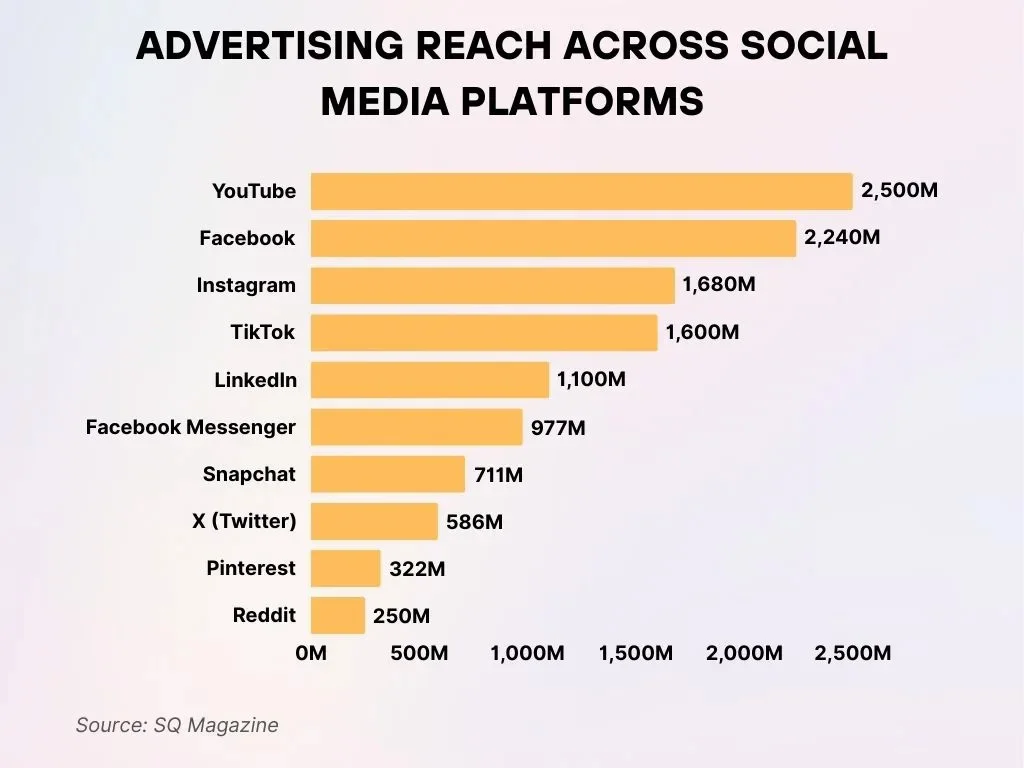
- YouTube dominates with an enormous potential ad reach of 2,500 million, marking the highest audience availability among all platforms.
- Facebook comes next with an extensive advertiser reach totaling 2,240 million users.
- Instagram grants brands access to 1,680 million users, reinforcing its role as a powerful visual advertising channel.
- TikTok presents marketers with a reach of 1,600 million, reflecting its rapid worldwide expansion.
- LinkedIn connects advertisers to 1,100 million users, making it ideal for B2B and professional targeting.
- Facebook Messenger enables ad delivery to roughly 977 million users across its messaging network.
- Snapchat showcases a potential reach of 711 million, maintaining strong appeal among younger demographics.
- X (Twitter) offers an advertising reach of 586 million users across its global audience.
- Pinterest provides access to 322 million users, proving valuable for niche lifestyle and shopping-focused content.
- Reddit completes the list with 250 million users available for specialized, targeted advertising opportunities.
Mobile Advertising Trends
- Global mobile ad spend reaches $402 billion in 2025, up 11% year-over-year.
- In-app advertising is projected to reach $390.04 billion globally in 2025.
- US mobile ad spend hits $228.11 billion in 2025, with 82.3% from in-app.
- Social media ad spend totals $276.7 billion in 2025, 83% mobile by 2030.
- Video ads hold 37.2% share of in-app revenue, and rewarded video grows at 12.8% CAGR.
- Short-form videos drive the highest engagement rates, outperforming static formats.
- Social commerce mobile ads reach $212.68 billion by 2028.
- US search ads lead mobile formats at $97.7 billion in 2025.
Cost Per User Metrics
- Marketers spend an average of $46.47 per user to reach social audiences in 2025.
- Global social media ad spend reaches $276.7 billion in 2025, with 83% mobile-generated by 2030.
- Average social platforms CPM stands at $5.69 for 1,000 impressions in late 2024.
- Businesses allocate $850–$2,000 monthly on social ad spend, plus 10–20% management fees.
- Facebook ads average $0.44 CPC and $14.40 CPM across industries.
- Instagram feed ads benchmark at $6.59 CPM, Stories at $6.25 CPM.
- TikTok ads cost $10 CPM and $1 CPC on average.
- Multi-platform strategies drive 9.37% annual ad spend growth through 2025–2030.
- Mobile social ads yield higher CTR and efficiency versus desktop channels.
Platform ROI Comparison
- 28% of marketers ranked Facebook as the platform delivering the highest social media ad ROI in 2025.
- Mobile native video ads account for approximately 80–82% of internet traffic by 2025, driving higher engagement and ROI.
- Advertisers using diversified spend across multiple social platforms see an average ROI improvement of 15-20%.
- Direct response social media campaigns report 40% higher return on ad spend (ROAS) compared to search or display channels.
- Mobile ad formats such as Stories and Reels generate up to 3x higher engagement rates than standard display ads.
- Cost per acquisition (CPA) on mobile ads is typically 30% lower than desktop ads, boosting overall campaign ROI.
- TikTok ranks among the top platforms, with advertisers achieving ROI multiples of 4x to 5x on spend.
- Multi-platform social media campaigns achieve an average conversion lift of 25% over single-platform efforts.
- Social commerce driven by social media ads contributes to 17.11% of total online sales in 2025.
- Brands allocating 10-20% of their digital marketing budget to social media ads report an optimal ROI balance.
Ad Click-Through Rates
- The average click-through rate (CTR) for Facebook ads across all industries is 1.71% in 2025.
- Video ads on Facebook using traffic objectives have an average CTR of 1.57%, with some sectors hitting above 2.5%.
- Short-form video ads, such as Stories and Reels, typically achieve higher CTRs than static ads, with video emails boosting CTRs by up to 300%.
- Mobile social ads see a modest CTR increase compared to desktop, with TikTok’s CTR ranging from 0.63% to 3.76%.
- YouTube video ad formats like Demand Gen campaigns reach CTRs as high as 7.6% for entertainment advertisers.
- Instagram feed ads average a CTR of around 0.88%, while Twitter ads have a CTR near 0.86%.
- LinkedIn ads have a lower average CTR at about 0.52%, with retail hitting 0.80% as a top sector.
- Social ads optimized for conversions show a CTR benchmark of around 9.21% conversion rate from clicks on some platforms.
- The average Google Ads CTR in 2025 is approximately 6.66%, with variation across industries.
- Facebook ad CTRs for lead campaigns hold steady around 2.59%, reflecting engagement-driven optimization.
Cost Per Click Metrics
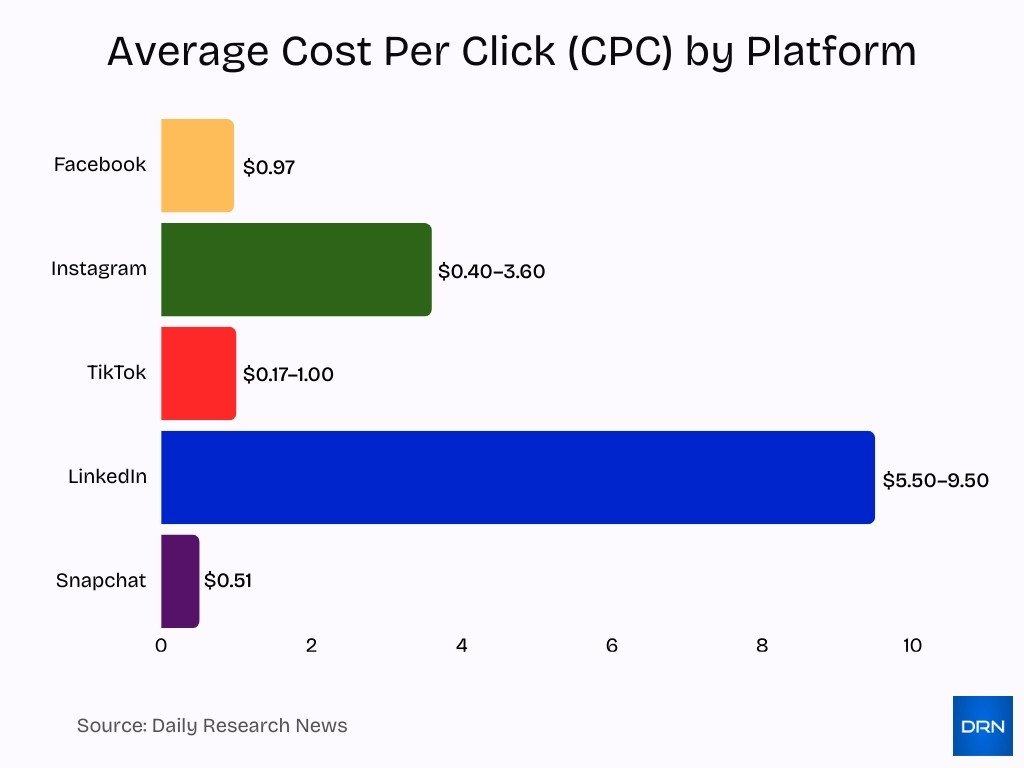
- The average cost per click (CPC) on Facebook is $0.97 in 2025.
- Instagram’s average CPC is around $3.60 in 2025.
- LinkedIn’s CPC ranges from $5.50 to $9.50, making it the most expensive social platform for clicks.
- TikTok ads have the lowest average CPC of about $1.00, showing cost efficiency.
- Average cost per thousand impressions (CPM) for Meta platforms (Facebook and Instagram combined) is around $6.59 in late 2025.
- TikTok’s CPM stands at a cheaper rate of about $2.97, reflecting mobile-first ad cost efficiency.
- Mobile ads on social platforms generally cost up to 30% less CPC than desktop ads for similar campaigns.
- Distributing ad spend across video and interactive ad formats can reduce CPC by an average of 15-20%.
- Snapchat CPM has risen to approximately $12.84, but CPC stays around $0.51, indicative of efficient click costs despite higher impressions costs.
- Ads across combined social platforms often achieve 15-30% lower customer acquisition costs compared to broader digital display campaigns due to advanced targeting capabilities.
Influencer Marketing ROI
- In 2025, the global influencer marketing industry is projected to reach $32.55 billion, reflecting roughly a 35% increase from 2024.
- About 86% of U.S. marketers plan to partner with influencers in 2025, up from roughly 70% in prior years.
- On average, influencer marketing delivers $5.78 in revenue for every $1 spent in 2025, nearly double the ROI of many traditional digital ads.
- Among B2B marketers, 80–82% used influencer marketing in 2024, underscoring the growing appeal of influencer strategies beyond consumer brands.
- 53% of marketers report their dedicated influencer marketing budget is growing in 2025.
- A majority of brands, around 73%, prefer working with micro or mid-tier influencers, citing strong engagement to cost ratios.
- 92% of brands are using or open to using AI tools to support influencer marketing workflows (e.g., content creation, targeting, analysis).
- The shift in measurement is clear; more campaigns track performance metrics (like conversions or sales) rather than vanity metrics such as likes or reach.
Video Advertising Trends
- Global digital video ad spend reaches $214.76 billion in 2025, growing at a 9.54% CAGR through 2030.
- 89% of businesses use video marketing as a key tool in 2025.
- 93% of marketers report positive ROI from video marketing efforts.
- 60% of marketers prioritize engagement metrics like likes and shares for video success.
- Websites with video marketing achieve a 4.8% conversion rate, versus 2.9% without.
- 87% of marketers say video increases sales directly.
- 86% of marketers confirm video generates leads effectively.
- 75% of video marketers use AI tools for creation and editing in 2025.
- 28% of marketers plan to adopt interactive videos by 2025.
Brand Awareness Impact
- Social media ads rank as the leading source of brand awareness among internet users aged 16-34.
- 83% of marketers report that social media efforts generate increased brand exposure.
- Video marketing boosts brand awareness for 96% of marketers using it.
- 78% of people prefer short video content to learn about new brands.
- 36% of brands state influencer content outperforms branded content for awareness.
- TikTok ads with influencers increase brand recall by 27% globally.
- Social media ads influence purchasing for 54% of people under 41.
- 70% of Gen Z watch online videos over 3 hours daily, aiding brand visibility.
- 63% of Gen Z find social media ads most influential for purchases.
Top Challenges in Social Media Marketing
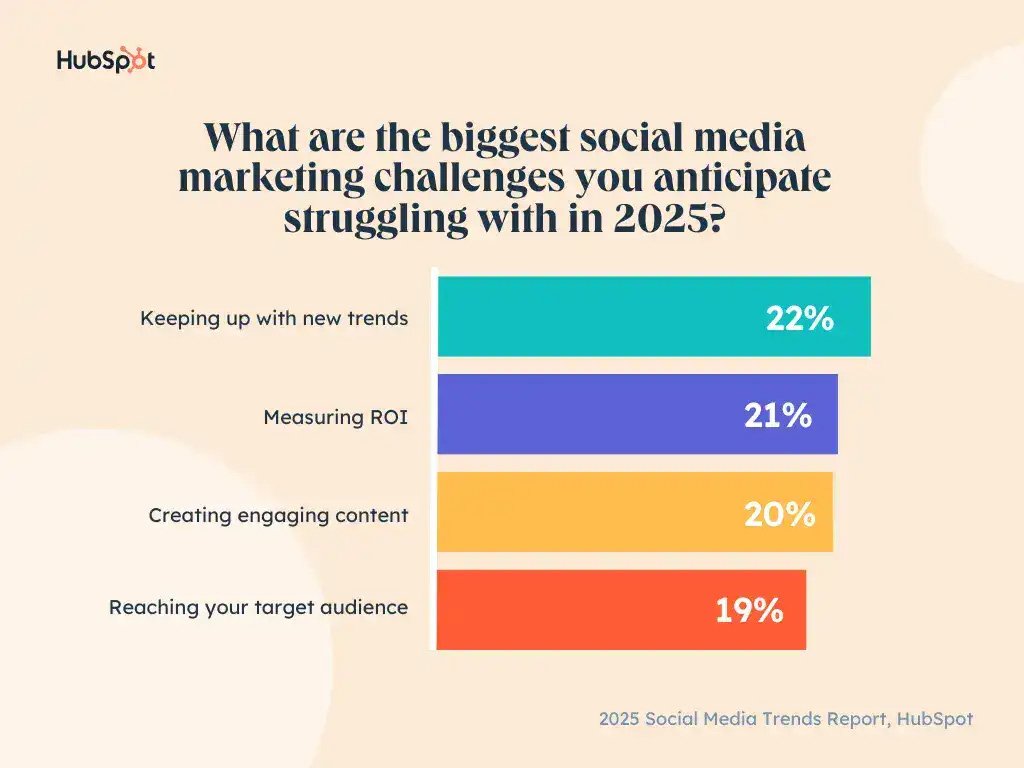
- 22% of marketers expect to face difficulties keeping up with new trends, marking it as the most significant challenge for 2025.
- 21% report that measuring ROI is difficult, underscoring a continuing problem in evaluating performance.
- 20% express concerns about crafting engaging content that truly connects with their audience.
- 19% struggle with effectively reaching their target audience, showing that targeting accuracy remains a major obstacle.
Facebook Advertising Stats
- 93% of U.S. marketers use Facebook as a primary advertising channel in 2025.
- Facebook ads deliver an average 5.3x ROAS, the highest among social platforms vs Instagram (4.8x) and TikTok (3.8x).
- US Facebook ad CPM averages $20.48, competitive for broad reach targeting.
- 38.5% of U.S. Facebook users expected to purchase directly via ads in 2025.
- Advantage+ campaigns yield 12% higher ROAS using AI optimization tools.
- Women aged 45-54 show the highest Facebook ad engagement rates across demographics.
- Average Facebook CTR reaches 2.53% for lead-gen ads across industries.
- Global CPM benchmark stands at $19.77 for Facebook impressions in 2025.
- 93% of marketers integrate Facebook for retargeting and lookalike audiences.
Instagram Advertising Stats
- Instagram reaches 1.74 billion users worldwide with ads, covering 21% of the global population.
- Global Instagram ad revenue hits $67.27 billion in 2025.
- Carousel posts achieve the highest engagement at 0.55%.
- Average Instagram ad CPC ranges from $0.40–$0.70.
- Story ads boast an 82% completion rate.
- Brands see average conversion rates of 1-2% on Instagram ads.
- Influencer campaigns yield $5.20 ROI per $1 spent.
- Reels ads drive 22% more engagement than standard videos.
- Instagram Live generates 10x more engagement than regular posts.
- Engagement rate by reach averages 3.00% on Instagram.
TikTok Advertising Stats
- TikTok ads reached 1.59 billion users globally in January 2025, growing by 31.2 million users in one year.
- TikTok’s average ad conversion rates range between 1.1% and 2.4% in 2025.
- The platform’s average click-through rate (CTR) is 0.84%, indicating solid audience engagement.
- TikTok’s cost per thousand impressions (CPM) averages between $4.20 and $9.00 in 2025, with cost per click (CPC) ranging from $0.17 to $1.00.
- Brands using TikTok influencer marketing see a 27% increase in brand advertising recall when partnered with influencers.
- Approximately 61% of marketers use TikTok for influencer marketing campaigns in 2025.
- TikTok influencers charge about $10 per 1,000 followers per sponsored post.
- The US TikTok user base is around 170 million monthly active users as of 2024-2025 projections.
- The average daily time spent on TikTok is about 58 minutes per user.
- TikTok ad revenue is expected to jump to over $33 billion in 2025, up 40% year-over-year.
Frequently Asked Questions (FAQs)
5.66 billion social-media “user identities” worldwide (start of October 2025).
72.7% of global advertising spending was invested in digital channels in 2024.
Global social media ad spend is projected to surpass $276.72 billion in 2025.
Social media ad spending is forecast to grow by 9.37% per year from 2025 to 2030.
Conclusion
Social media advertising sits at a crossroads of scale, sophistication, and opportunity. Influencer marketing now offers some of the highest ROI in digital advertising, while video formats grow stronger as engagement and conversion drivers. Platforms such as Facebook, Instagram, and TikTok provide distinct strengths, from broad reach and mature targeting to trend-driven, mobile-first interactions.
As more brands combine formats, optimize with AI, and shift toward performance-based metrics, social media increasingly acts as both a brand-building engine and a direct sales channel. For marketers willing to evolve, the data suggests 2025 offers fertile ground to reach audiences efficiently and profitably.