

Social media screen time remains a central part of daily life for billions of people around the world. Users of all ages are spending significant portions of their day scrolling feeds, watching short videos, and messaging friends and family. These patterns affect digital behavior, mental health, and workplace productivity, making screen time a key metric for researchers and industry leaders alike. Real-world applications range from employers tracking digital well-being to designing healthier workflows to marketers optimizing content formats based on time spent data for higher engagement. Explore the detailed statistics below to understand how screen time trends are shaping society.
Editor’s Choice
- The global average daily social media screen time is roughly 2 hours 21 minutes in 2025.
- Around 5.41 billion people use social media worldwide, about 65.7% of the global population.
- TikTok users spend an average of about 58 minutes daily on the app.
- Mobile devices account for about 92% of all social media usage.
- Short-form video platforms dominate engagement metrics in 2025.
- Women typically spend more time daily on social media than men.
- Gen Z users have the highest social media usage among age groups.
Recent Developments
- In 2025, global social media screen time will continue its upward trend compared with recent years.
- Platforms with AI-driven content feeds have contributed to longer session lengths.
- Short-form videos now significantly influence total engagement across networks.
- The shift toward messaging as a core activity is evident on many platforms.
- Daily average usage metrics show slight regional declines in some markets but growth in others.
- Unlike long-form browsing, short-form content captures rapid, repeat engagement patterns.
- A notable shift in content moderation conversations has emerged due to youth safety concerns.
- Messaging functions have grown faster than traditional newsfeed interactions.
Social Media Screen Time by Generation (Gen Z, Millennials, Gen X, Boomers)
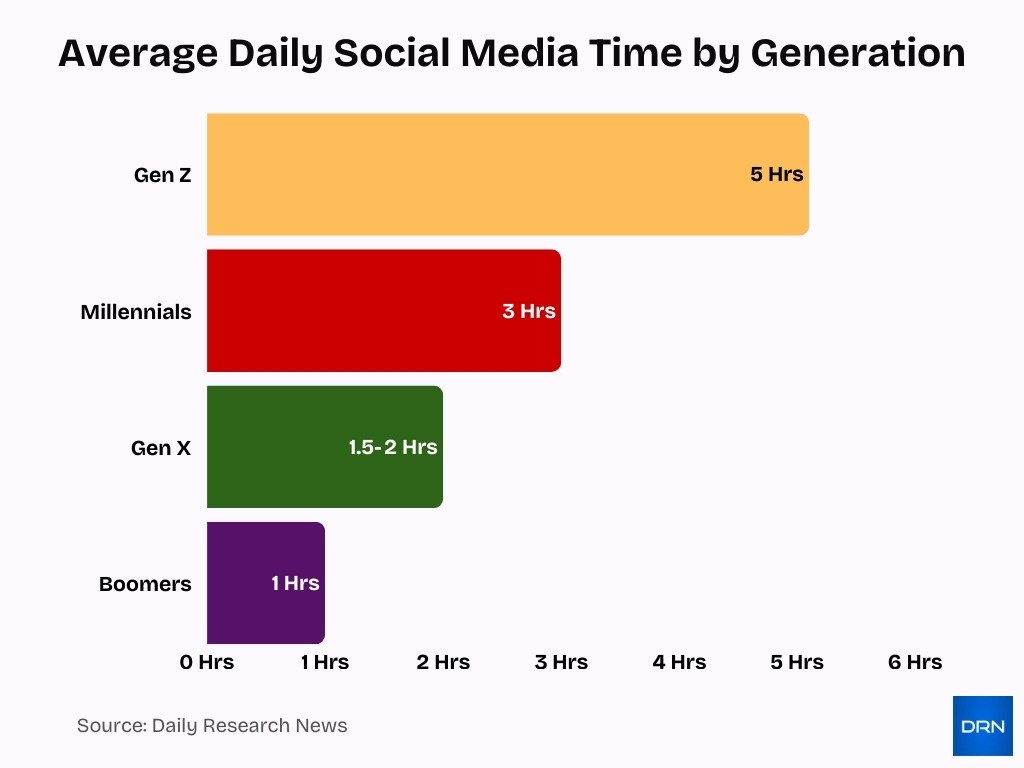
- Gen Z continues to dominate usage, with nearly 5.1 hours per day reported in early 2025.
- Global studies find that older teens and young adults in Gen Z average around 4 hours daily.
- Millennials typically spend about 3 hours per day on social platforms.
- Gen X averages around 1.5 to 2 hours daily.
- Boomers are the lightest users, averaging about 1 hour per day.
- The generational divide shows a clear step down in total screen time with age.
- Social commerce and video trends attract younger generations disproportionately.
- Younger generations report stronger personal connections with creators, increasing time spent.
Global Social Media Screen Time
- Average global social media screen time sits near 2.3 to 2.4 hours per day in 2025.
- Around 5.3 to 5.4 billion users are actively engaged with social platforms.
- Mobile access accounts for about 92% of all social media activity worldwide.
- Countries like the Philippines average over 3 hours and 30 minutes daily on social media.
- Growth rates are highest in nations like India, Brazil, and South Africa.
- Urban users report higher usage than rural users, reflecting infrastructure and lifestyle differences.
- Global screen time growth shows a small year-over-year increase in most regions.
- Short-form videos contribute materially to the global screen time.

Daily Average Screen Time Across Digital Devices
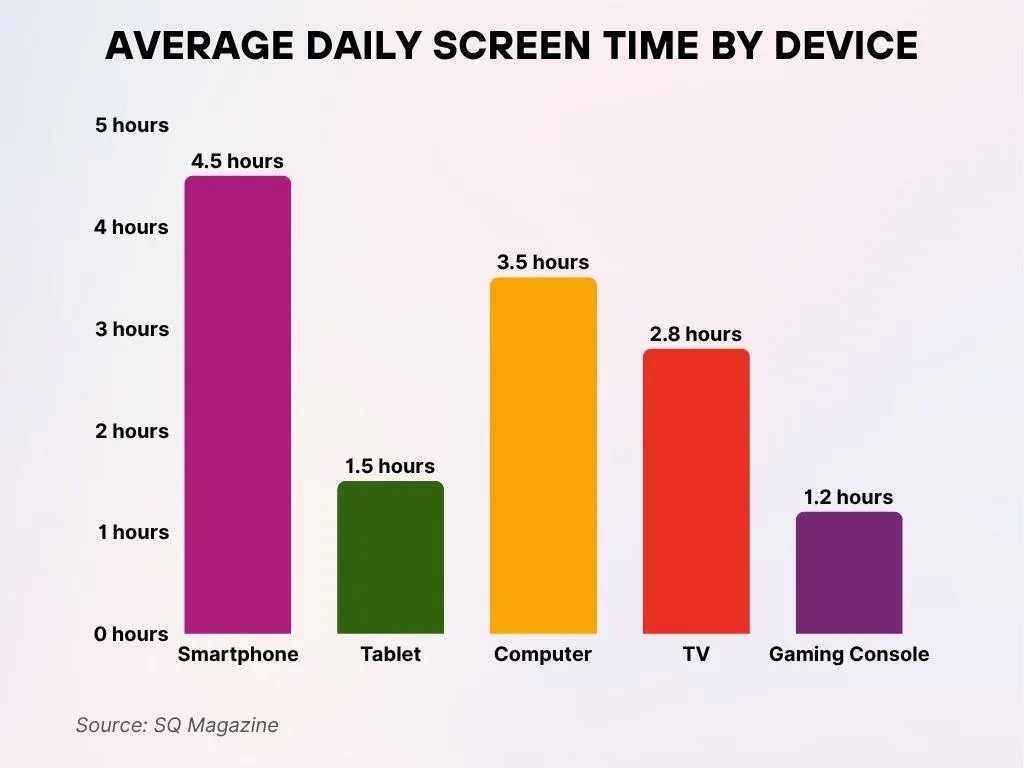
- Smartphones lead all devices with the highest average daily screen time of 4.5 hours, underscoring their central role in everyday digital life and constant connectivity.
- Computers rank second, as users spend an average of 3.5 hours daily, reflecting their importance for work, education, and web browsing activities.
- TV viewing represents 2.8 hours per day, highlighting its continued relevance for entertainment even as mobile streaming platforms expand.
- Tablet users spend roughly 1.5 hours daily, indicating a more limited yet purposeful use when compared with smartphones and computers.
- Gaming consoles record the lowest screen time at 1.2 hours per day, likely due to their niche appeal and more recreational usage patterns.
Average Daily Time Spent on Social Media
- The global average daily usage is about 2 hours and 21 minutes.
- Some estimates place the average near 2 hours and 31 minutes.
- US adults average slightly below the global mean, around 2 hours 14 minutes daily.
- Daily time on social platforms has risen modestly year over year.
- Users typically engage with roughly 6.8 different platforms monthly.
- Session lengths on mobile have increased slightly due to video content.
- Frequent app checks, such as within minutes of waking up, are common among active users.
- Short-form video viewing accounts for a large share of daily engagement.
Social Media Screen Time by Platform
- TikTok users now average ~56 minutes of daily screen time, accounting for about 32% of total social media time in the U.S.
- Global TikTok usage reaches ~34 hours per month, roughly 6 hours more monthly screen time than YouTube and 14 hours more than Facebook.
- In 2025, around 35% of total Instagram usage time is spent on Reels, making it over one‑third of all in‑app screen time.
- Half of all Instagram time is spent watching Reels, with users consuming about 17.6 million hours of Reels content daily.
- Facebook users spend about 30.8 minutes per day on the platform on average, with 98.3% of usage coming via mobile devices.
- WhatsApp captures a little over 17 hours per month of user time, ranking just behind Facebook in global monthly social screen time.
- TikTok users open the app about 19 times per day and stay for roughly 11 minutes per session, driving some of the deepest short‑form video engagement.
- American adults now spend about 31 minutes per day on Facebook, nearly 50% less time than they spend on YouTube at 46 minutes per day.
Social Media Screen Time by Gender & Age Group
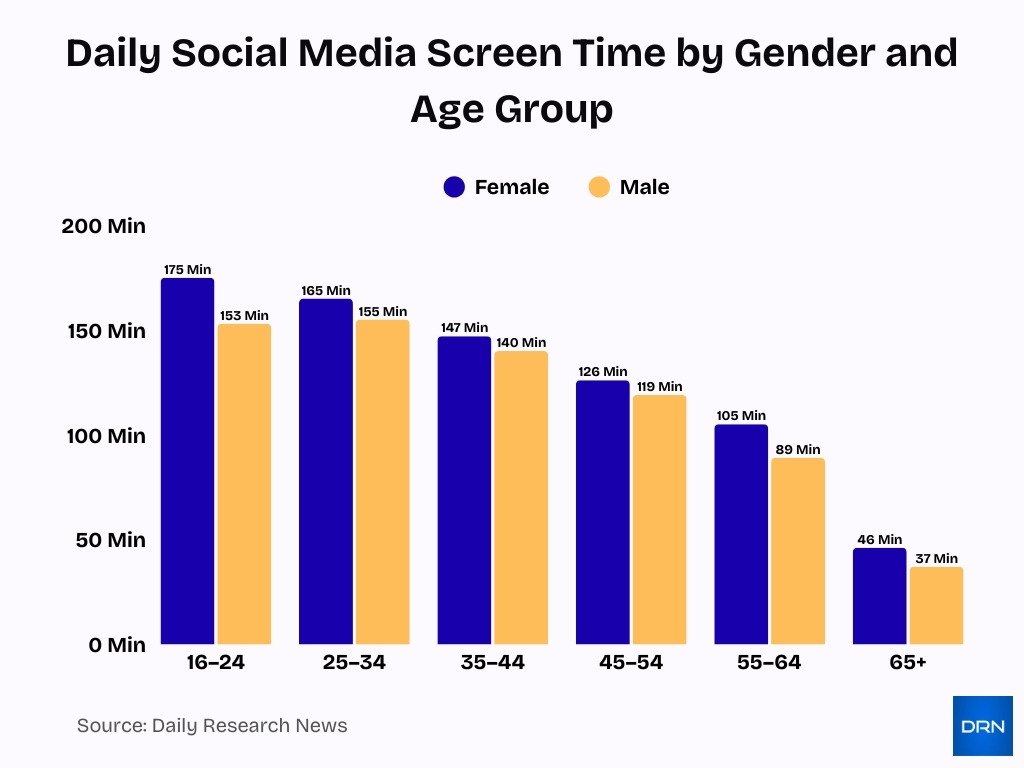
- In 2025, women worldwide average 2h 59m of daily social media screen time, about 17 minutes more than men at 2h 42m.
- Globally, women spend roughly 12% longer on social platforms than men, translating to an extra 16 minutes per day of social media use.
- Females aged 16–24 spend around 2h 55m per day on social media, compared with males at 2h 33m, a gap of 22 minutes daily.
- Among users 25–34, women average about 2h 45m of daily social media time versus men at 2h 35m, keeping a 10‑minute lead.
- In the 35–44 group, women log roughly 2h 27m on social platforms daily, while men are close behind at 2h 20m, a modest 7‑minute difference.
- For ages 45–54, women report about 2h 6m of social media per day compared with men at 1h 59m, maintaining a 7‑minute edge.
- Among older adults 55–64, women average 1h 45m of daily social screen time versus men at 1h 29m, narrowing the gap to 16 minutes.
- older people 65+ show the smallest gender difference, with women at about 46 minutes of daily social media use and men at 37 minutes, under 10 minutes apart.
- In the US, women aged 18–29 have some of the highest engagement, spending roughly 3.5 hours on social media each day across platforms.
- Teen girls (13–17) average about 3.7 hours of daily social media screen time, nearly 45 minutes more than boys in the same age range.
Time Spent on Short Form Video Platforms (TikTok, Reels, Shorts)
- TikTok users average ~56 minutes daily on the app, consuming ~34 hours per month, the highest time spent among major social platforms.
- Gen Z spends ~57 minutes per day on TikTok, making this cohort the heaviest short-form video consumers on the platform.
- 11–12 minutes is the average TikTok session length, with users opening the app around 19 times per day, driving highly frequent short-form viewing.
- Half of all time spent on Instagram is now devoted to Reels, with users watching an estimated 17.6 million hours of Reels daily worldwide.
- About 35% of total Instagram usage time in 2025 is spent on Reels, confirming that short-form clips dominate the app’s engagement.
- YouTube Shorts generate around 6.5 billion daily views globally, reflecting massive time spent on vertical short videos inside YouTube.
- 69% of US consumers watch short-form video 30 minutes to 3 hours per day, making it a core component of their daily screen time.
- Short-form video accounts for roughly one-third (32%) of total social media time in the US on TikTok alone, underscoring how these clips dominate attention.
- Short videos often achieve 100%+ average percentage viewed on YouTube Shorts, as many viral clips are watched more than once, boosting total watch time.
Country-Wise Social Media Screen Time
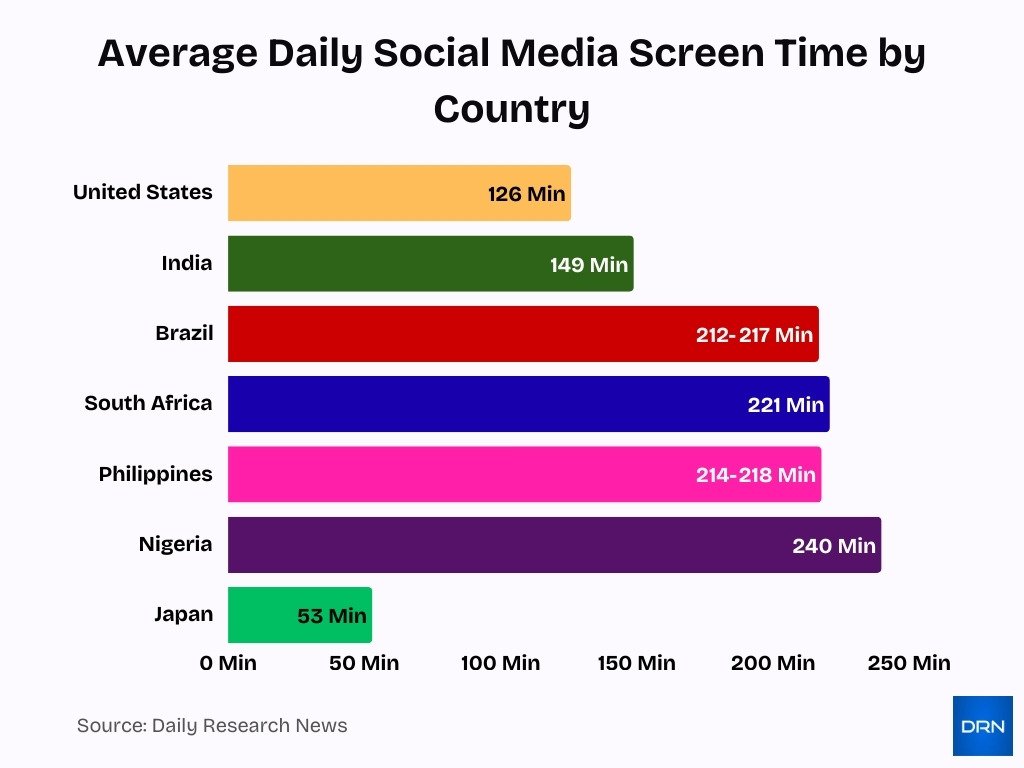
- In the United States, average daily social media screen time is about 2.1 hours per user, below the global mean of roughly 2.3 hours.
- In India, people spend around 2 hours 29 minutes per day on social platforms, slightly above the worldwide average.
- Users in Brazil average roughly 3 hours 32–37 minutes of social media use daily, among the highest globally.
- In South Africa, typical users spend about 3 hours 41 minutes per day on social platforms, placing the country near the very top worldwide.
- The Philippines records more than 3 hours 30 minutes of daily social media use, often cited between 3h34m and 3h38m per user.
- Nigeria sees users spending almost 4 hours per day on social media, making it one of the most engaged markets.
- Japan has among the lowest social media screen times, with users averaging around 46–53 minutes per day.
- Across the Asia-Pacific, leading markets like the Philippines and Indonesia often exceed 3 hours daily, driven heavily by short-form video platforms.
- Globally, people now spend about 2 hours 21–28 minutes per day on social media, totaling more than 15 billion hours of consumption daily.
Time Spent on Messaging and Chat Apps
- Messaging apps account for roughly 65% of total mobile screen time in 2025.
- WhatsApp alone has over 2 billion active users globally.
- Direct message-based interaction makes up about 41% of total social communication.
- Messaging use spikes during commuting hours and evenings.
- Messaging and social networking increasingly overlap within platforms.
- South Asia and Latin America show especially high messaging engagement.
- Messaging apps are often the first checked after waking.
- Privacy and security features help sustain heavy messaging use.
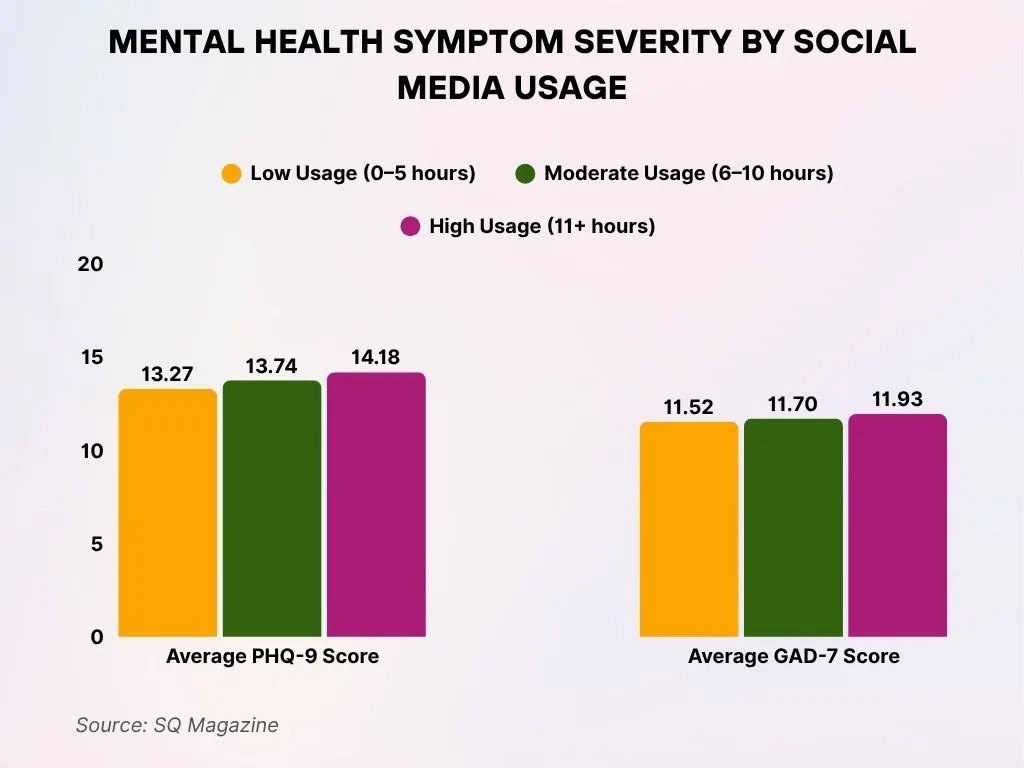
Mental Health Symptom Severity Linked to Social Media Usage
- Higher social media usage is associated with more severe depression symptoms, reflected by an increasing PHQ-9 score of 13.27 for low usage (0–5 hours).
- Depression severity continues to rise with moderate usage (6–10 hours), where the PHQ-9 score reaches 13.74, indicating worsening symptoms.
- Among high social media users (11+ hours), depression symptoms peak with a PHQ-9 score of 14.18, showing the strongest severity level.
- Anxiety symptoms also show an upward pattern, with GAD-7 scores at 11.52 for individuals with low social media usage.
- For users with moderate screen time, anxiety levels increase slightly, as indicated by a GAD-7 score of 11.70.
- High social media usage is linked to the highest anxiety severity, with a GAD-7 score of 11.93, reflecting elevated symptoms.
- Overall, the data demonstrates a clear upward trend in both depression and anxiety symptoms as social media usage exceeds 11 hours per day.
Social Media Screen Time Trends Over Time
- Global daily social media time rose from about 2 hours 4 minutes in 2020 to about 2 hours 41 minutes in 2025.
- Weekly usage surpassed 18.8 hours globally in 2025.
- Time spent on algorithm-recommended content increased sharply since 2023.
- Short-form video adoption added about 30 minutes of weekly screen time over two years.
- Growth among older age groups is notable but still trails younger users.
- Evening usage peaks have strengthened over time.
- Post-pandemic usage shows stability with gradual increases.
- Users favor frequent short sessions across multiple apps.
Social Media Screen Time by Time of Day
- In 2025, 20% of social media users open an app within 5 minutes of waking, and over 60% do so within 30 minutes.
- Around 55–60% of users report checking social apps at least once during morning commutes between 7–9 a.m.
- Global social media activity reaches about 3+ hours per day, with usage peaking around lunch hours (12–2 p.m.).
- Late afternoon to early evening (5–8 p.m.) accounts for the highest engagement windows on major platforms like Instagram, TikTok, and Facebook.
- Entertainment and video-focused platforms see their strongest evening usage, with prime video slots typically 6–10 p.m. local time.
- Gen Z users aged 16–24 spend about 3–4 hours daily on social media, with a substantial share of that time recorded in the evening and late night.
- Social media usage remains elevated late at night, with teens and young adults overrepresented among users active after 11 p.m.
- Commuting “rush hours” of 8–10 a.m. and 5–7 p.m. show spikes in messaging and feed-refresh activity on Twitter/X and similar apps.
- Posting during weekday mid-mornings and late evenings can boost average engagement rates by 10–20% compared with off-peak hours.
- About 74% of users multitask on social media (e.g., watching TV or commuting), leading to frequent short sessions spread throughout the day.
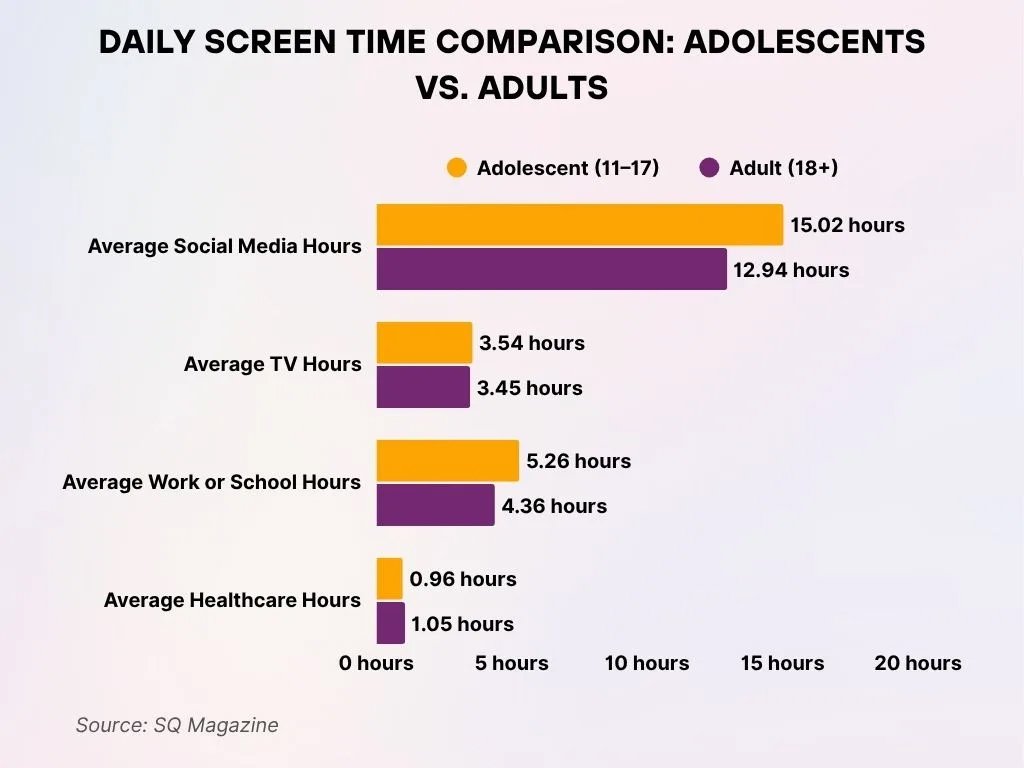
Daily Screen Time Breakdown: Teens Compared to Adults
- Adolescents aged 11–17 spend an astonishing 15.02 hours per day on social media, which is significantly higher than adults aged 18+, who average 12.94 hours daily on these platforms.
- Television viewing time remains almost identical for both groups, with adolescents logging 3.54 hours per day and adults close behind at 3.45 hours daily.
- Screen time for work or school activities is notably higher among adolescents, who spend 5.26 hours per day, compared with adults, who average 4.36 hours daily.
- In terms of healthcare-related screen usage, adults lead slightly, spending 1.05 hours per day, while adolescents average 0.96 hours daily on similar activities.
Social Media Screen Time and Productivity
- Employees spend an average of 2 hours 23 minutes per day on social media, cutting into deep work time and focus.
- Younger workers check phones up to 150 times daily, heightening interruptions and reducing sustained attention on tasks.
- Workers switch between apps or tabs about 33 times a day, fueling digital fatigue and fragmented concentration.
- Roughly 1 in 5 employees lose 2+ hours per week to app switching, equal to about 100 hours of lost productivity per year.
- Around 21% of workers say frequent app switching makes them less efficient, and 17% report working longer hours because of it.
- Heavy media multitaskers show slower reaction times and more errors on high-load tasks, reflecting reduced cognitive control.
- Media multitasking can improve recall accuracy but increases total task completion time, revealing a trade-off between speed and precision.
- Nearly 46% of U.S. teens report being online almost constantly, indicating high social media exposure that can spill over into study or work time.
- The average person now spends about 6 hours 38 minutes daily on internet-connected screens, creating sustained risks of eye strain and mental fatigue.
- Nearly 4 in 5 (79%) employees say their company has not addressed tool fatigue, despite growing use of digital wellbeing and productivity platforms.
Year-over-Year Growth in Social Media Screen Time
- Global average daily social media use rose 1.4% year over year, from 143 minutes in 2024 to 145 minutes in 2025, adding roughly 2 extra minutes of screen time per user.
- Urban users now spend about 2.5 hours daily on social media versus 2.4 hours in rural areas, with urban growth running roughly twice as fast annually.
- Average daily time on messaging apps increased by about 3–5% YoY, adding roughly 3–4 minutes per user to social media screen time, largely from mobile messaging.
- Short-form video platforms pushed session length up by around 6–8% YoY, with leading apps now averaging 45–60 minutes of daily watch time per active user.
- From 2020 to 2025, global social media time per user jumped from about 90 minutes to 141 minutes per day, representing roughly a 57% increase over five years.
- Algorithm and feed optimization lifted engagement gradually, with estimated annual gains of 2–4% in average session duration and 5–7% in content impressions per user.
- Regional growth diverged, with emerging markets adding 10–15 more minutes per day since 2020 while mature markets added only 3–5 minutes, though both remained net positive overall.
- Rising penetration and engagement combined so that total global social visits climbed 83.4% in five years, from 2.95B to 5.41B monthly visits, magnifying overall screen time.
- In India, average daily social media time reached 2 hours 28 minutes in 2025, a 1.2% YoY increase of about 2 extra minutes, driven by higher per-user engagement.
Frequently Asked Questions (FAQs)
On average, people spend about 2 hours and 24–2 hours and 41 minutes per day on social media in 2025.
Approximately 65.7% of the global population is active social media users in 2025.
Users in the Philippines average about 3 hours and 32 minutes per day on social media, higher than the global average.
Gen Z spends around 3 hours and 18 minutes daily on social media, compared with the global average of roughly 2 hours and 41 minutes.
Conclusion
Social media screen time reflects deeply embedded digital habits across ages, regions, and daily routines. Teenagers continue to lead in total engagement, while working adults blend social media into work and personal life. Mental health and productivity concerns rise alongside higher usage, even as platforms deliver connection, entertainment, and information at scale. Year over year growth remains steady, driven by mobile-first behavior and short-form video.
Understanding these patterns equips individuals, families, businesses, and policymakers to make more informed decisions about balanced and intentional social media use.