

Spam remains a defining challenge of global digital communication. As email volume surges, so does the flood of unsolicited and unwanted messages, forcing individuals, businesses, and service providers to confront rising security, efficiency, and trust issues. In real-world terms, businesses waste hours filtering junk mail and sometimes lose opportunities when legitimate messages land in spam, and individuals risk phishing scams or lose time sorting unwanted content. Below, we examine the key numbers shaping the spam landscape today, inviting readers to explore how these trends affect daily digital life.
Editor’s Choice
- In 2025, global daily email volume is projected to reach ~376.4 billion emails per day.
- As of December 2024, roughly 46.8% of all email traffic was spam.
- In 2023, about 160 billion spam emails were sent each day.
- The United States sends about 9.1 billion spam emails daily and China about 8.7 billion, making them the top global sources of spam worldwide.
- The number of global email users is forecast to exceed 4.6 billion by 2025.
- Spam share in global email traffic rose to 47.27% in 2024, up about 1.27 percentage points from the previous year.
- On average, 241 million emails are sent every minute worldwide in 2025.
Recent Developments
- The overall global email traffic continues its rise, from around 333.2 billion daily emails in 2022 to an expected 376.4 billion in 2025.
- In 2024, spam’s share of global email traffic reached 47.27%, indicating a slight uptick compared to 2023.
- Spam peaked seasonally in 2024, highest in June (≈49.5%) and July (≈49.3%), lowest in October–November (~45.3%).
- Though the percentage share fluctuates, the absolute number of spam emails continues to grow because overall email volume keeps increasing.
- Global projections anticipate that by 2025, email users will surpass 4.6 billion, expanding both the target base and potential spam exposure.
- Spam filters became more aggressive in 2025, causing many legitimate-looking marketing emails to be flagged as spam or unwanted.
- Users increasingly check inboxes, with 84.9% checking at least twice daily, raising exposure to potential spam.
Global Spam Volume
- Daily global email traffic in 2025 is projected at ~376.4 billion emails per day.
- With spam comprising roughly 46.8–47.3% of that, global spam volume reaches ~175–180 billion spam emails per day.
- In 2023, spam volume stood at about 160 billion spam emails per day, reflecting a massive scale.
- Even when the percentage share dips, the absolute count of spam emails rises, driven by growing email adoption.
- Global email users are expected to exceed 4.6 billion by 2025, expanding spam reach further.
- Billions of potentially harmful or unwanted messages circulate every minute, amplifying both security and productivity risks.
- As more countries gain connectivity, spam volume is expected to continue growing, increasing the load on filtering systems.
Most Common Channels for Receiving Spam
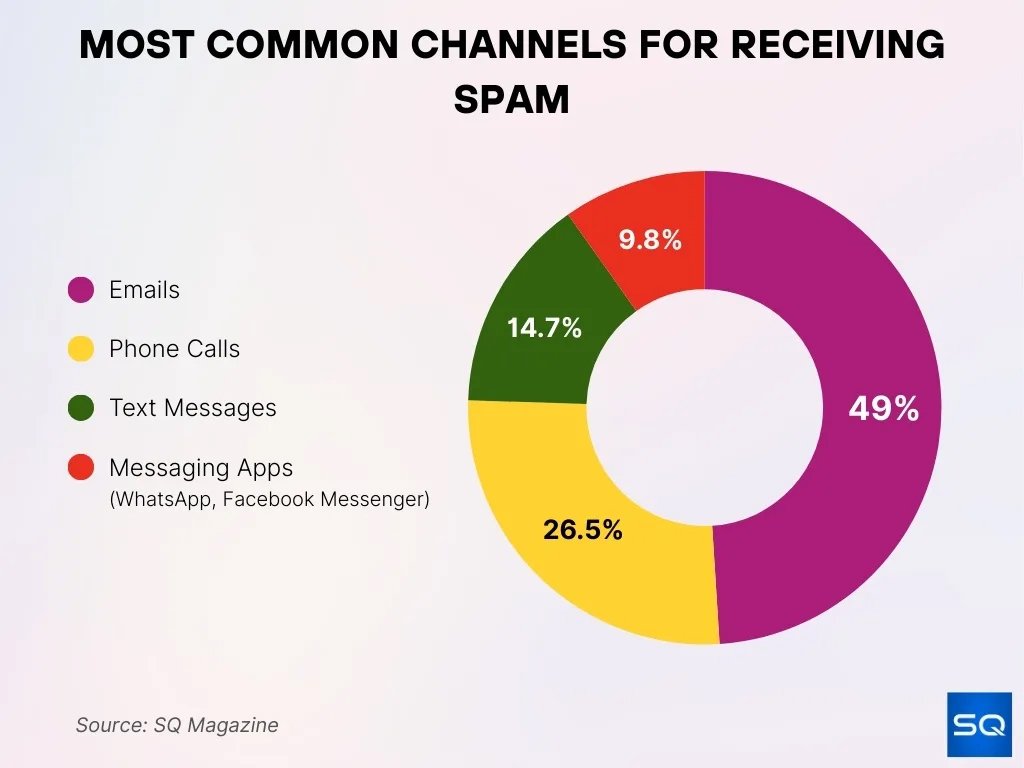
- Emails remain the primary channel for spam distribution, impacting 49% of users worldwide.
- Phone calls make up 26.5% of global spam complaints, frequently associated with robocalls and scam attempts.
- Text messages contribute to 14.7% of spam incidents, often involving phishing tactics and malicious links.
- Messaging apps such as WhatsApp and Facebook Messenger account for 9.8% of all reported spam cases.

Daily Spam Emails
- In 2025, global email traffic hit 376.4 billion messages daily, with spam at 46.8%.
- The United States sends the most spam, averaging 8–10 billion emails per day.
- China follows with 7.6–9 billion spam emails daily worldwide.
- Gmail blocks over 15 billion spam emails daily from inboxes.
- Phishing emails, a key spam type, total 3.4 billion sent daily globally.
- From 2017 to 2025, daily spam volume grew from 152 billion to 176 billion.
- 46–47% of all email traffic was classified as spam or unwanted in 2025.
- India contributes 8 billion spam emails daily, ranking among the top sources.
Spam Percentage Trends
- In 2022, about 48.6% of global email traffic was spam.
- In 2023, the spam share dipped to 45.6%, marking a temporary improvement.
- By December 2024, spam share rose again to ≈46.8%.
- In 2024, spam traffic averaged 47.27%, up roughly 1.27 percentage points from 2023.
- Seasonal fluctuations show peaks in June and July and declines in October and November.
- Despite fluctuations, spam has remained consistently around 45–47% of all email traffic in recent years.
- The apparent percentage decline in some years does not reduce absolute spam counts because total email volume continues rising.
Top Spam Countries
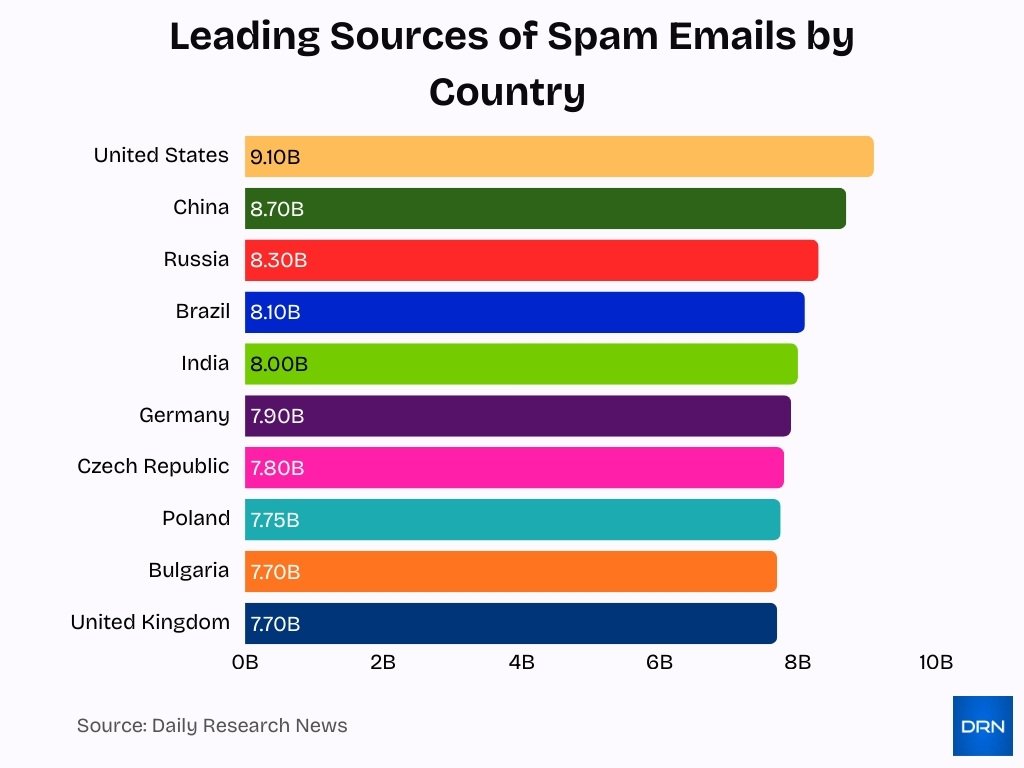
- The United States sends 9.1 billion spam emails daily.
- China generates 8.7 billion spam emails per day.
- Russia produces 8.3 billion spam emails daily.
- Brazil sends 8.1 billion spam emails each day.
- India sends 8.0 billion spam emails daily.
- Germany contributes 7.9 billion spam emails per day.
- The Czech Republic generates 7.8 billion spam emails daily.
- Poland produces 7.75 billion spam emails each day.
- Bulgaria and the UK each send 7.7 billion spam emails daily.
Top Spam Sources
- Global daily email volume reaches 376.4 billion in 2025, with 46.8% classified as spam.
- The United States leads spam sources, sending 9.1 billion spam emails daily.
- China follows closely, originating 8.7 billion spam emails per day.
- Russia contributes 8.3 billion spam emails daily from its networks.
- India generates 8.0 billion spam messages each day worldwide.
- Germany accounts for 7.9 billion daily spam emails in 2025.
- Phishing emails, a key spam type, total 3.4 billion sent globally daily.
- Botnet activity surged 26% in early 2025, fueling spam from compromised servers.
- Spam comprises 47% of total email traffic, equaling 176 billion messages daily.
Common Spam Topics
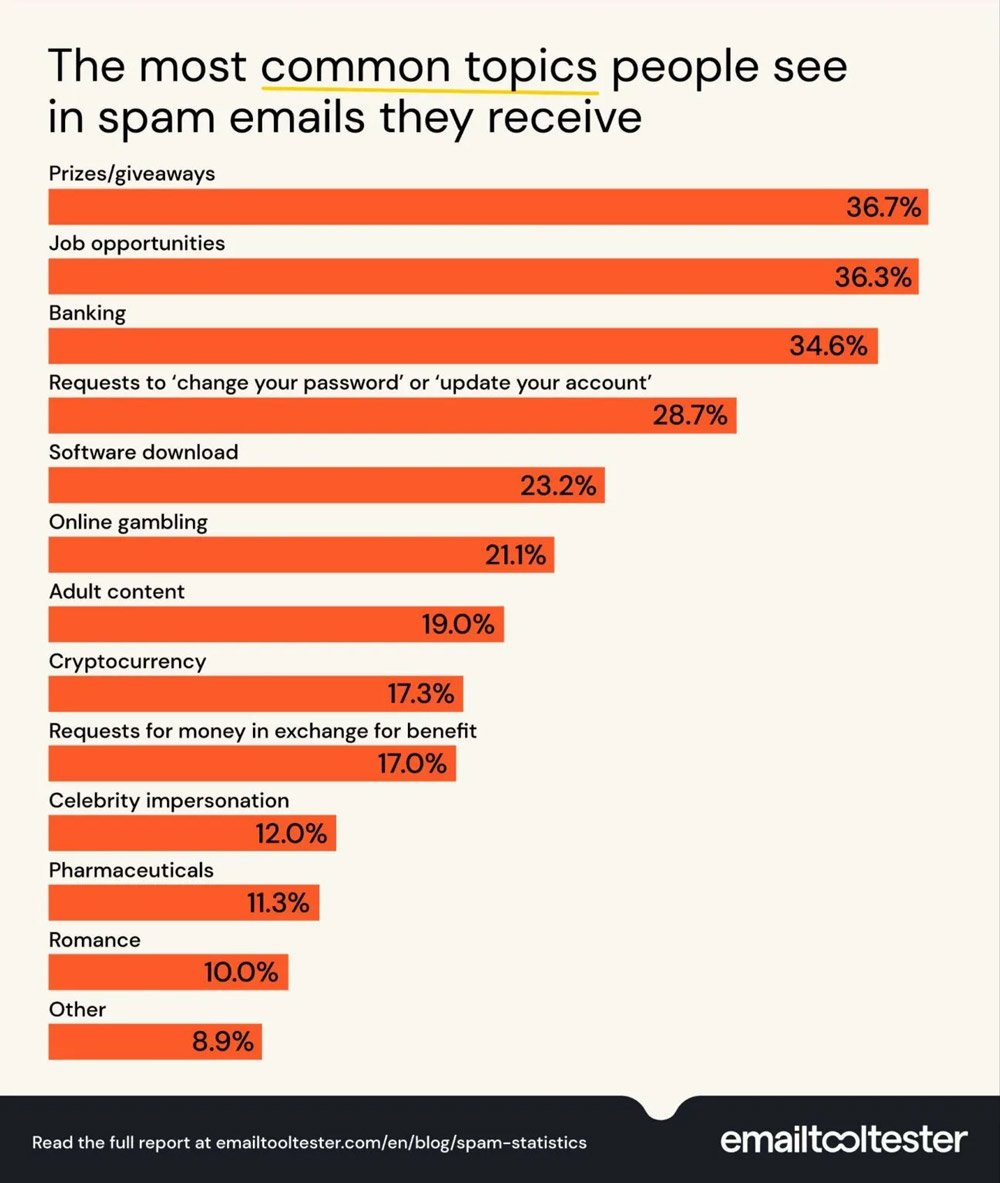
- Prizes and giveaways dominate spam categories with 36.7%, enticing users through deceptive promises of fake rewards.
- Job opportunities constitute 36.3% of spam, frequently aiming at unemployed individuals or remote workers with misleading offers.
- Banking-related spam reaches 34.6%, attempting to fool users into surrendering financial credentials.
- Account update scams (including password reset deceptions) represent 28.7% of spam emails.
- Software download prompts appear in 23.2% of spam, typically distributing malware under the guise of updates or tools.
- Online gambling spam accounts for 21.1%, exploiting tendencies toward addictive behavior.
- Adult content spam comprises 19.0% of unsolicited emails, frequently slipping past standard email filters.
- Cryptocurrency-themed spam represents 17.3%, capitalizing on market hype and user FOMO.
- Requests for money in exchange for benefits appear in 17.0% of spam, echoing traditional scam models.
- Celebrity impersonation emails account for 12.0% of spam, deceiving recipients through forged endorsements.
- Pharmaceutical spam covers 11.3%, promoting unverified or illegal products.
- Romance-themed spam shows up in 10.0%, preying on emotionally vulnerable individuals.
- Miscellaneous spam topics make up the remaining 8.9%, spanning various unrelated deceptive themes.
Phishing and Scam Stats
- Around 20% of all global emails in 2024 contained spam or phishing elements.
- In 2025, roughly 3.4 billion phishing emails per day circulated globally, about 1.2% of total email volume.
- Attackers generated more than 1.13 million phishing attacks in Q2 2025 alone.
- Nearly 900 million phishing attempts were blocked in 2024, up substantially from 2023 totals.
- Phishing serves as the initial vector in about 36% of data breaches.
- Phishing attacks spike during holidays and travel seasons, exploiting seasonal urgency.
- Many phishing emails use malicious attachments, forged metadata, or embedded URLs.
- Highly targeted sectors include IT, education, and financial services.
AI in Spam
- 82% of phishing campaigns in 2025 used AI-written or AI-assisted emails.
- Phishing emails grew 202% in H2 2024, with credential phishing surging 703% due to AI.
- AI-generated phishing achieves a 54% click-through rate, 4.5x more effective than traditional attacks.
- Spear-phishing by LLMs like GPT-4 gains 56% click-through, outperforming generic emails by 350%.
- Phishing attacks surged 58.2% in 2023, driven by generative AI tools.
- AI-generated phishing accounts for 47% of initial access attacks by 2025.
- Traditional spam filters show false negative rates up to 10% for AI spam.
- Only 0.7–4.7% of phishing emails evading filters were AI-written in 2024.
- AI phishing volume increased 1,265% since 2023, per a 2025 analysis.
Spam by Demographics
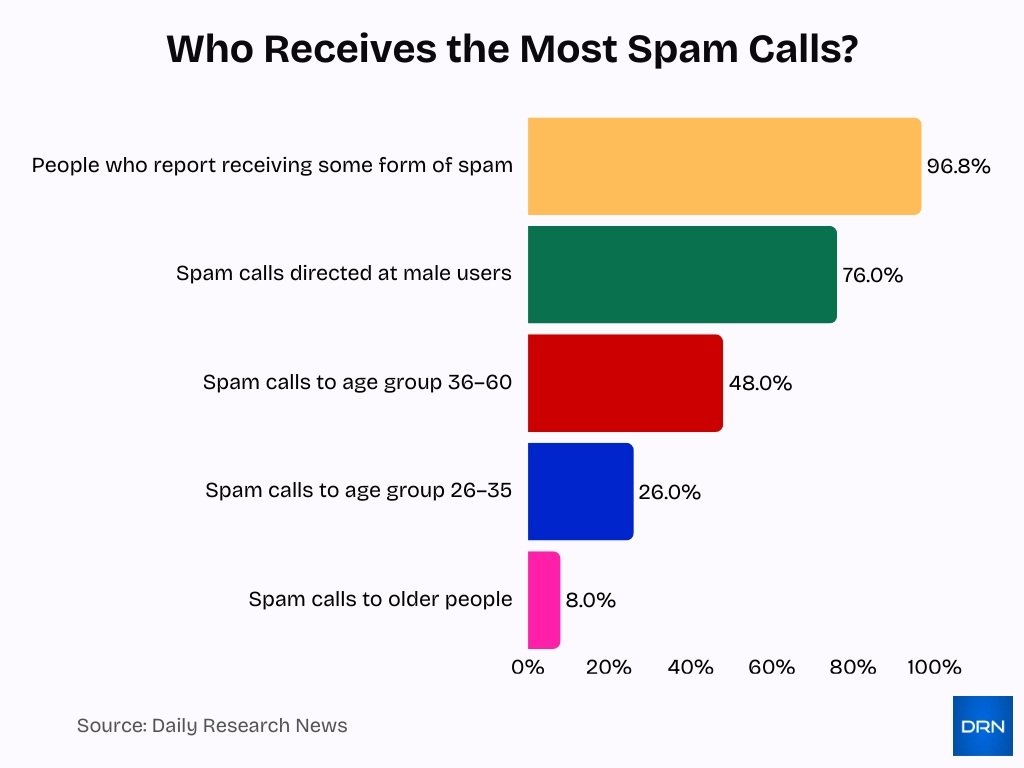
- 96.8% of people report receiving some form of spam.
- Adults 65+ receive the most spam calls, averaging 35.5 per month.
- Young adults (18–34) receive the fewest spam calls, around 14.2 per month.
- 76% of spam calls were directed at male users in a telecom study.
- Age groups 36–60 accounted for 48% of spam calls.
- Men aged 35–44 face the highest phone spam targeting, women aged 18–34 next.
- 26% of spam calls targeted the 26–35 age bracket.
- Mississippi tops US states with the most unwanted calls per user monthly.
- 8% of spam calls reached older people.
Economic Cost of Spam
- The average phishing-initiated data breach costs $4.88 million.
- U.S. losses from Business Email Compromise reached $2.7 billion in 2024.
- Spam drives indirect costs, including downtime, recovery, and infrastructure stress.
- Earlier estimates put global spam costs at $100 billion per year, even before modern filtering.
- Spam increases storage and processing demands across organizations.
- Spam-mitigation investments, such as training and monitoring, become ongoing operational costs.
- Users face lost time, financial harm, and emotional distress, contributing to a broad economic impact.
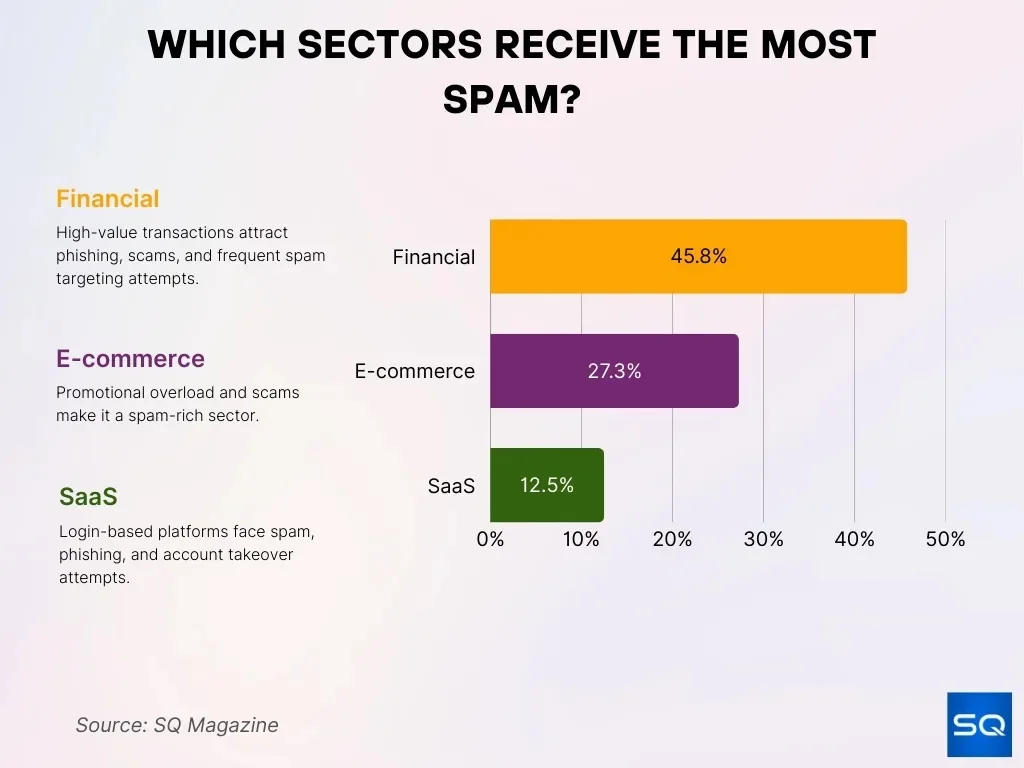
Top Industries and Sectors Most Frequently Targeted
- The financial sector receives 45.8% of spam attacks, leading all industries in overall targeting volume.
- The e-commerce sector accounts for 27.3% of spam activity, making it the second most targeted sector.
- SaaS companies experience 12.5% of spam attempts, emphasizing their high visibility to attackers.
- Emails in the dating industry endure a 14.97% spam rate, which is the highest across all sectors.
- In contrast, home & garden, food & drink, and clothing sectors face comparatively lower spam rates at around 10.6%.
- Spam targeting WordPress sites remains significant, as 69% of platforms using WordPress are attacked, especially through form submissions.
- The most frequently spammed online forms include sign-up forms (45%), contact forms (35%), and e-commerce forms (15%).
Environmental Impact
- Around 376 billion total emails are sent daily, with 46.8% spam, equaling 176 billion spam emails.
- Each spam email emits an average of 0.3 grams of CO₂.
- Global spam generates 17 million metric tons of CO₂ annually, rivaling 1.5 million U.S. homes.
- Spam email energy use equals 33 TWh yearly, powering 2.7 million U.S. homes.
- Over 45% of all daily emails were classified as spam in 2025.
- Spam emissions match electricity for two million homes annually.
- 10 daily spam emails pollute like driving 50 km in a car.
- Spam alone drives 22% of the average business user’s 131 kg yearly CO₂ from email.
Mental Health Impact
- 68.8% of people receiving spam or phishing report negative mental-health effects.
- 86% of fraud victims experience anger, 73% stress, and 63% anxiety.
- 69% of scam victims report a negative mental health impact, with 36% less trusting of online platforms.
- 79% of fraud or scam victims suffer some form of emotional harm.
- 55% of affected fraud victims experience anxiety, and 48% depression.
- 60% of the workforce faces increased burnout from digital fatigue and constant online pressure.
- One in three small business owners targeted by cyber attacks reports a significant mental health impact.
- 18% of cybercrime victims report depression, 3% suicidal thoughts.
Deliverability Rates
- Roughly 46–47% of all email traffic is classified as spam or unwanted.
- About 10.5% of emails land in spam folders, and 6.4% are blocked entirely.
- Many legitimate marketing emails never reach inboxes due to aggressive filtering.
- Providers now require proper authentication, clean lists, and engagement to ensure inbox placement.
- Algorithmic filtering moves many emails to Promotions or other tabs, reducing visibility.
- More users create secondary or disposable accounts, lowering list quality.
- Poor deliverability harms the sender’s reputation and increases the risk of blocklisting.
Frequently Asked Questions (FAQs)
About 46.8% of all emails worldwide were identified as spam in December 2024.
Roughly 160 billion spam emails per day were sent globally as of 2023.
Around 3.4 billion phishing emails per day, which represents about 1.2% of global email traffic.
The average phishing-related data breach reportedly costs about $4.88 million.
Conclusion
The data shows that spam, whether email, calls, or messages, remains a pervasive and evolving threat with wide-reaching consequences. From demographic targeting patterns to staggering economic losses, environmental strain, and mental-health effects, spam’s impact extends far beyond simple annoyance. The rise of AI-generated spam has deepened complexity, while stricter filtering has challenged legitimate communication and deliverability.
Addressing spam now requires coordinated action across technology, user education, policy, and security practices, reflecting the broader goal of restoring trust and efficiency in modern digital communication.