

Steam remains the world’s most widely used digital distribution platform for PC gaming, driving major trends across the industry. Its reach continues to grow with record engagement, new technology transitions, and ever-expanding content popularity. Whether it’s millions logging in daily or tens of millions playing simultaneously, Steam’s data reveals how gaming habits are evolving. From daily usage figures to regional adoption, this article explores key metrics shaping the platform’s present and future impact.
Editor’s Choice
- 147 million monthly active users on Steam by Q1 2025, up from 132 million the previous year.
- 69 million daily active users in 2025, maintaining high user engagement.
- 41.66 million peak concurrent users recorded in October 2025, setting a new record.
- Steam’s global revenue in 2024 reached $10.8 billion, reflecting strong year-over-year growth.
- Over 117,000 games are available on Steam as of late 2025.
- 52%+ of monthly users access Steam daily, signaling habitual platform use.
- Steam’s US market share in PC game distribution stands at roughly 75%.
Recent Developments
- Steam transitioned fully to a 64-bit Windows client in late 2025, improving stability and performance.
- Official support for 32-bit Windows systems will end in January 2026.
- A global outage on December 25, 2025, temporarily disrupted services for thousands of players.
- UI and chat upgrades rolled out alongside the 64-bit update enhanced community interaction.
- Controller support expanded to include newer Nintendo and GameCube adapter options.
- Big Picture Mode and Remote Play features saw incremental usability improvements.
- Steam Replay 2025 showed that older games still dominate playtime, with only 14% tied to 2025 releases.
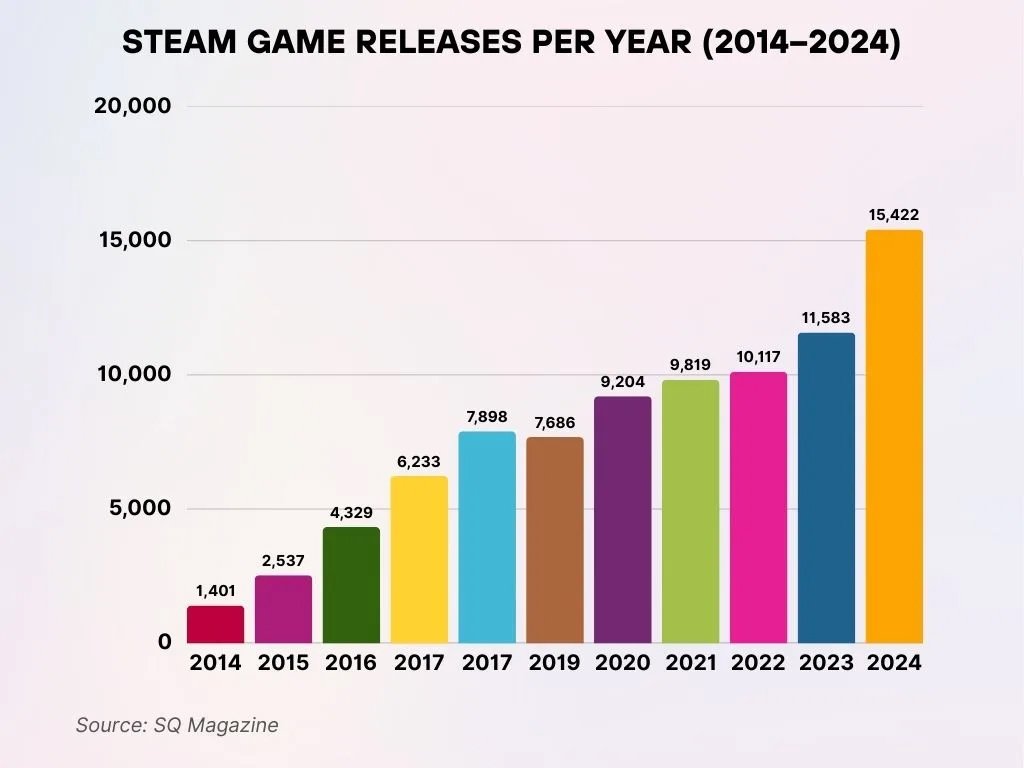
Annual Game Release Volume on Steam (2014–2024)
- Steam set a new milestone in 2024, releasing 15,422 games, the highest annual count ever, underscoring the platform’s massive expansion within the global gaming ecosystem.
- In 2014, just 1,401 games launched on Steam, reflecting a comparatively modest release volume during the platform’s early growth stage.
- By 2015, annual releases almost doubled to 2,537 games, highlighting Steam’s rising appeal among indie developers.
- The year 2016 experienced a sharp upswing with 4,329 games released, signaling improved accessibility and ease of publishing on the platform.
- In 2017, releases climbed further to 6,233 games, reinforcing Steam’s steady upward trajectory in game availability.
- During 2018, Steam added 7,987 games, a notable jump that solidified its dominance in digital game distribution.
- The year 2019 recorded a slight decline to 7,686 games, indicating a brief slowdown in publishing momentum.
- Steam rebounded strongly in 2020 with 9,204 games released, largely driven by the pandemic-fueled surge in gaming demand.
- In 2021, momentum continued with 9,819 games, demonstrating consistent year-over-year growth.
- The platform crossed a major threshold in 2022, surpassing five digits for the first time with 10,117 games released.
- This growth trend persisted in 2023, as 11,583 games launched while indie and mid-tier developers increasingly embraced Steam.
Daily and Monthly Users on Steam
- Steam reached 147 million monthly active users by early 2025.
- 69 million daily active users were recorded in 2025.
- Daily active users represent roughly 52.27% of monthly users.
- More than 52% of monthly users log in daily.
- Daily active users rose from 62.6 million in 2024 to 69 million in 2025.
- Major sales events push daily active usage above 17 million during peak periods.
- Average weekly playtime per user increased from 6.3 hours in 2024 to 7.1 hours in 2025.
- These metrics keep Steam among the most engaged entertainment platforms worldwide.

Historical Growth Trends of Steam
- Monthly active users grew from 132 million in 2024 to 147 million in 2025.
- Daily active users increased by about 10% year over year.
- Peak concurrent usage climbed more than 24% from 2024 to 2025.
- Average weekly playtime rose by approximately 12.7% compared to the prior year.
- Steam’s user base has more than doubled since 2017.
- Growth continued despite increased competition from other PC game stores.
- Annual concurrency records have increased consistently since 2020.
- Long-term trends highlight Steam’s sustained relevance in PC gaming.
Demographics and Player Behavior on Steam
- The average Steam user plays 4.5 games per year.
- About 63% of US players purchase two games or fewer annually.
- The median Steam user played four games in 2025.
- Only 0.56 new games released in 2025 were played by the median user.
- Fewer than 5% of users buy more than one game per month.
- Steam Chat usage rose roughly 20% in 2025.
- Only 14% of total playtime went to games released in 2025.
- Player behavior reflects loyalty to established and evergreen titles.
Engagement and Playtime Patterns on Steam
- 40% of total Steam playtime went to games over eight years old.
- Games released 1-7 years ago accounted for 44% of hours played.
- New 2025 releases comprised just 14% of total playtime.
- Average weekly playtime per user rose from 6.3 hours in 2024 to 7.1 hours in 2025.
- Peak concurrent users hit 41.66 million in October 2025, surpassing prior records.
- Seasonal sales like Summer Sale drive massive spikes, with 33 million games sold in two weeks.
- Daily active users average 69 million, far outpacing occasional logins.
- Median users play just 4 games yearly, favoring deep engagement over churn.
- Older titles like Counter-Strike 2 lead with 871,756 concurrent players.
Regional User Distribution across Steam
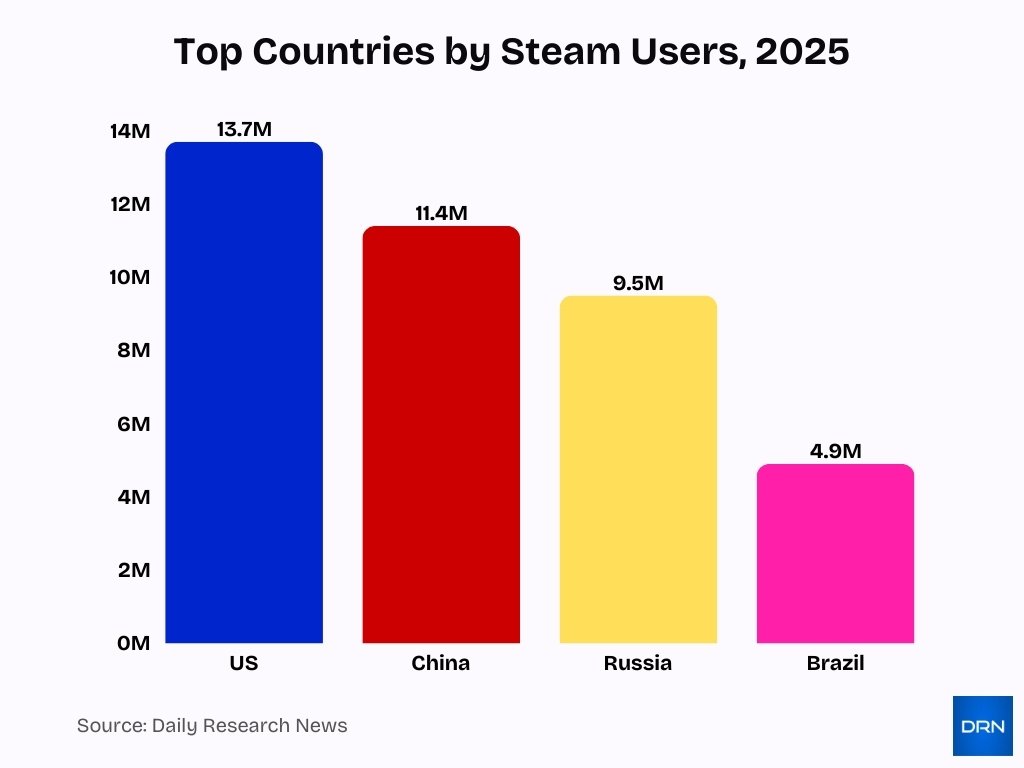
- North America holds 22% of Steam’s total active users, leading with 13.7 million from the US.
- Asia-Pacific commands 42% of Steam’s user base, up from 37% in 2023.
- Europe accounts for 28% of users, with Germany at 3.6 million.
- The US dominates with 13.7 million users, followed by China at 11.4 million.
- Russia ranks third with 9.5 million active Steam users.
- Brazil contributes 4.9 million users, powering Latin America‘s 5% share.
- Southeast Asia saw 11 million yearly users in 2024, with 38% YoY growth in India.
- Steam captured 75% of the US PC gaming distribution market in 2025.
- Q4 2025 Asia-Pacific reached 17.3 million quarterly players, the fastest-growing region.
- Western regions average a higher spend per user than emerging markets by 2-3x conversion rates.
Game Library and Catalog Size in Steam
- Steam’s catalog reached 117,881 total titles by late 2025.
- 16,774 new games were added during 2025.
- 18,691 titles launched in 2024, marking a record year.
- Steam adds an average of 45 to 50 games per day.
- Independent developers account for more than 61,000 titles.
- Nearly 19,000 games launched in 2025.
- Almost half of the new games received fewer than 10 reviews.
- Steam’s vast catalog reinforces its dominance in PC gaming distribution.
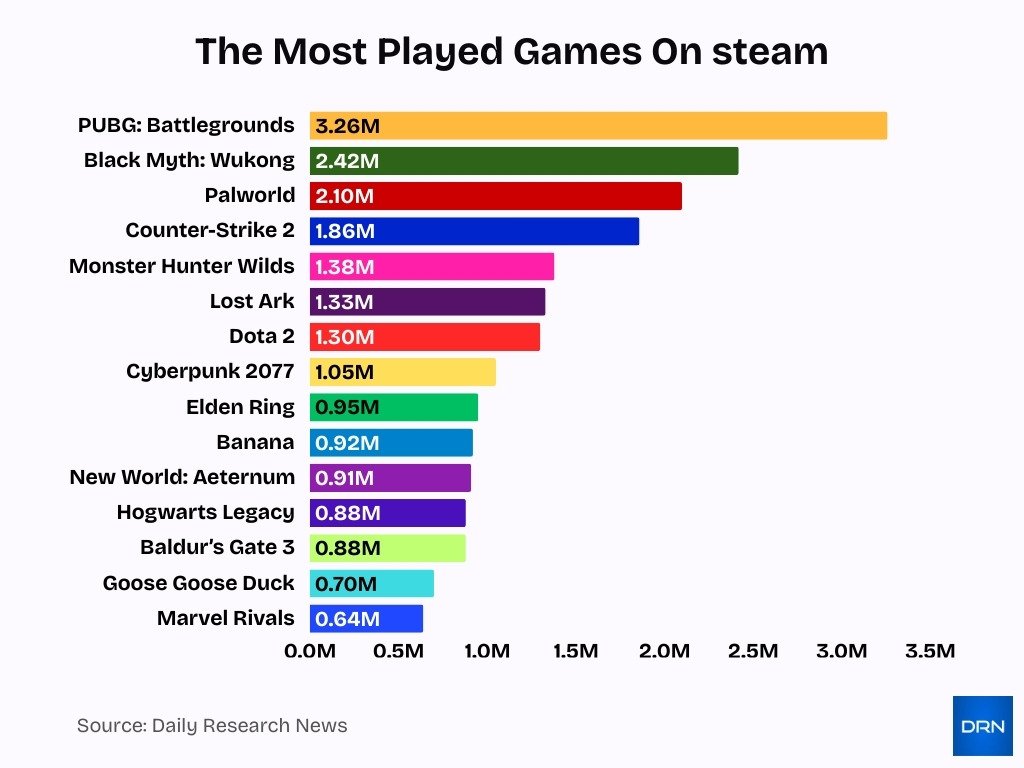
Most Played Games on Steam by Player Count
- PUBG: Battlegrounds leads Steam engagement with 3.26 million players, maintaining its position as the most played game on the platform.
- Black Myth: Wukong records an impressive 2.42 million players, highlighting its strong launch momentum and global appeal.
- Palworld attracts 2.10 million players, proving its viral popularity and sustained community interest.
- Counter-Strike 2 continues its legacy with 1.86 million players, reinforcing its status as a competitive multiplayer staple.
- Monster Hunter Wilds reaches 1.38 million players, reflecting strong franchise loyalty among action RPG fans.
- Lost Ark maintains solid engagement at 1.33 million players, supported by its MMORPG-driven player base.
- Dota 2 draws 1.30 million players, showing long-term retention in the MOBA segment.
- Cyberpunk 2077 sees 1.05 million players, signaling a successful post-launch recovery and renewed interest.
- Elden Ring captures 0.95 million players, demonstrating continued demand for premium single-player experiences.
- Banana surprises with 0.92 million players, underscoring the impact of viral and casual gaming trends.
- New World: Aeternum records 0.91 million players, reflecting revived interest following updates and expansions.
- Hogwarts Legacy engages 0.88 million players, driven by the strength of its global IP.
- Baldur’s Gate 3 also posts 0.88 million players, highlighting the mainstream success of RPG titles.
- Goose Goose Duck attracts 0.70 million players, benefiting from social and party-based gameplay appeal.
- Marvel Rivals rounds out the list with 0.64 million players, showing growing traction for superhero-themed multiplayer games.
Game Genre Distribution within Steam
- Action games claim the top spot with 92,584 titles and 58.37% of Steam’s total revenue.
- Indie games lead Steam’s library at 110,634 titles, spanning simulation, strategy, RPG, and hybrids.
- Competitive multiplayer like Counter-Strike 2 tops charts with 1.86 million peak concurrent players.
- RPGs drive 17.11% of revenue and sustain engagement via JRPGs at 6.1 hours median playtime.
- Free-to-play titles dominate playtime, with service games filling 85% of top concurrent slots.
- Niche genres like roguelikes generate $710 million through loyal communities.
- Esports games like Dota 2 hit 1.3 million peak users, ranking high in active counts.
- Genre diversity surges with 18,626 new games added in 2024 alone.
- Simulation spans 53,589 titles, capturing 9.76% of platform revenue.
Download Volumes and Bandwidth Usage on Steam
- Steam peaked at 51 Tbps global download bandwidth after Cyberpunk 2077’s launch.
- Download traffic hit 23 Tbps during Cyberpunk 2077 pre-load, nearly tripling prior peaks.
- China accounts for 26.1% of global Steam bandwidth usage as of 2025.
- The US holds 20.6% share of total Steam data consumption worldwide.
- Asia dominates with 32.2% of Steam traffic in mid-2025.
- Russia captures 5.9% of global Steam bandwidth usage.
- AAA titles like ARK: Survival Evolved exceed 275 GB install sizes on Steam.
- Cyberpunk 2077’s launch drove Steam bandwidth beyond 200 Gbps routinely.
- Sales events boost Steam game views up to 7x average in 2024.
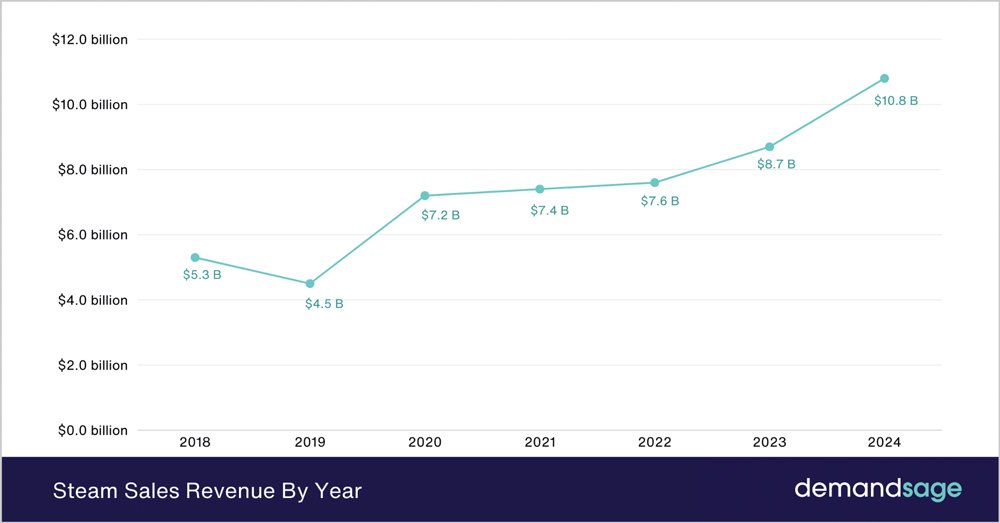
Steam Sales Revenue Growth Trends (2018–2024)
- Steam generated $5.3 billion in 2018, reflecting a strong baseline for the platform’s digital game sales performance.
- In 2019, revenue declined to $4.5 billion, marking the lowest point in the observed period.
- A major rebound occurred in 2020, with Steam sales revenue jumping to $7.2 billion, driven by increased gaming demand during global lockdowns.
- 2021 saw continued stability, as revenue edged up to $7.4 billion, indicating sustained user engagement.
- Steam’s sales revenue reached $7.6 billion in 2022, maintaining a steady upward growth trend.
- In 2023, revenue rose sharply to $8.7 billion, highlighting strong post-pandemic momentum.
- 2024 marked a record-breaking year, with Steam sales revenue surging to $10.8 billion, showcasing accelerated growth and expanding market dominance.
Device and OS Platform Breakdown for Steam Users
- Windows 11 64-bit accounts for 65.59% of Steam users.
- Windows 10 64-bit holds approximately 29.06% share.
- Windows systems represent 94.79% of total OS usage.
- Linux usage reached 3.20%, an all-time high.
- macOS accounts for roughly 2% of users.
- SteamOS adoption continues rising alongside handheld devices.
- DirectX 12 systems exceed 90% adoption.
- NVIDIA and AMD GPUs dominate hardware configurations.
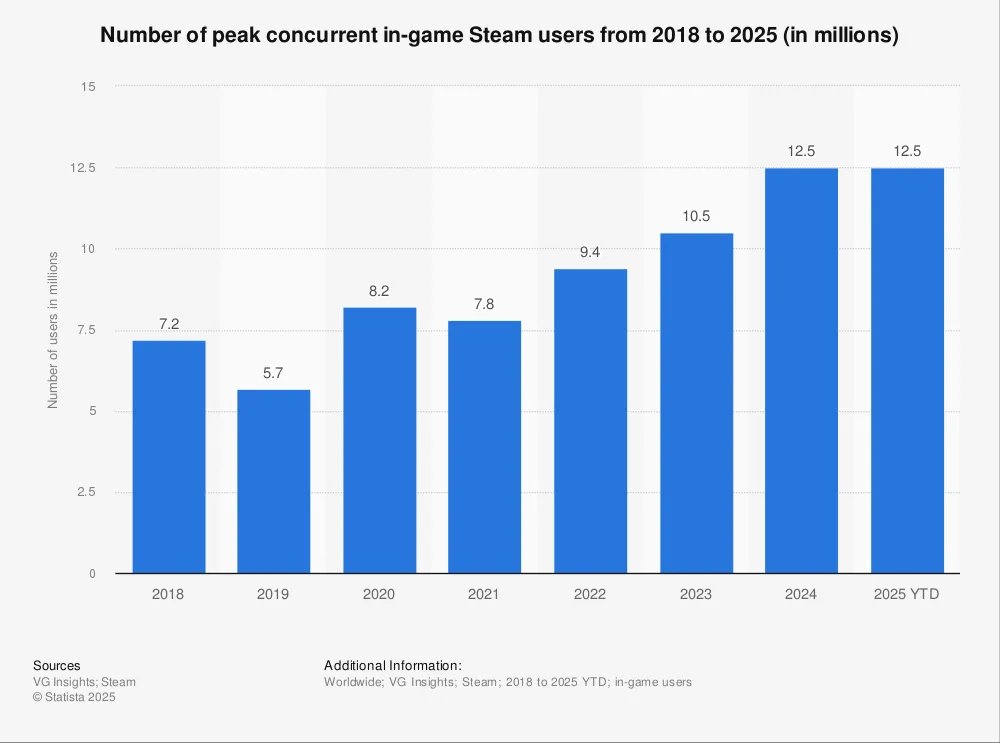
Highest Peak Concurrent In-Game Users on Steam (2018–2025)
- Both 2024 and 2025 YTD reached the highest peak ever at 12.5 million users, highlighting record-breaking engagement and a rapidly expanding user base on the platform.
- In 2018, Steam logged 7.2 million peak concurrent in-game users, demonstrating strong and healthy engagement among global gamers.
- User activity declined in 2019 to 5.7 million, representing the lowest peak level recorded during the observed timeframe.
- A significant rebound occurred in 2020, with 8.2 million peak concurrent users, largely driven by the global shift toward indoor entertainment during the pandemic.
- During 2021, Steam sustained solid engagement with 7.8 million users, indicating a slight drop but overall stable demand.
- In 2022, peak concurrent players increased to 9.4 million, reinforcing the platform’s renewed upward momentum in worldwide gaming activity.
- By 2023, Steam achieved a new milestone of 10.5 million concurrent users, as the platform continued expanding its audience and content offerings.
Hardware & Software Survey Insights from Steam
- The Steam Hardware & Software Survey updates monthly.
- Windows 11 adoption increased by about 2% in late 2025.
- CPUs with eight or more cores are increasingly common.
- AMD CPUs surpassed 40% market share among surveyed systems.
- NVIDIA GPUs remain the most widely used.
- 92%+ of systems support DirectX 12.
- VR hardware usage remains niche but stable.
- 16 GB or more RAM is now common among active users.
Adoption Trends of Steam Deck
- Steam Deck shipments exceeded 3.7 million units by early 2025.
- Around 2.3 million PC gaming handhelds were projected to sell in 2025.
- Annual adoption growth is estimated at 6 to 8%.
- The LCD Steam Deck model was discontinued in late 2025.
- OLED models now serve as the primary offering.
- SteamOS compatibility expanded to third-party devices.
- Portable PC gaming demand remains steady.
- Future hardware revisions remain possible as technology advances.
Achievements, Badges, and Wishlist Behavior on Steam
- Some users have earned the Game Collector 40,000+ badge.
- Only about 6% of games exceed 100,000 wishlists before launch.
- Roughly 66% of games have fewer than 10,000 wishlists.
- Wishlist counts strongly correlate with early sales performance.
- High wishlist titles convert more effectively at launch.
- Marketing strategies often focus on wishlist growth.
- Achievements encourage deeper platform engagement.
- Wishlist metrics shape developer launch strategies.
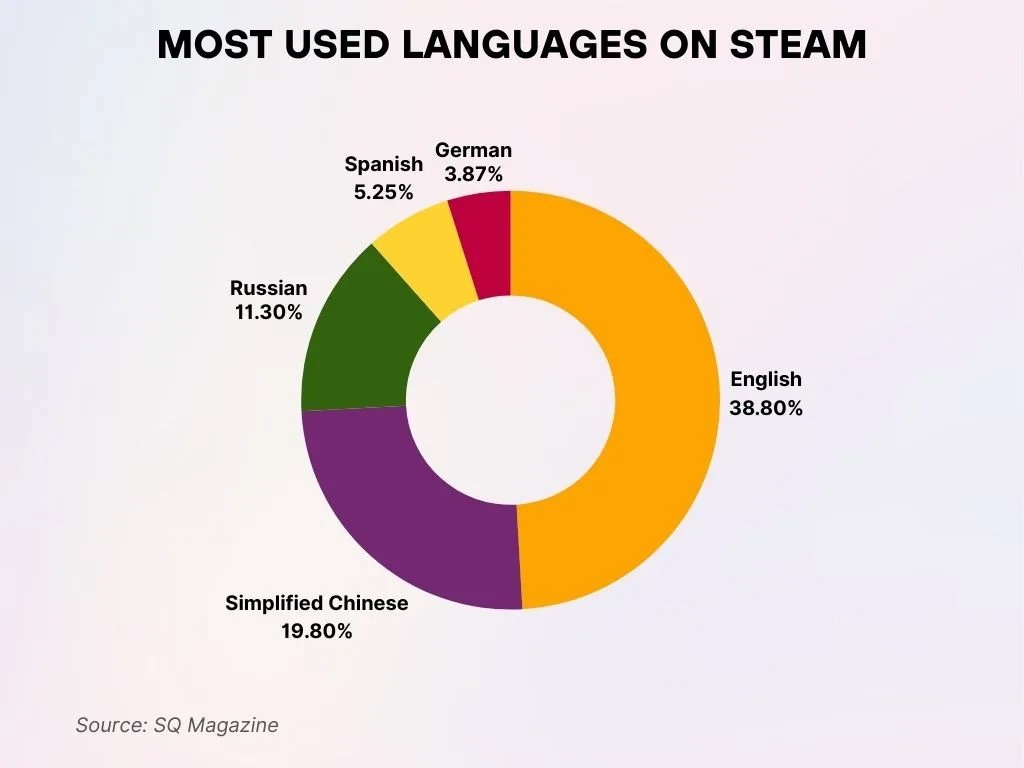
Top Languages Most Commonly Used on Steam
- German completes the top five languages on Steam with 3.87%, emphasizing its steady presence and continued relevance within European gaming communities.
- English remains the most dominant language on Steam, used by 38.80% of the platform’s global user base, reflecting its worldwide reach, broad accessibility, and international appeal.
- Simplified Chinese secures the second position with a 19.80% user share, highlighting the rapidly growing influence of Chinese gamers within the PC gaming ecosystem.
- Russian stands as the third most used language, accounting for 11.30% of Steam users, driven by a strong regional gaming culture and high engagement levels.
- Spanish is used by 5.25% of Steam users, demonstrating notable representation from Spanish-speaking regions and a broad global footprint across the platform.
User Reviews and Community Content on Steam
- Nearly 48% of 19,000+ Steam 2025 releases received fewer than 10 reviews.
- 2,200 2025 Steam games received zero user reviews.
- Only 6.2% of 2025 releases surpassed 500 reviews on Steam.
- Steam Workshop hosts over 6.5 million items with 120 million downloads in 2024.
- Top 5 mod-supported games account for 71% of all Steam Workshop activity.
- 78% of 2.7 million monthly Steam user reviews are positive.
- Very Positive (80–89%) rated games sell 3–5x more in the first 90 days.
- 950,000+ creators published Workshop content since its inception.
- Steam indie titles represent 99% of releases but 58% of sales volume.
Future Projections and Outlook for Steam
- Steam concurrent users projected to hit 45 million peak by late 2026.
- Handheld PC market, led by Steam Deck, to grow 29.7% in 2025, reaching 1.92 million units.
- SteamOS updates deliver stable frame rates and improved thermals for long-term platform stability.
- The Steam VR headset market is forecasted to reach $2.14 billion in 2025 with 18.1% CAGR.
- Games with over 100k wishlists show strong launch performance on Steam.
- 1.7 million new Steam users spent $20 million on microtransactions and $73 million on DLC.
- The Steam platform games market is valued at $5.37 billion in 2025, growing at 8.9% CAGR to 2033.
- PC gaming handhelds surge 32% to 2.3 million units in 2025.
- DLC accounts for 14% of PC revenue at $5.3 billion.
Frequently Asked Questions (FAQs)
Steam had approximately 132 million monthly active users in 2025.
Steam reached a peak of about 41.66 million concurrent players in October 2025.
Steam generated $10.8 billion in revenue during 2024.
Steam captures roughly 74–75% of the PC digital distribution market as of 2025.
Conclusion
Steam’s metrics reveal a platform defined by scale, consistency, and adaptability. From user growth and engagement patterns to hardware evolution and community systems, Steam continues shaping how PC games are played, sold, and sustained. As new technologies emerge and global adoption expands, Steam’s role as the backbone of PC gaming appears firmly set for the years ahead.