

Streaming has reshaped how people consume entertainment and information. In the U.S., more than 8 in 10 adults use at least one streaming service, shifting hours of TV viewership from traditional broadcast and cable to digital platforms in recent years. Streaming’s impact spans industries, from media companies relying on subscription and advertising revenue to advertisers reallocating budgets to digital video ads.
In the corporate world, brands use livestreaming to engage audiences in real time, while sports and events leverage streaming to expand global reach. Explore how these numbers paint the picture of streaming’s growth and influence.
Editor’s Choice
- Streaming accounts for nearly 45% of total TV viewership in the U.S., surpassing broadcast and cable.
- 83% of U.S. adults now stream video content, highlighting widespread adoption.
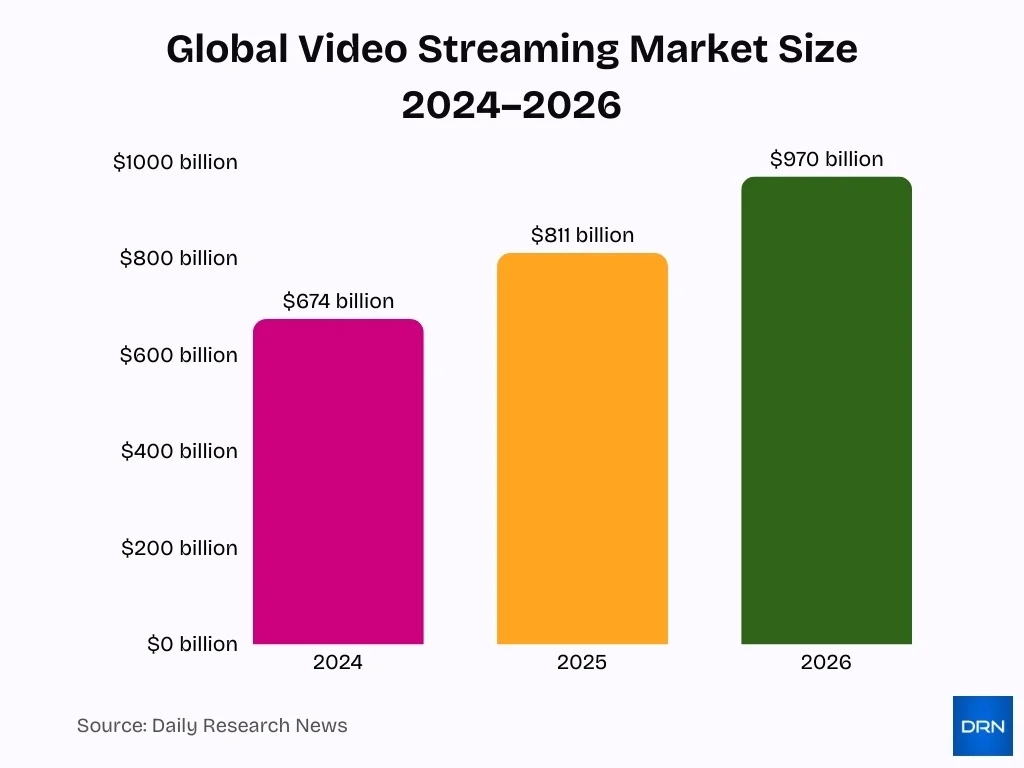
- The global video streaming market is estimated at $674.25 billion in 2024.
- Netflix reported over 325 million subscribers worldwide at the end of 2025.
- The live streaming market is projected to reach $600+ billion by 2032.
- Ad-supported streaming viewing hours rose 43% in 2025.
- Hybrid monetization (subscription + ad) is now a key industry pivot.
Recent Developments
- In Q4 2025, Netflix reported $12.05 billion in revenue, up ~18% year-over-year.
- Netflix’s advertising tier revenue reached $1.5 billion in 2025, more than double that of 2024.
- The ad-supported model now accounts for a rising share of household viewing hours.
- Netflix acquired Warner Bros. and HBO Max assets in a major industry consolidation play (2025).
- Live streaming as a medium is expanding beyond gaming into sports, events, and politics in 2026.
- Platforms are introducing interactive video ads and engagement tools to increase ad revenue.
- Declining traditional TV ad revenue continues as streaming advertising grows.
- Major SVOD services are scaling global availability with regional expansion strategies.
What Is Streaming?
- Streaming services host content on remote servers and deliver it via the internet to users’ devices, from smart TVs to phones.
- Viewers access content instantly without storing large files locally.
- Streaming includes subscription models (SVOD), free ad-supported tiers (AVOD/FAST), and live formats.
- Video streaming differs from traditional broadcast TV in its flexibility and personalization.
- Platforms use data analytics to recommend content tailored to user behavior.
- Streaming monetization spans subscriptions, advertising, and pay-per-view models.
- Social media platforms often integrate streaming features to expand engagement.
- Streaming now serves gaming, fitness, education, and live events, broadening its role beyond entertainment.
Global Streaming Market Size & Growth
- The global video streaming market was valued at approximately $674.25 billion in 2024.
- Industry forecasts project significant expansion through the late 2020s.
- One report estimates the global market value at $811.37 billion in 2025.
- The market is expected to hit nearly $970 billion in 2026.
- North America leads with ~37.7% global market share in 2025.
- CAGR forecasts span 12–21% through 2030+, varying by source.
- Hybrid revenue models are driving growth in media streaming worldwide.
- Streaming market dynamics now influence broader entertainment industry revenues, projected to exceed trillions globally across digital media sectors.

Streaming Revenue and Growth Trends
- Global streaming revenue continues to expand alongside subscriber growth.
- Online video streaming revenue is expected to grow 12–15% annually in many markets.
- Subscription revenue accounts for the majority of streaming income worldwide.
- Advertising revenue tied to streaming services is projected to rise faster than traditional TV ad spend.
- Hybrid monetization strategies have increased profitability by blending SVOD and AVOD.
- Platforms like Netflix are diversifying revenue through ad tiers and interactive formats.
- The average revenue per user (ARPU) remains a key focus for platform growth strategies.
- Market players are investing heavily in original content to drive subscriptions and reduce churn.
Number of Streaming Users Worldwide
- Approximately 2.50 billion people worldwide were expected to watch digital video (YouTube included) in 2025, with about 2.25 billion watching subscription OTT video.
- As internet users grow, OTT video viewers are projected to encompass over half of all global internet users by 2025.
- Much of this growth comes from the Asia-Pacific, Latin America, and the Middle East, where internet adoption is rapidly expanding.
- In 2025, streaming accounted for nearly half of all television usage in the U.S. for the first time, reflecting higher user counts.
- Connected TV streaming in internet-enabled homes reached 96.4 million households, rising year-over-year.
- The average U.S. household now subscribes to about 6.9 streaming services, indicating widespread multi-platform use.
- Worldwide, the number of OTT platforms and related digital services continues to grow, broadening the user base beyond traditional subscribers.
- India’s streaming audience climbed to an estimated 601 million users in 2025, showing regional market expansion.
- Niche and regional streamers (e.g., Tubi reaching 100 million monthly users) contribute significantly to total global streaming engagement.
Streaming Subscriber Base vs Revenue Performance
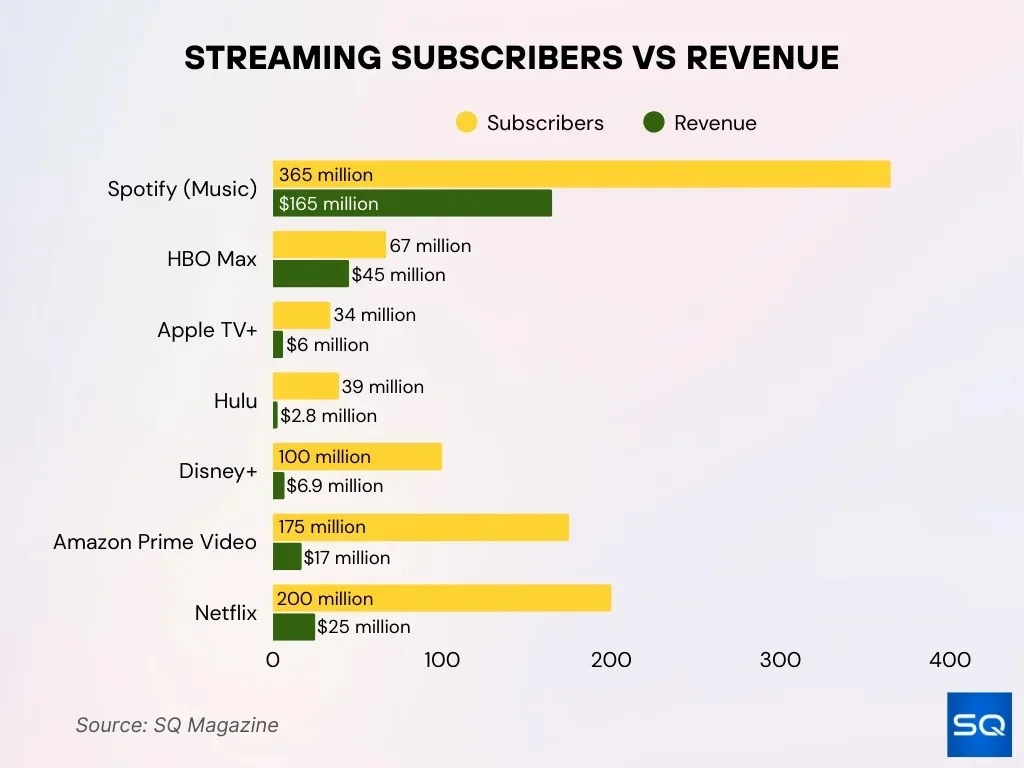
- Spotify dominates music streaming with 365 million subscribers and an impressive $165 billion in revenue, clearly leading the market in both scale and earnings.
- Netflix maintains a massive footprint with 200 million subscribers while generating approximately $25 billion, reflecting strong scale but comparatively modest ARPU.
- Amazon Prime Video reports a substantial 175 million subscribers alongside $17 billion in revenue, highlighting its broad global reach.
- Disney+ draws in 100 million users and produces roughly $6.9 billion in revenue, underscoring rapid growth with moderate monetization.
- HBO Max generates a striking $45 billion in revenue from just 67 million subscribers, signaling exceptionally high ARPU relative to its user base.
- Apple TV+ reaches 34 million subscribers and earns close to $6 billion, reflecting steady growth in a competitive streaming landscape.
- Hulu counts 39 million subscribers but brings in only $2.8 billion in revenue, placing it among the lowest earners in this comparison.
Streaming Adoption by Region
- North America holds a 31.3% share of the global video streaming market in 2024, driven by high broadband access.
- 90% of U.S. households have CTV devices, with over 250 million Americans watching streaming content.
- 91% of U.S. internet households subscribe to at least one streaming service as of 2025.
- Streaming captured 44.8% of total U.S. TV viewership in May 2025, surpassing broadcast and cable combined.
- Asia Pacific commands a 38.7% share of the media streaming market in 2025, with rapid growth fueled by mobile adoption.
- Southeast Asia added 1.5 million net new premium VOD subscribers in Q2 2025 alone.
- India saw connected TV viewership surge 87% year-over-year, reaching 129.2 million active users in 2025.
- Europe‘s streaming revenues grew 16% in Spain and 14% in Italy during 2024.
- The MENA streaming market reached $1.5 billion in 2025, with SVOD subscriptions exceeding 27 million.
- Latin America shows high CTV adoption at 94% in Brazil and 93% in Mexico.
- Sub-Saharan Africa expects 50% mobile internet penetration by 2025, boosting streaming access.
Streaming vs Traditional TV Usage
- Streaming overtook traditional television (broadcast + cable) usage in the U.S., representing 44.8% of overall TV time in May 2025.
- By late 2025, streaming’s share climbed further, with some reports showing 47.5% of TV viewing via streaming platforms.
- Traditional broadcast and cable television usage continues to decline as streaming becomes more convenient.
- Connected TV devices now deliver a larger share of viewing than some linear channels in many markets.
- Younger demographics (Gen Z and Millennials) spend more time on streaming platforms than on traditional TV.
- Roku-powered streaming has surpassed broadcast viewership on multiple U.S. measurement periods.
- YouTube’s viewing share on screen time continues to grow, reshaping how audiences define “television.”
- Traditional TV remains more prevalent in segments of older or rural audiences, but is steadily losing share.
- The shift reflects broader media consumption patterns moving from scheduled programming to on-demand and personalized viewing.
Device Usage for Streaming
- Smart TVs represent 82% of U.S. TV households in 2025.
- Connected TV streaming reached 96.4 million U.S. households in 2025.
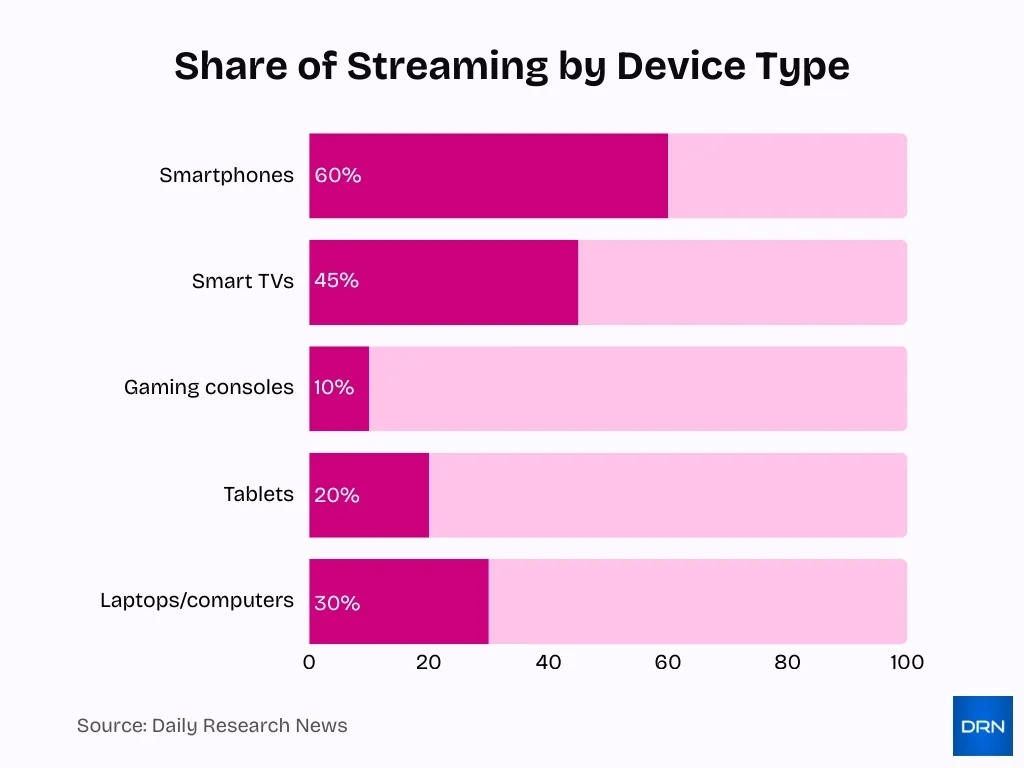
- Smartphones account for over 60% of global streaming device usage.
- Smart TVs hold 45% share of worldwide streaming consumption.
- India’s Connected TV audience surged 87% to 129.2 million users.
- Gaming consoles contribute 10% to total streaming device usage globally.
- Roku users averaged 253.7 minutes of daily streaming in 2024.
- Tablets make up 20% of streaming device usage worldwide.
- Laptops/computers represent 30% of users’ streaming preferences.
Time Spent on Streaming Content
- Total streaming hours climbed to 13.9 billion hours in 2025, a year-over-year rise of about 6%.
- The average U.S. household watches content from approximately 6.9 streaming services, reflecting diverse content preferences.
- Daily time spent streaming in the U.S. is around 4.5 to 5 hours, edging closer to or surpassing traditional TV time.
- Ad-supported streaming hours grew 43% year-over-year among major platforms, underscoring demand for free or lower-cost options.
- Connected TV devices account for a significant portion of viewing minutes, especially during prime time.
- Short-form and micro-content formats are contributing a growing slice of overall streaming time.
- Live events and sports streams also add measurable viewing hours beyond on-demand libraries.
- Time spent on streaming reflects broader shifts toward personalized and on-demand consumption preferences.
Subscription Video on Demand (SVOD) Statistics
- SVOD accounts for 46.12% of the global OTT market revenue in 2025.
- Netflix leads with 325 million global subscribers by the end of 2025.
- Ad-supported tiers comprise 46% of SVOD subscriptions on dual-option platforms in 2025.
- Netflix reached 190 million monthly active users in 2025.
- US SVOD subscriptions total nearly 339 million in mid-2025.
- 58% of SVOD subscribers bundle services, averaging 2.8 per bundle in 2025.
- US SVOD net churn rate stands at 3.5% monthly in late 2024.
- 39% of consumers canceled at least one SVOD service in the last six months of 2025.
- North America holds 40% of the global SVOD market share.
Advertising-Based and Free Streaming (AVOD/FAST) Statistics
- Netflix’s ad-supported tier generated $1.5 billion in ad revenue in 2025, projected to double to $3 billion in 2026.
- FAST viewership in the US will surpass 125 million in 2026, representing over 62% of AVOD viewers.
- Total hours watched on major AVOD/FAST services grew by 43% year-over-year in 2025.
- Netflix ad-tier accounts for 45% of total household viewing hours, up from 34% last year.
- 64% of US streaming households currently watch FAST content.
- Global AVOD market projected to reach $218 billion by 2033, from $54 billion in 2025.
- US FAST viewership expected to grow 21% in 2026, reaching 120 million annual viewers.
- The FAST channels market is valued at $11.08 billion in 2025, with 8.74% CAGR to 2033.
- 40% of Netflix active accounts use the ad-supported tier in 2025.
- CTV streaming reached 96.4 million US households in 2025, with 13.9 billion viewing hours.
Live Streaming Market Growth and Forecast Insights
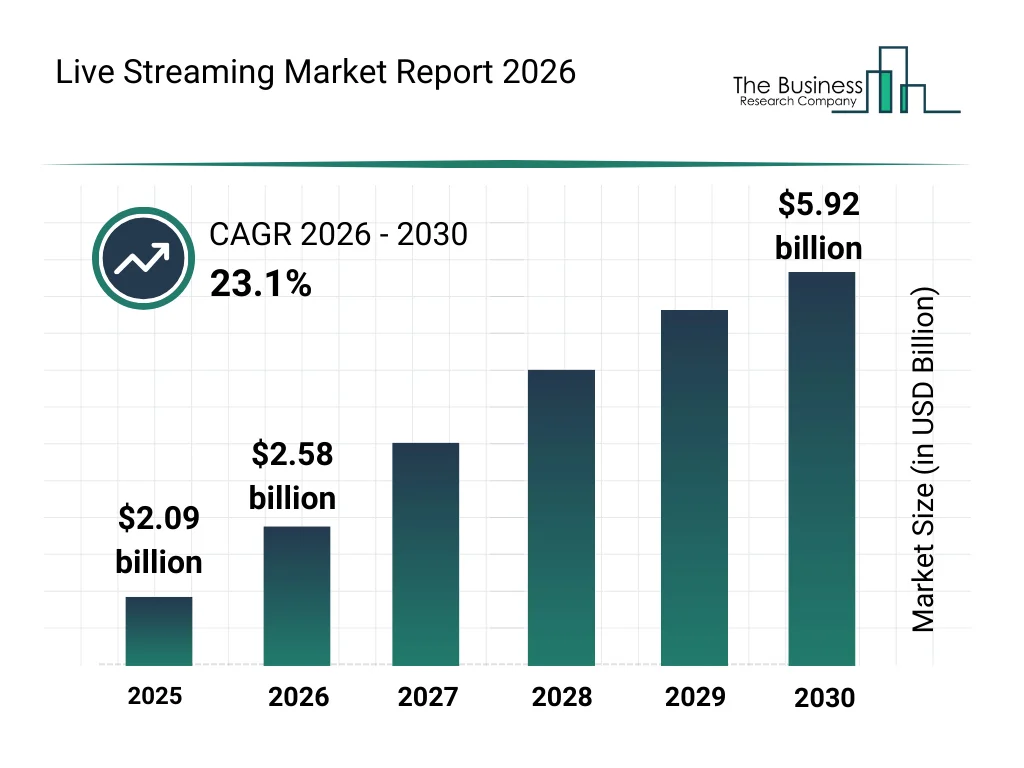
- The global live streaming market was valued at $2.09 billion in 2025, highlighting its strong foundational growth phase.
- Market size increased to $2.58 billion in 2026, driven by rising demand for real-time digital content across platforms.
- In 2027, the live streaming market is projected to cross $3.2 billion, reflecting accelerating adoption by creators and enterprises.
- The market is expected to reach approximately $4.0 billion in 2028, supported by growth in gaming, events, and e-commerce live streaming.
- By 2029, live streaming revenue is forecast to climb to around $4.9 billion, fueled by expanding advertising and monetization models.
- The market is projected to achieve $5.92 billion by 2030, underscoring its rapid expansion.
- Overall, the live streaming market is set to grow at a strong 23.1% CAGR between 2026 and 2030, indicating sustained long-term momentum.
Music Streaming Statistics
- The global music streaming market is estimated at approximately $49.1 billion in 2026, with projections to grow to $176.8 billion by 2033.
- On-demand music streaming accounts for the largest share (about 53.6%) of music streaming services in 2026.
- North America is the dominant music streaming region, representing around 48.2% of the global market in 2026.
- Hybrid and ad-supported music tiers help broaden audience access while driving incremental advertising revenue.
- Major platforms like Spotify, Apple Music, Amazon Music, and YouTube Music continue to compete for subscribers and exclusive content.
- Personalized playlists and algorithmic recommendations fuel daily active user engagement across services.
- Music streaming is increasingly bundled with video platforms and mobile carriers to boost uptake.
- Emerging markets like Latin America and Southeast Asia show some of the fastest growth rates in music streaming adoption.
Top Music Streaming Platforms by Subscriber Share
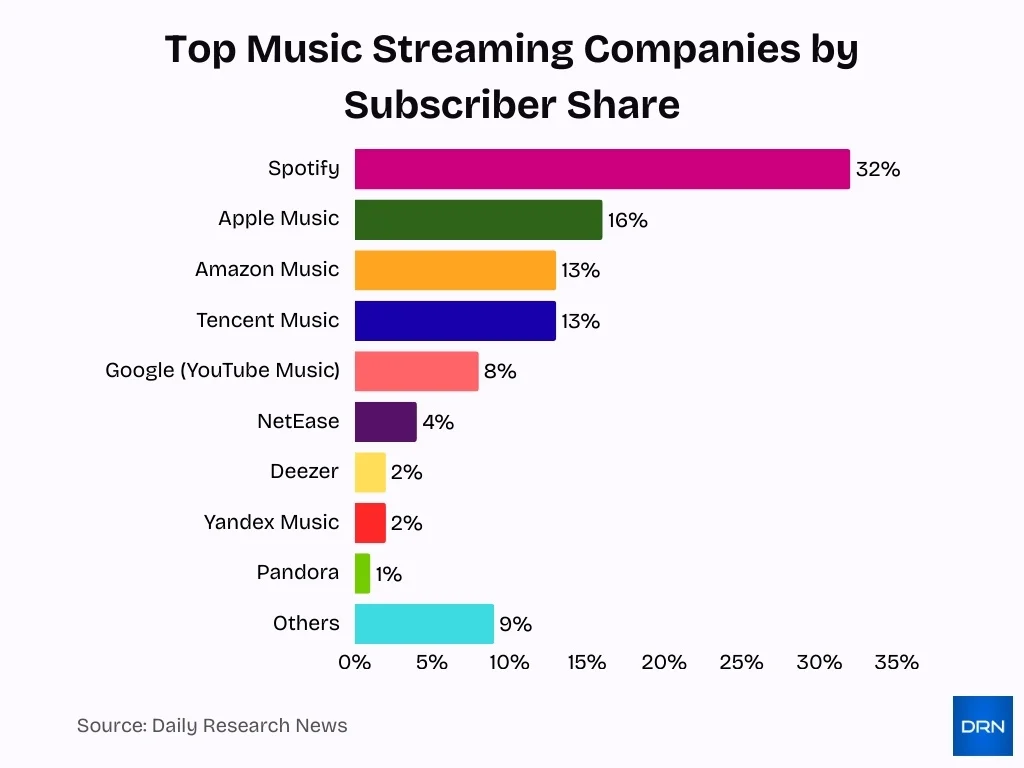
- Spotify leads the global music streaming market with a 32% subscriber share, reinforcing its position as the industry leader.
- Apple Music ranks second, capturing 16% of total subscribers, which is half of Spotify’s market share.
- Amazon Music and Tencent Music are tied for third place, each holding a 13% subscriber share worldwide.
- Google’s music streaming services account for 8% of subscribers, showing steady global adoption.
- NetEase secures a 4% market share, driven largely by its strong presence in China.
- Deezer and Yandex Music each hold 2% of global subscribers, reflecting limited but stable user bases.
- Pandora records the smallest share at just 1%, highlighting its reduced competitiveness in subscription streaming.
- Other music streaming platforms collectively make up 9% of the market, indicating ongoing fragmentation beyond major players.
Video Game and Esports Streaming Statistics
- The global game streaming market was valued at about $10.85 billion in 2024 and is projected to grow to more than $31 billion by 2033, at a CAGR of about 12.9%.
- Live streaming for gaming remains a core driver of real-time content engagement across platforms like Twitch, YouTube Gaming, and others.
- Esports and competitive gaming events increasingly stream to millions, with peak concurrent audiences continuing to climb year-over-year.
- Platforms focused on supporting creators (e.g., Kick) are expanding monetization options for smaller streamers.
- Gaming streams contribute significantly to total live streaming hours in major markets like the U.S.
- Interactive features like chat and donations fuel engagement and keep viewers tuned in longer.
- Gaming stream viewership continues to influence advertising and sponsorship budgets in digital media.
- Younger audiences show particularly strong engagement with gaming content, often leading overall livestream consumption.
Market Share Distribution Among Top Video Streaming Platforms
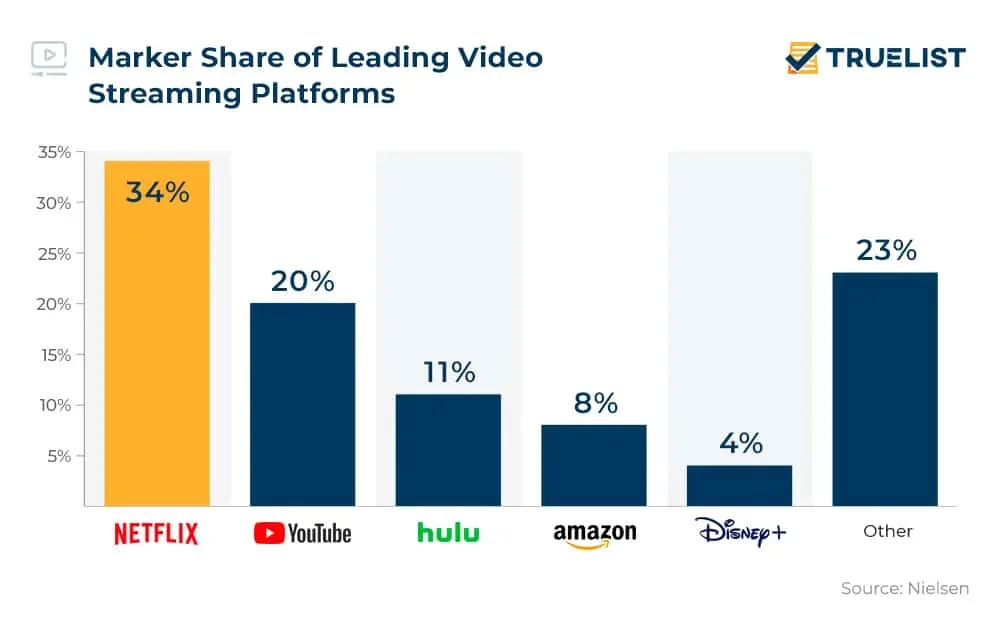
- Netflix dominates the video streaming landscape with a commanding 34% share of the overall streaming market.
- YouTube ranks second with a strong 20% share, underscoring its leadership in ad-supported streaming content.
- Hulu secures 11% of the total market, supported by its hybrid subscription and advertising-based model.
- Amazon Prime Video accounts for 8%, strengthened by seamless integration with Prime memberships.
- Disney+ lags with only 4%, despite its globally recognized and extensive content library.
- Other streaming platforms combined represent a notable 23% share, highlighting ongoing market fragmentation beyond the top five players.
Streaming Content Preferences and Genres
- Entertainment and movies claim the largest share at 46% of total streaming consumption in 2025.
- Sports streaming grows at 8.3% YoY, with live events driving 47.5% of TV usage.
- Short-form video boasts 90% higher completion rates than long-form content weekly.
- Music streaming on mobile hits $25.1 billion market, growing 13.1% CAGR to 2032.
- Gaming and esports draw 640 million viewers, 56% via mobile platforms.
- Educational and wellness genres expand with 25.4-minute average live sessions.
- Niche genres on Twitch span 46,371 categories, enhancing diversity.
- Genre mixing boosts session lengths by blending live and on-demand formats.
User Demographics and Audience Segmentation
- 87% of viewers aged 18–24 access TV content through the internet, compared with 70% of those aged 35 and older, highlighting younger cohorts’ heavier streaming reliance.
- Millennials account for 62M connected TV users in the U.S. and Gen Z for 52.8M, versus 51.6M Gen X and 35.8M Boomers, confirming youth-led streaming growth.
- Diverse, multicultural homes now represent 40%+ of Wi‑Fi CTV households in the U.S., making them a key driver of overall streaming expansion.
- Over 70% of OTT content consumption globally is on smartphones, underscoring mobile‑first behavior among younger and emerging‑market audiences.
- Black households report 86% SVOD subscription penetration versus 81% for the total market, and 80% use free OTT services versus 70% overall, clearly over‑indexing in streaming usage.
- Virtual MVPD subscriptions reach 34% of Black consumers compared with 23% of the total market, reinforcing their higher adoption of vMVPD offerings.
- The share of Black viewers relying solely on streaming jumped from 5% in 2015 to 47% in 2025, while exclusive MVPD reliance fell from 44% to 5%, illustrating a dramatic shift toward OTT.
- The typical Gen Z streamer now uses 6+ streaming services, up from 5 in 2020, reflecting broader platform stacking and experimentation among younger audiences.
- 83% of U.S. households used at least one paid SVOD service in 2023, confirming mainstream adoption across families and older demographics for on‑demand viewing.
- Among global internet users, about 50% use a free or paid ad‑supported streaming service, signaling broad uptake of AVOD alongside traditional SVOD models.
Frequently Asked Questions (FAQs)
The global video streaming market was valued at $811.37 billion in 2025.
The video streaming market is projected to grow at a CAGR of about 12.3% from 2026 to 2036.
Streaming accounted for 44.8% of total TV viewership in the U.S. in May 2025.
Netflix’s ad‑supported tier generated $1.5 billion in advertising revenue in 2025, with expectations to reach about $3 billion in 2026.
Conclusion
Streaming is no longer a niche medium; it’s the central hub for global entertainment, engagement, and advertising. From subscription video-on-demand to fast-growing ad-supported services, platforms are diversifying how they reach viewers and monetize content. Live streaming has expanded beyond gaming into sports, events, and lifestyle broadcasts, pulling in millions of engaged users each week.
Music and game streaming markets are also scaling rapidly, reflecting broader digital consumption patterns and device ubiquity. As audiences continue to fragment across devices, genres, and formats, the streaming landscape will evolve further, shaping how content is created, distributed, and experienced worldwide.