

Video marketing continues to define how brands connect with target audiences. Businesses of all sizes increasingly rely on video content to boost awareness, generate leads, and support sales funnels. Two clear real-world impacts are visible: (1) consumer education, where product explainer videos are used across ecommerce and SaaS sites to shorten learning curves, and (2) social engagement, where short-form videos drive daily interactions on platforms like TikTok and Instagram. These shifts show how video is solving real audience challenges and driving measurable business results. Explore the statistics below to understand how video is shaping marketing strategies today.
Editor’s Choice
- 89% of businesses use video as a marketing tool in 2025.
- 95% of marketers say video is crucial to their overall strategy, up from prior years.
- 93% of marketers report positive ROI from video marketing efforts.
- 87% of marketers say video has increased sales for their business.
- 80–82% of internet traffic is expected to be video by 2025.
- Mobile devices account for 75%+ of video views globally.
- AI tools are used for video production by 51% of marketers.
Recent Developments
- In 2025, 89% of marketers are using video marketing, a slight dip after years of stable growth.
- 95% of marketers consider video essential, up from 88% in 2024.
- AI integration in video workflows continues rising, with 51% already using AI for creation and editing.
- Captioning has surged, with 254% more videos captioned in 2023 vs 2022.
- Only 5% of companies plan to cut video budgets, showing strategic investment resilience.
- Marketers are allocating video spend across channels, with email and website video use growing.
- Short-form and live streaming video investments are rising for 2025.
- Mobile-first video production trends are accelerating due to consumer viewing habits.
Global Video Marketing Overview
- Approximately 89% of businesses worldwide now deploy video as part of their marketing strategy in 2025.
- Video usage peaked at 91% in 2024 before a slight dip to 89% in 2025.
- Across industries, most marketers, 95%, see video as critical.
- Video is expected to account for 80–82% of all internet traffic by 2025.
- Global demand for video remains high, with over 3.5 billion online video viewers worldwide.
- Gen Z and affluent audiences show a strong preference for personalized and interactive video formats.
- Video content plays a central role in digital culture trends across regions.
- Growth in video-on-demand consumption patterns continues globally.
Video Adoption by Companies: Key Trends Over Time
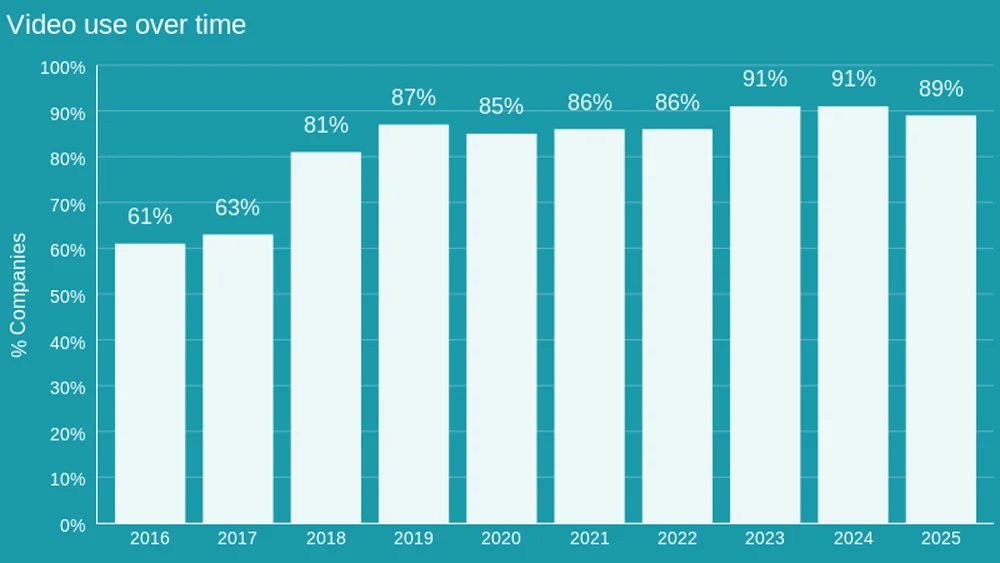
- Strong long-term growth in video usage among companies, rising from 61% in 2016 to 89% in 2025.
- A modest early increase between 2016 (61%) and 2017 (63%), followed by a major jump in 2018 to 81%, signaling wider adoption.
- Rapid acceleration continued in 2019, with video use reaching 87%, confirming video as a mainstream business tool.
- A temporary dip in 2020 to 85%, likely reflecting market disruption, but adoption remained high despite challenges.
- Stabilization period from 2021 to 2022, with consistent usage at 86%, indicating maturity in video adoption.
- Peak adoption levels were recorded in 2023 and 2024, with 91% of companies using video, the highest point in the timeline.
- A slight decline in 2025 to 89%, suggesting market saturation rather than reduced relevance.

Video Content Production and Frequency
- 89% of businesses use video marketing, with 93% planning to maintain or increase spending in 2025.
- 78% of marketers post 2-10 videos monthly, balancing frequency with quality for engagement.
- 36% of businesses create new videos monthly, the most common production frequency among marketers.
- AI tools auto-generate captions in videos, with 254% more businesses captioning in 2023 than prior year.
- 63% of businesses report that AI video tools cut production costs by 58% compared to traditional methods.
- AI editing tools boost team productivity by 47%, speeding up scripts and editing processes.
- 53% of marketers spend $5,000 or less on video projects, prioritizing cost-effective production.
- 93% of marketers report positive ROI from video, linking frequency to lead generation gains.
- 74% share 2-6 videos monthly across channels, driven by AI efficiencies for short-form content.
- Short-form videos under 1 minute achieve 50% engagement rates, outpacing longer formats.
Goals and Objectives of Video Marketing
- 38% of marketers prioritize video for lead generation and sales.
- 88% of video marketers report success in product education and user understanding.
- 96% of marketers achieve brand awareness through video content.
- Short-form videos dominate with 90% of internet traffic projected by 2025.
- 43% of marketers track engagement metrics like likes, shares, and comments.
- 87% of B2B marketers use video for complex tech product explanations.
- Video in marketing funnels boosts conversions by 66%.
- 46% of brands leverage live streaming for real-time interaction objectives.
- 93% of marketers confirm positive ROI from video marketing goals.
Video Marketing ROI and Effectiveness
- 93% of marketers say video marketing delivers a positive ROI.
- Around 90% of marketers report that video offers good ROI.
- 66% measure ROI through engagement metrics such as likes, shares, and comments.
- 62% quantify ROI through video views.
- 49% of marketers track leads and click-throughs as ROI indicators.
- 40% gauge ROI by brand awareness and PR outcomes.
- 36% consider customer engagement and retention when evaluating ROI.
- 30% directly link video marketing to sales, tracking revenue impact.
- Video ROI measurement is diversifying beyond views, with more emphasis on actionable metrics tied to growth.
Video Marketing Distribution: Where Brands Primarily Share Video Content
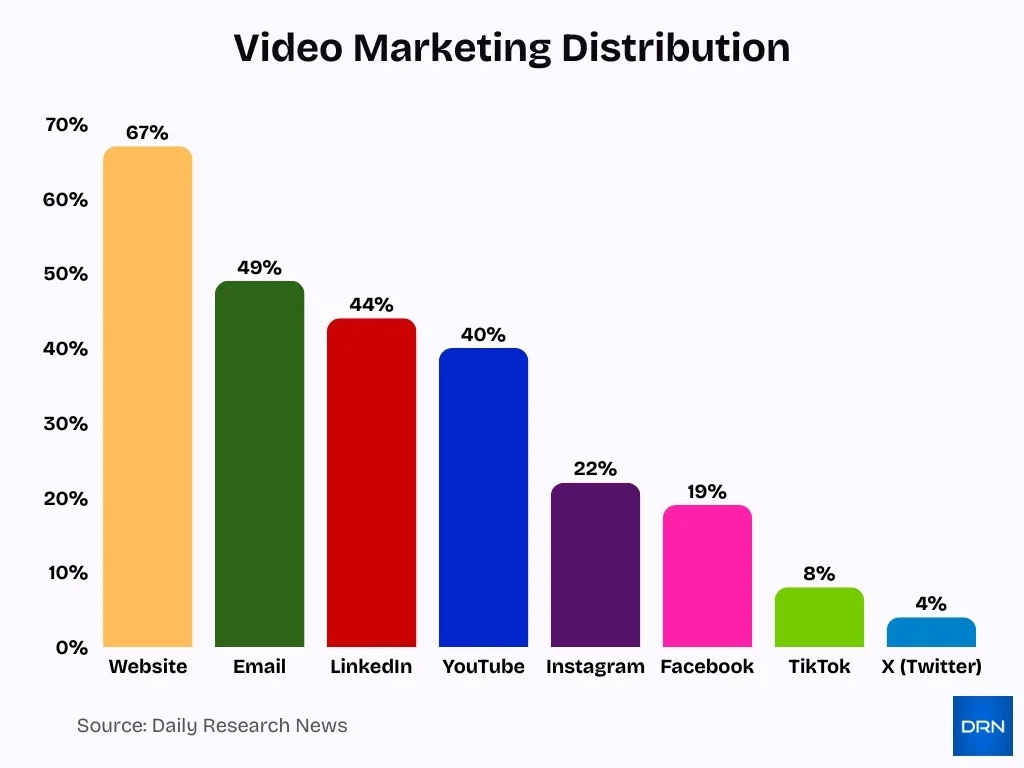
- Websites dominate video distribution, with approximately 67% of businesses embedding or hosting video content directly on their own sites.
- Email marketing is the second most common channel, used by around 49%, highlighting the importance of video in nurture campaigns and customer communication.
- LinkedIn is the leading social platform for video sharing, with about 44%, reflecting its strong role in B2B and professional marketing.
- YouTube remains a core video platform, used by roughly 40%, but is not the top destination for primary video distribution.
- Instagram accounts for around 22%, showing moderate adoption, often for short-form and engagement-driven content.
- Facebook usage is slightly lower at about 19%, indicating a decline compared to owned and professional channels.
- TikTok adoption is still relatively limited, with only 8% using it as a primary video distribution channel.
- X (formerly Twitter) is the least used platform, at approximately 4%, suggesting minimal reliance for video marketing efforts.
Impact of Video on Sales and Revenue
- 88% of marketers say video helps generate leads, feeding the top of the sales funnel.
- 87% report direct sales increases due to video content efforts.
- Brands using sponsored videos on ecommerce platforms saw 21% sales growth after deployment.
- In B2B contexts, video content contributes to an average 38% increase in lead generation.
- 70% of B2B buyers say video helped them decide faster.
- Video-driven landing page conversions are 34% higher than text-only pages.
- B2B videos with strong CTAs show 42% higher conversion rates.
- Product videos deliver high ROI, outperforming other formats for many marketers.
- Integrating video into sales touchpoints can shorten cycles by 23% on average.
Video and Lead Generation
- 87% of marketers credit video with boosting lead generation.
- B2B video use correlates with 27% higher MQL rates.
- Videos on landing pages can increase conversions by 34%.
- 88% say videos improve user understanding, increasing CTA effectiveness.
- Explainer and product videos are especially effective in ushering leads toward conversions.
- Videos shared on company websites boost form fills and inquiries.
- 62% say video helped reduce support queries, indirectly supporting lead nurturing.
- Marketers frequently connect video CTAs directly to landing pages to maximize leads.
Video and Website Performance
- 82% of marketers say video boosts dwell time on websites.
- 84% of video marketers report longer visitor time on sites with videos.
- Pages with videos show an 11% lower bounce rate than those without.
- 34% lower bounce rates occur on pages featuring video content.
- 80–82% of marketers note that videos drive increased web traffic.
- Websites with videos rank 53 times higher in Google search results.
- 62% of video marketers see reduced support queries via videos.
- Embedding videos in blogs doubles overall conversion rates.
Essential Social Media Video Marketing Statistics You Should Know
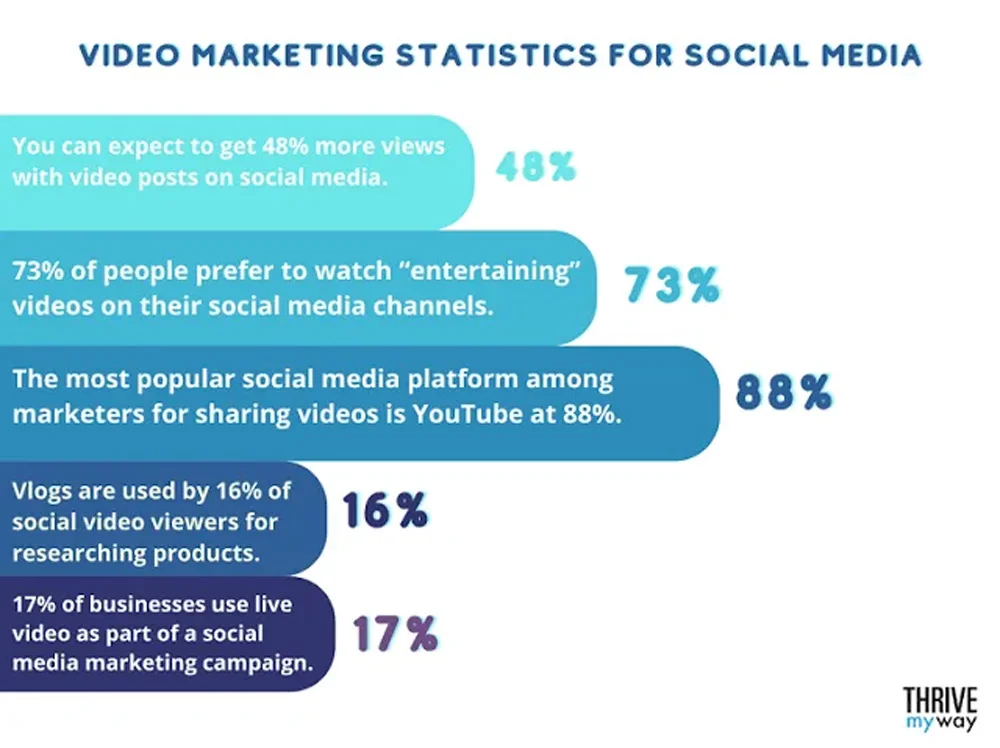
- Video posts shared on social media platforms can generate 48% more views, which makes them a highly effective tool for boosting audience engagement.
- 73% of users state that they prefer watching entertaining videos on their social channels, strongly emphasizing the importance of creating fun and engaging content.
- YouTube continues to dominate as the leading platform for marketers, with 88% selecting it as their preferred channel for sharing video content.
- 16% of viewers depend on vlogs for product research, clearly demonstrating their role in influencing purchasing decisions.
- 17% of businesses actively integrate live video into their social media marketing campaigns, highlighting its growing adoption and strategic value.
Audience Engagement with Video
- Engagement metrics like likes, comments, shares, and completion rate are among the top 3–5 KPIs brands track for video performance across social platforms.
- Short-form videos under 1 minute can reach around 50% average engagement rates, making them one of the most engaging content types for social feeds.
- Viewers typically watch about 82% of how‑to videos under 60 seconds, but only just over 50% of videos between 1 and 30 minutes, showing a clear drop‑off with length.
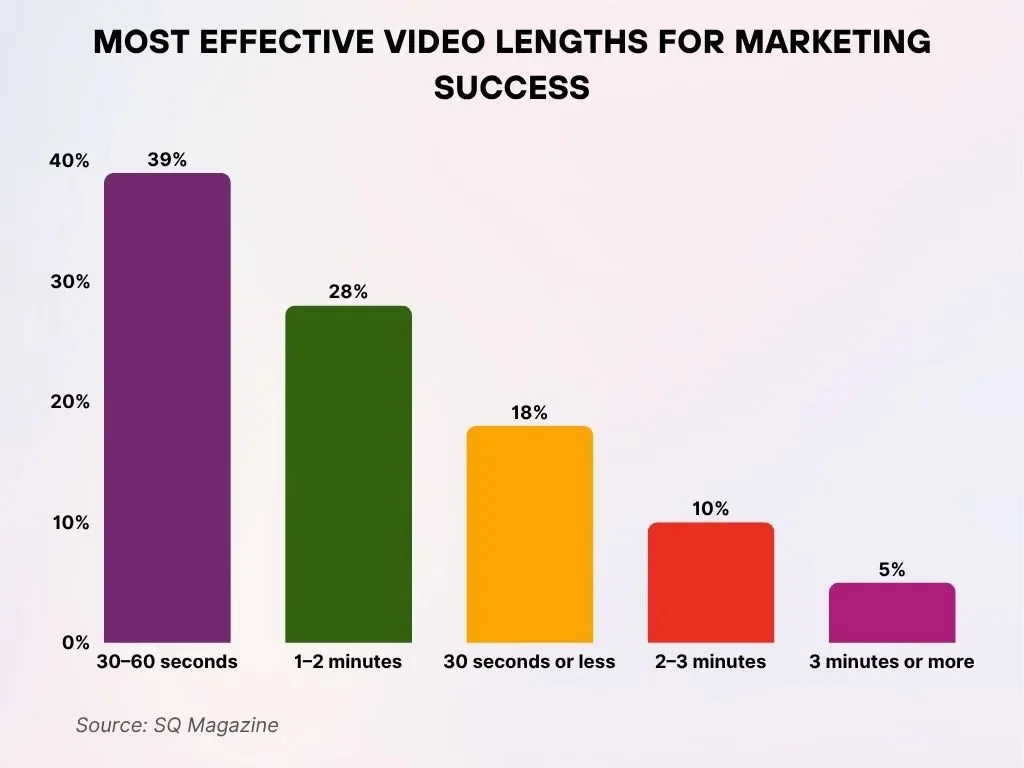
- Around 39% of marketers say the most effective video length is 30–60 seconds, while only 28% favor 1–2 minutes, confirming lower engagement for longer formats.
- Roughly 90%+ of marketers report that video has improved brand awareness and engagement, with most planning to maintain or increase video investment.
- Viewers retain about 95% of a message when they watch it in a video compared with about 10% when reading text, highlighting video’s stronger information retention.
- Interactive videos can drive about 300% higher engagement and up to 44% longer viewing time than standard, non‑interactive video content.
- Personalized interactive CTAs in video have been shown to increase conversion rates by about 202%, turning engagement into measurable actions.
- Decision‑tree style interactive paths in video can boost viewer retention by around 30%, encouraging repeat interactions and deeper engagement.
Consumer Preferences for Video
- 78% of users prefer short videos for learning about products and services.
- 51% of consumers rely on product videos to make purchase decisions.
- 66% of consumers report a better understanding after watching a video.
- 87% of consumers will watch a video before buying.
- Video quality influences trust for 91% of consumers.
- Instructional and demo videos rank highest for decision support.
- Consumers increasingly expect video across websites and social channels.
Most Impactful Video Durations for Marketing Performance
- 39% of marketers state that videos lasting 30–60 seconds are the most effective for grabbing attention and delivering value quickly without losing audience focus.
- 28% of marketers favor videos between 1–2 minutes, as they provide more space for storytelling while still maintaining strong viewer engagement.
- 18% believe that short videos under 30 seconds remain highly impactful, particularly for mobile audiences and quick product teaser content.
- 10% of marketers consider 2–3 minute videos to be effective, especially when used for explainer videos or testimonial-based content.
- Only 5% report that videos lasting 3 minutes or more are the most effective, emphasizing a clear shift toward shorter, easily digestible content.
YouTube Marketing Statistics
- Users watch over 1 billion hours of YouTube videos daily.
- YouTube Shorts receives over 70 billion views per day.
- YouTube Shorts average 5.91% engagement rates.
- Around 2 billion people use YouTube Shorts monthly.
- YouTube is part of the strategy for 90% of video marketers.
- Long-form YouTube videos continue to dominate total watch time.
- Daily YouTube watch time averages 19 minutes per user.
- Marketers combine long-form YouTube and Shorts for layered strategies.
TikTok and Emerging Video Platforms
- TikTok generated an estimated $23 billion in revenue in 2024.
- The platform has 1.6 billion monthly active users.
- TikTok’s algorithm drives deep daily engagement.
- Emerging platforms experiment with vertical mini-dramas and episodic formats.
- Social video platforms account for 20% of total TV viewing time.
- TikTok remains a priority channel for reaching Gen Z audiences.
- Instagram and Facebook Reels show steady growth but lower engagement than TikTok.
- Short-form platforms align strongly with mobile-first viewing and ad growth.
Key Obstacles Businesses Face in Developing Video Content
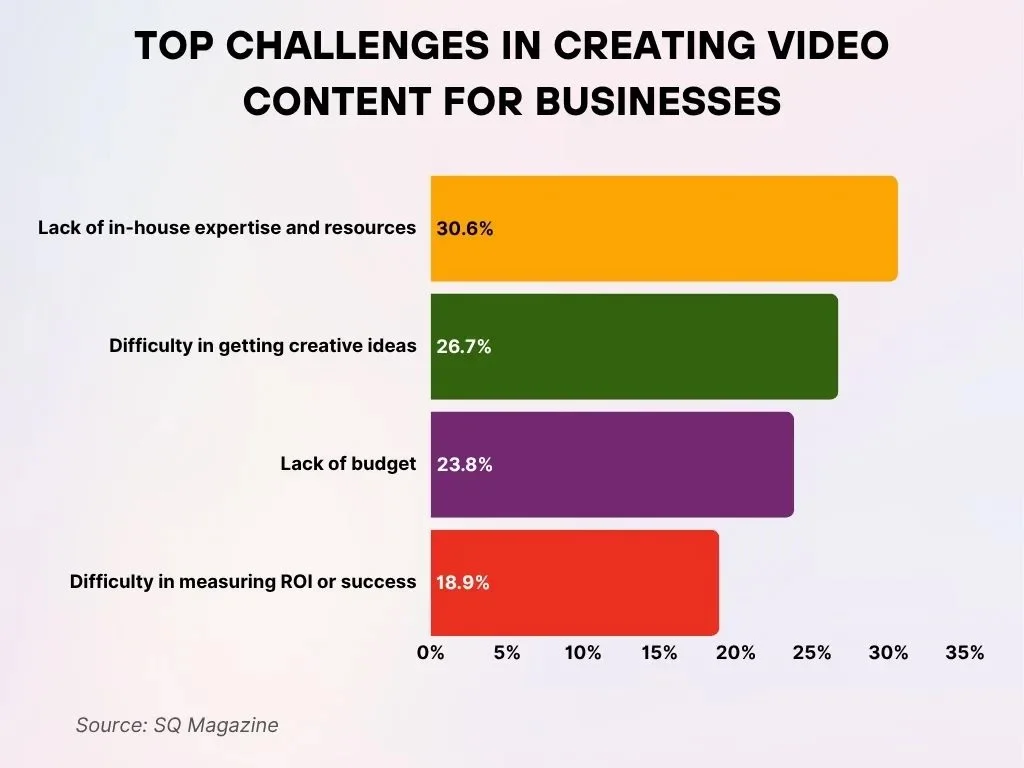
- 30.6% of marketers state that their largest challenge is the lack of in-house expertise and resources, which continues to make video production a significant operational gap for businesses.
- 26.7% of professionals struggle with generating creative ideas, underscoring a strong need for more strategic, innovative, and inspired content planning approaches.
- 23.8% encounter budget limitations, clearly indicating that financial constraints still play a major role in restricting effective video marketing efforts.
- 18.9% report difficulty in measuring ROI or overall success, emphasizing that analytics, performance tracking, and measurement frameworks remain critical weak points.
Mobile Video Consumption
- Video is expected to account for 80–82% of all internet traffic by 2025, largely via mobile.
- More than 75% of video consumption occurs on mobile devices.
- The average user spends multiple hours per day watching mobile video.
- Short-form video represents 75–80% of global mobile data consumption.
- Mobile video ad spend is projected to reach $402 billion in 2025.
- TikTok users spend 1.5+ hours daily on the app.
- YouTube exceeds 2.6 billion monthly users, many watching on mobile.
- Mobile-first design and vertical formats improve retention and engagement.
Live Streaming and Webinars
- 75% of viewers engage more with interactive live streams featuring polls and gamification.
- 73% of B2B marketers rank webinars as top for high-quality lead generation.
- Shorter videos under 1 minute achieve 62% viewer retention rates.
- Live video boosts session duration with viewers spending 3x longer than on pre-recorded content.
- Twitch captured 4.64 billion hours watched in Q2 2025, leading gaming streams.
- YouTube Live draws 8.12 billion hours of views quarterly across categories.
- Webinar attendees convert to customers at 5–20% rates, outperforming other channels.
- Live streams generate 10x more comments than regular videos on platforms like Facebook.
- Hybrid strategies see 47% of webinar views from on-demand replays.
Frequently Asked Questions (FAQs)
Around 89% of businesses use video as a marketing tool in 2025, according to Wyzowl’s latest State of Video Marketing report.
80–82% of all internet traffic is projected to be video content by 2025, highlighting video’s dominance in online consumption.
93% of marketers say video marketing delivers a positive return on investment in their campaigns in 2025.
96% of video marketers report that video has helped increase brand awareness in their marketing efforts in 2025.
Conclusion
Video marketing continues to expand, with short-form formats driving engagement and conversion while long-form content maintains deep watch time and educational value. Platforms like YouTube, TikTok, and Instagram Reels remain essential channels for marketers seeking reach and measurable ROI. Mobile consumption dominates, fueling advertising growth and audience interaction across devices. Live streaming and webinars further extend video’s impact through immersive, real-time experiences.
Together, these trends confirm that video is not just a tactic, but a core pillar of modern marketing strategy.