

Web design remains a cornerstone of digital success, driving brand credibility, user engagement, and conversion performance. As businesses increasingly prioritize online presence, design quality has become as strategic as marketing or product value. For example, retailers are investing more in UX to reduce bounce rates and increase mobile sales, while service providers rework sites to support remote customer interactions. Across industries from eCommerce to SaaS, effective web design now directly affects customer trust, retention, and revenue growth. Explore the trends, growth, and workforce insights shaping web design.
Editor’s Choice
- Web design services industry revenue in 2025 is ~$61.23 billion, reflecting steady market demand.
- The web development market is projected to grow from $74.69 billion in 2025 to over $104 billion by 2030 at a roughly 6.9% CAGR.
- Over 252,000 new websites are created daily, highlighting rapid digital expansion.
- 72% of businesses have a website in 2025, showing increased adoption compared with prior years.
- Mobile devices generate roughly 60–64% of global web traffic, reinforcing mobile-first priorities.
- Responsive design is implemented on roughly 90% of websites, making it a standard practice.
- 75% of website credibility judgments are based on visual design, underlining its business impact.
Recent Developments
- The web design and development sector continues to record around 9% annual job growth globally.
- AI-powered tools are increasingly used by designers to streamline workflows and asset creation.
- No-code and low-code platforms are reshaping how websites are built and updated.
- Businesses are investing more heavily in UX research and personalization initiatives.
- WordPress continues to dominate, powering about 43–44% of all websites worldwide.
- Tools focused on speed, accessibility, and responsive layouts are gaining traction.
- Motion design, expressive typography, and AI-assisted visuals are emerging as common trends.
Web Design Industry Size and Growth Statistics
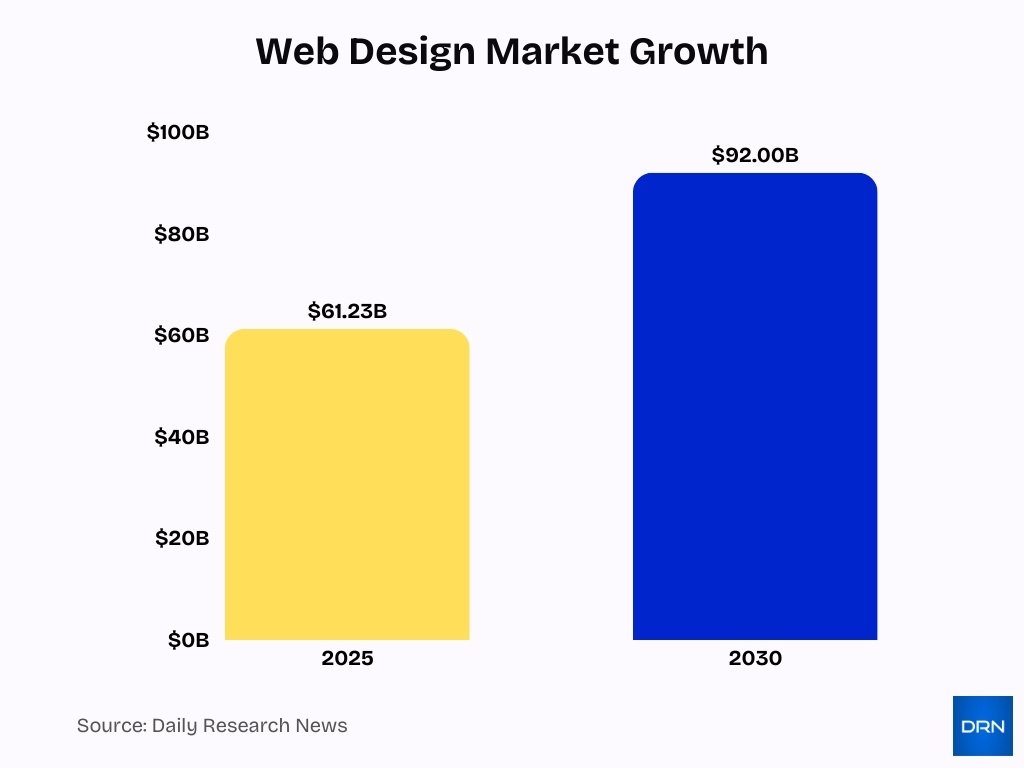
- The global web design market is valued at approximately $61.23 billion in 2025.
- The market is projected to reach nearly $92 billion by 2030, reflecting strong CAGR growth.
- US web design services generated around $43.5 billion in revenue in 2024, with continued growth expected.
- Some forecasts place the global market above $55–$60 billion in 2025, depending on methodology.
- The broader web development market is estimated at $74.69 billion in 2025.
- Alternative estimates value the web development services market at over $80 billion in 2025.
- Persistent growth reflects sustained demand across eCommerce, SaaS, and service industries.
- North America holds the largest share of global web design revenue.
Global Website and Internet Usage Statistics
- Approximately 252,000 new websites launch each day, signaling continued digital acceleration.
- Mobile devices account for roughly 60–64% of global web traffic.
- More than 60% of total web traffic in 2024 came from mobile devices.
- WordPress powers roughly 43–44% of all websites worldwide.
- Global internet usage continues to rise as billions of users engage online daily.
- Website launch rates reflect widespread digital adoption across sectors.
- Businesses increasingly shift services online, influencing usage and engagement patterns.
- User expectations for fast, responsive websites continue to shape browsing behavior.

Web Designers and Developers Workforce Statistics
- Employment of web developers and digital designers is projected to grow 7% from 2024 to 2034, much faster than average.
- About 14,500 job openings for web developers and digital designers are projected annually through 2034.
- The number of web developers and designers in the US is expected to exceed 229,000 by 2032.
- Web developers’ employment is projected to grow 9% from 2023 to 2033, with 8,500 new jobs.
- Nearly 36% of web designers use AI tools daily in their workflows.
- 93% of web designers incorporated AI tools into workflows in the past three months.
- Freelancers comprise 28% of US skilled knowledge workers, including web developers.
- Over 20,791freelance web designers are currently employed in the United States.
- California leads with 25,370web and digital interface designers in recent data.
- The Southeast US shows the strongest web design demand due to population and business growth.
Business Adoption of Professional Web Design
- Approximately 73% of small US businesses maintain an online presence in 2025.
- 75% of users judge a company’s credibility based on its web design.
- 62% of companies reported increased sales after responsive mobile website design.
- Businesses with mobile-optimized sites see 67% higher sales than non-optimized ones.
- Responsive websites deliver up to 25% higher conversion rates.
- 94% of users mistrust websites with poor design quality.
- 80% of US small and medium businesses plan website redesigns by 2025 for better UX.
- 27% of small businesses without websites believe their industry doesn’t require one.
- Professional web design investments correlate with 200-400% conversion rate jumps.
Most Frequent Web Design Errors Committed by Small Businesses
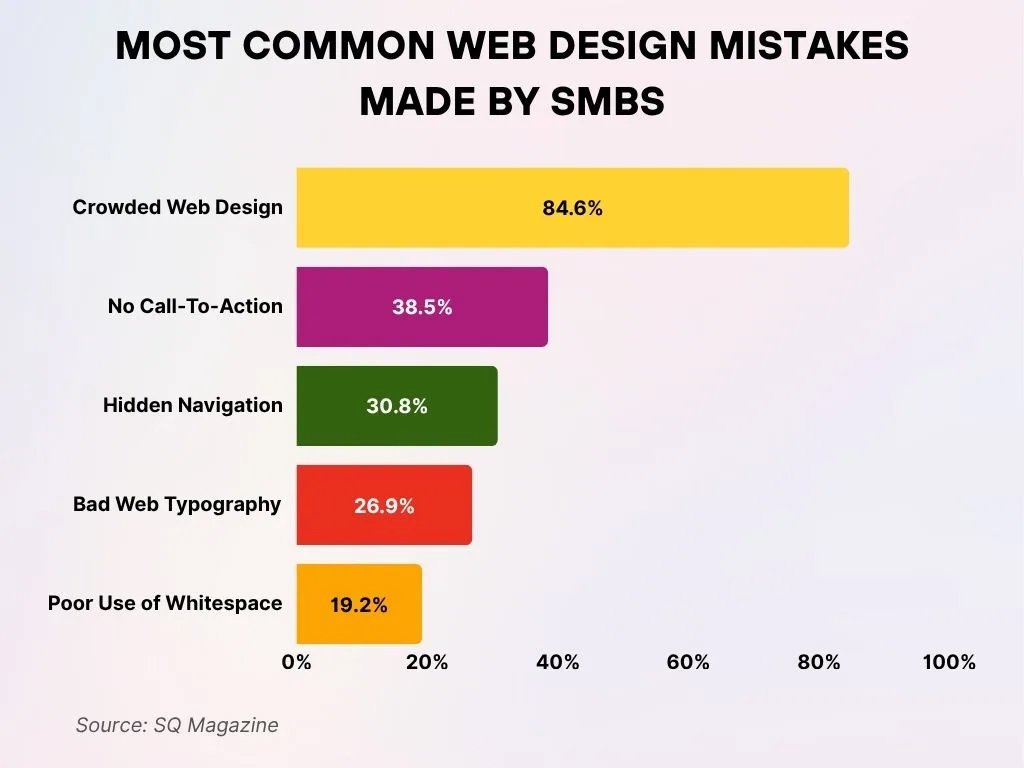
- 84.6% of small businesses make the critical mistake of using crowded web design, which overwhelms users through cluttered layouts and excessive on-page elements.
- 38.5% fail to add a clear call-to-action (CTA) on their websites, directly weakening conversion opportunities and user decision-making.
- 30.8% experience issues with hidden navigation, making it difficult for users to locate important pages and essential site sections.
- 26.9% struggle with poor web typography, negatively impacting readability, visual clarity, and overall user engagement.
- 19.2% face challenges due to the ineffective use of whitespace, resulting in a cramped, cluttered, and confusing visual experience for users.
Website Redesign and Refresh Statistics
- 38% of visitors judge navigation and layout immediately, driving redesign priorities.
- 80.8% of designers cite poor conversion rates as a key reason for redesigns.
- Declining UX scores and high bounce rates trigger about 65% of redesign projects.
- 61.5% of redesigns focus on improving usability and overall user flow.
- 84.6% of professionals identify crowded design as a major usability issue.
- Many businesses refresh their websites every two to three years.
- Mobile UX shortcomings often prompt responsive redesign initiatives.
- AI-enhanced design tools increasingly influence redesign strategies.
Website Usability and User Experience Statistics
- 94% of first impressions are design-related, formed within fractions of a second.
- A poor UX experience can drive away up to 88% of users.
- 53% of visitors abandon sites that load too slowly.
- 79% of users leave websites due to poor usability.
- Websites with strong UX achieve significantly better engagement metrics.
- UX improvements can drive conversion increases of up to 400%.
- Clear visual hierarchy and intuitive CTAs reduce bounce rates.
- Seamless UX strongly correlates with repeat visits and user loyalty.
User First Impressions and Trust in Website Design
- 94% of users form first impressions based on website design.
- 75% of users judge a site’s credibility by its design alone.
- Visitors form opinions in as little as 0.05 seconds.
- 38% of users leave a site if the layout is unattractive.
- Over 70% of users prefer clean and simple website designs.
- 28.5% of visitors assess trustworthiness based on organization and structure.
- Visual design strongly influences purchase decisions.
- Brand consistency across design elements increases user trust.
How Artificial Intelligence Is Transforming Modern Web Design
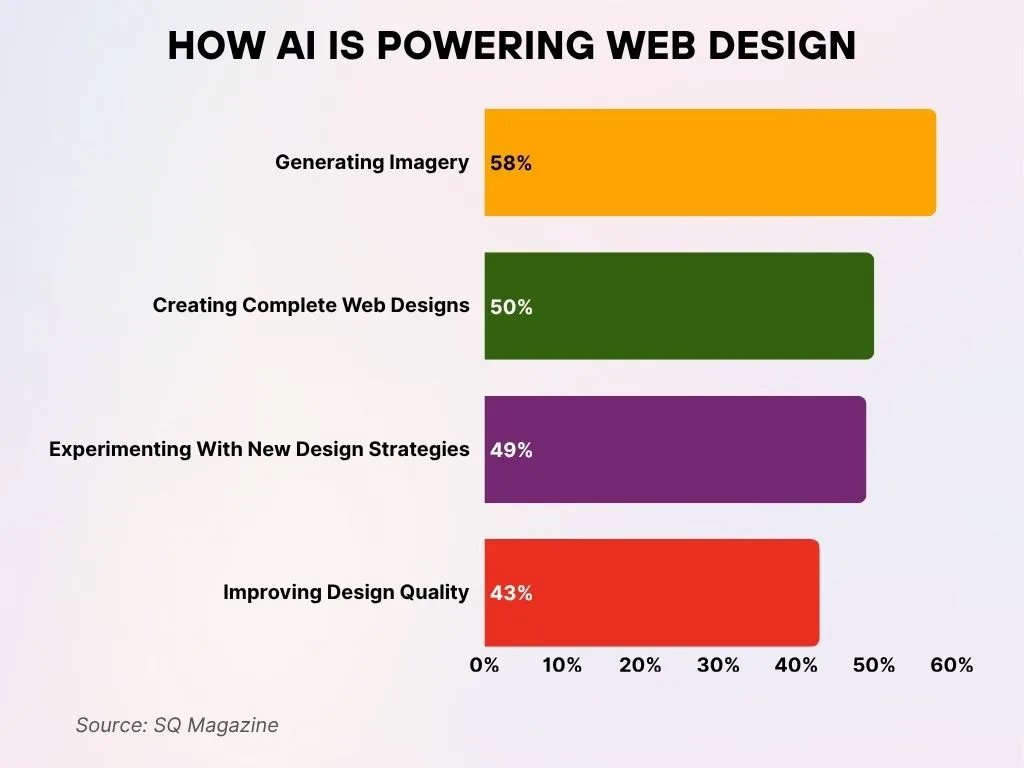
- 58% of web designers actively use AI-powered tools for image generation, making visual creation the most widely adopted AI use case in modern web design workflows.
- 50% of designers depend on AI to build complete web designs, helping streamline workflows, reduce manual effort, and significantly boost overall productivity.
- 49% of professionals leverage AI-driven experimentation to test new design strategies, enabling faster innovation, iterative improvements, and efficient A/B testing.
- 43% of designers apply AI technologies to enhance design quality, improving visual aesthetics, consistency, and the overall user experience (UX).
Website Credibility and Brand Perception Statistics
- 75% of website credibility is tied directly to design quality.
- Poor design causes 38% of visitors to disengage immediately.
- 44% of users leave sites when contact information is hard to find.
- 83% of mobile users expect consistent experiences across devices.
- 50% of consumers view good web design as critical to brand image.
- 60% of users consider usability more important than the product itself online.
- Modern, intuitive design significantly improves brand perception.
- Social proof elements enhance credibility and user confidence.
Navigation and Site Structure Usability Statistics
- 94% of users judge websites based on design, including navigation quality upon arrival.
- Average task completion rate across usability tests stands at 78%.
- 85% of users believe well-structured content enhances brand credibility.
- Users spend 6.44 seconds reviewing main navigation menus on average.
- 61.5% abandon sites are abandoned due to poor navigation.
- 67% of mobile sites show mediocre-to-poor homepage navigation performance.
- 68% of shoppers leave due to poor on-site search experiences.
- 50% of users exit if they can’t navigate easily.
- Confusing layouts frustrate 42% of users.
- 80% task completion is considered good for navigation usability.
Page Speed and Performance Optimization Statistics
- A two-second delay increases bounce rates by over100%.
- 40% of visitors abandon sites taking longer than 3 seconds to load.
- Each 1-second delay reduces user satisfaction by 16%.
- 39% of users lose interest in slow image loading.
- Over 50% of site owners plan to invest in speed optimization.
- Loading times rising from 1 to 3 seconds boost bounce rates by 32%.
- The 1-second delay causes 7% loss in conversions.
- From 2 to 5 second load time, bounce rates climb from 9% to 38%.
- 64% of dissatisfied shoppers avoid slow sites again.
- Each extra second of load time cuts conversions by 4.42%.
How Much Businesses Spend on Web Design Each Year
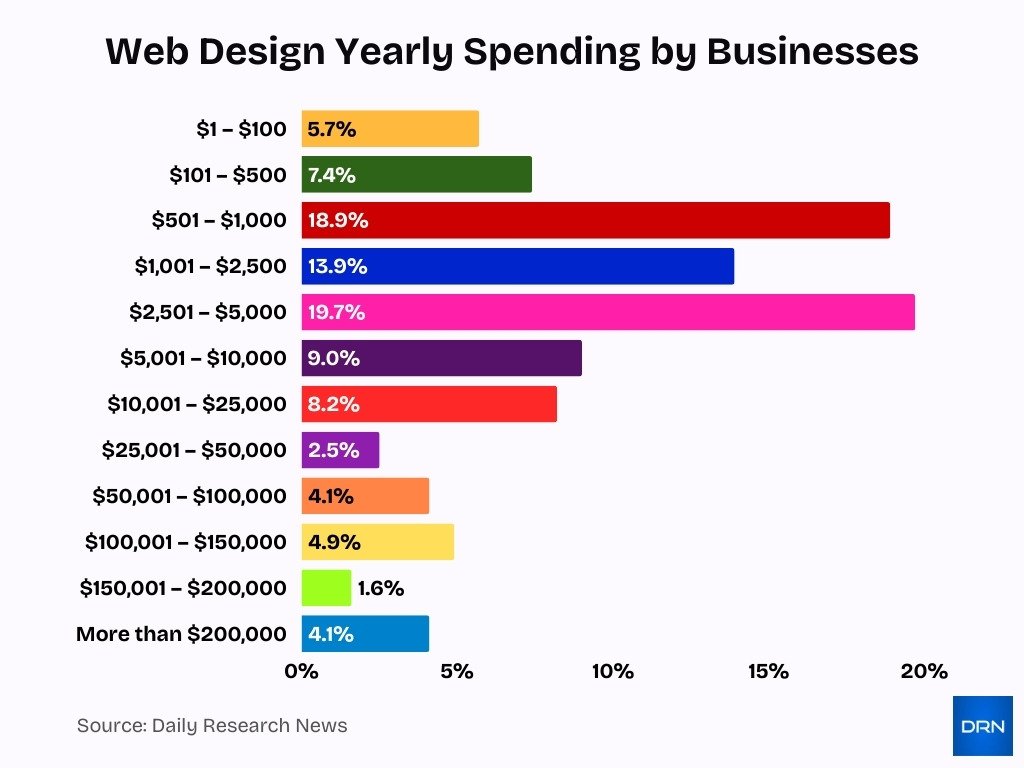
- Nearly one-fifth of businesses (19.7%) spend $2,501–$5,000 annually on web design, making it the most common budget range.
- 18.9% of businesses allocate $501–$1,000 per year to website design, highlighting strong demand for affordable professional services.
- 13.9% of companies invest $1,001–$2,500 annually, reflecting a mid-range approach to maintaining and improving their websites.
- 9.0% of businesses spend $5,001–$10,000, indicating a growing focus on advanced design features and functionality.
- 8.2% of organizations dedicate $10,001–$25,000 per year to web design, often linked to custom development and UX optimization.
- 7.4% of businesses operate on a smaller budget of $101–$500, typically relying on basic templates or minimal updates.
- 5.7% of companies spend just $1–$100 annually, suggesting very limited investment in web design.
- 4.9% of businesses invest $100,001–$150,000, showing a commitment to enterprise-level website development.
- 4.1% of companies spend $50,001–$100,000, while another 4.1% invest more than $200,000, reflecting large-scale digital strategies.
- 2.5% of businesses allocate $25,001–$50,000, positioning themselves between mid-market and enterprise budgets.
- Only 1.6% of organizations spend $150,001–$200,000, making it the least common spending bracket.
Core Web Vitals and Technical UX Statistics
- Core Web Vitals measure loading speed, responsiveness, and visual stability.
- LCP scores under 2.5 seconds are critical for user retention.
- CLS scores below 0.1 indicate strong visual stability.
- INP response times under 200 milliseconds correlate with better interaction quality.
- Improving Core Web Vitals boosts engagement and conversion rates.
- Real-user performance metrics are increasingly prioritized by search engines.
- Ongoing tracking of Core Web Vitals provides actionable UX insights.
- Technical UX improvements also enhance accessibility and mobile usability.
Accessibility and Inclusive Web Design Statistics
- Only 96.3% of the top 1 million homepages fail to comply with ADA accessibility standards.
- The top 1 million websites average 51 accessibility errors per homepage in 2025.
- 88% of 63,000+ analyzed websites lack full compliance with the latest web accessibility standards.
- 79.1% of homepages feature low contrast text, averaging 29.6 instances per page.
- Accessible websites gain 23% more organic traffic and rank for 27% more keywords.
- 73.4% of websites see traffic increases after accessibility improvements, averaging 12%.
- 71% of consumers prefer easy, accessible websites, boosting market demand.
- Inclusive design improves usability for all users by up to 30%.
- 96%+ of homepages have detectable WCAG failures, mainly color contrast issues.
Mobile Web Design and Usage Statistics
- About 60% of global web traffic in 2025 comes from mobile devices.
- Mobile traffic represented approximately 64% of global traffic in late 2024.
- 56.75% of US web traffic originates from mobile devices.
- Desktop usage remains stronger during certain workday hours.
- Mobile eCommerce users generate up to 71% of online sales conversions.
- 57% of users will not recommend a business with a poorly designed mobile site.
- Mobile video consumption continues to grow rapidly.
- Mobile search accounts for over 64% of total searches.
Latest Trends Shaping Modern Web Design
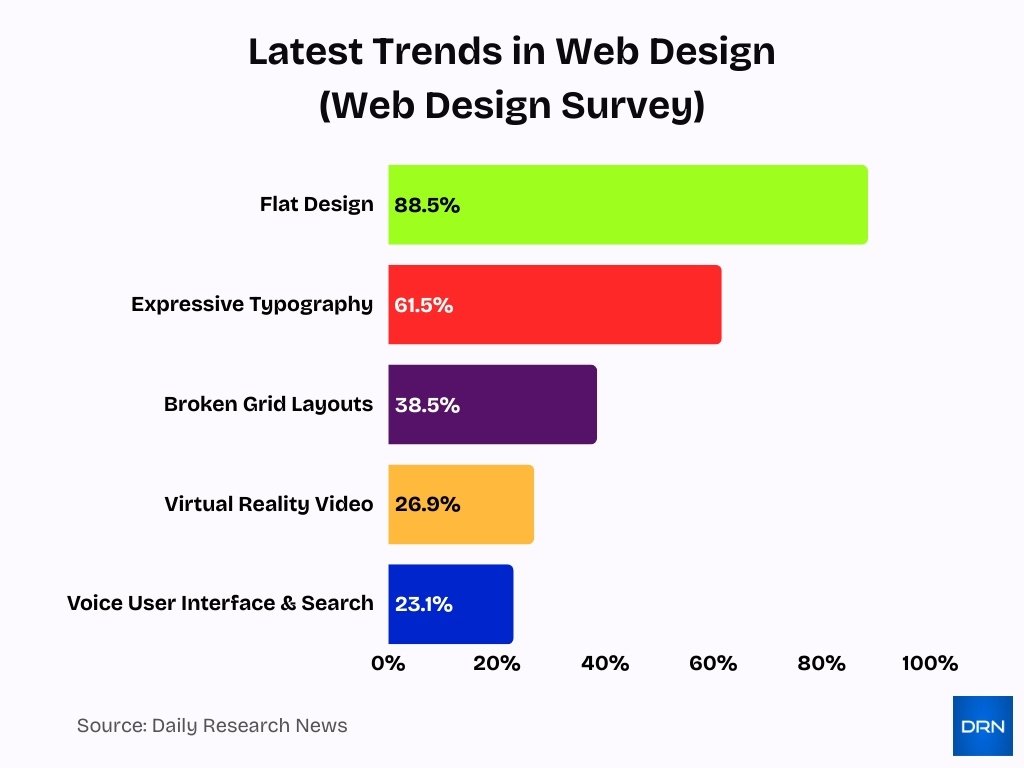
- Flat Design dominates the industry, with 88.5% of designers adopting it due to its clean layouts, simplicity, and improved user experience.
- Expressive Typography is a major visual trend, used by 61.5% of web designers to create a strong brand identity and visual hierarchy.
- Broken Grid Layouts are gaining traction, with 38.5% adoption, allowing designers to create dynamic, unconventional, and creative page structures.
- Virtual Reality (VR) Video is being explored by 26.9% of designers, highlighting growing interest in immersive and interactive web experiences.
- Voice User Interface & Search is used by 23.1% of web designers, reflecting the rising demand for hands-free navigation and voice-driven interactions.
Responsive and Mobile-First Design Adoption Statistics
- Around 90% of websites use responsive design in 2025.
- Responsive websites achieve approximately 11% higher conversion rates.
- 62% of businesses report higher sales after adopting responsive design.
- 73.1% of designers cite non-responsive design as a top reason users leave sites.
- Responsive layouts can increase mobile engagement by up to 15%.
- Poor responsiveness remains a leading trigger for website redesigns.
- Over 70% of users prefer sites optimized for their device.
- Designers increasingly rely on mobile-first workflows and fluid layouts.
Conversion Rate and Revenue Impact of Web Design
- A one-second improvement in load time boosts conversions by 27%.
- Responsive websites achieve 11% higher conversion rates than non-responsive ones.
- UX improvements can increase conversion rates by up to 200%.
- Clear CTAs and optimized navigation lifted conversions by over 3%.
- Interactive design elements raise conversion rates by up to 43%.
- Mobile-optimized checkouts cut cart abandonment from 86% to lower rates.
- 5% better UX boosts customer retention by 42% and profits by 25%.
- Design enhancements with UGC double purchase likelihood by 102%.
- Web design optimizations generate 3x more leads at 62% lower cost.
Key Challenges Encountered by Modern Web Designers
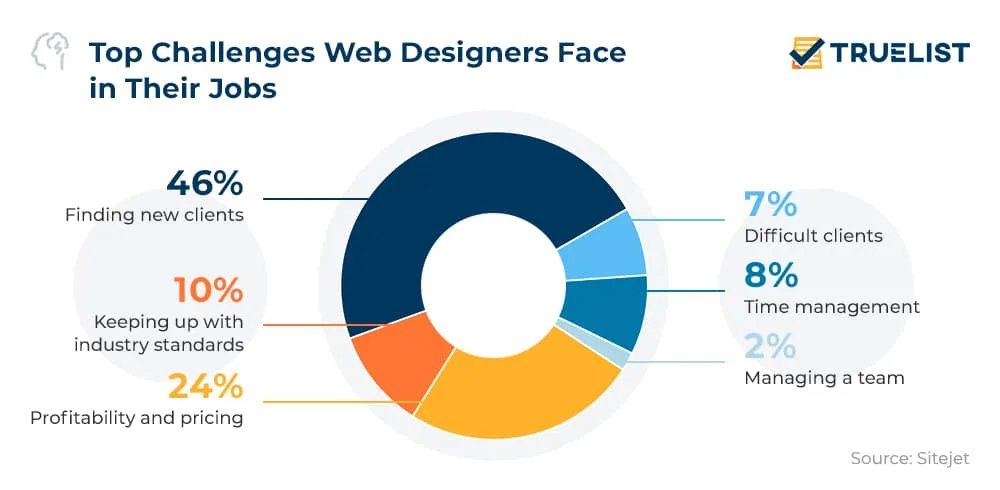
- 46% of web designers report that finding new clients is their biggest obstacle, making it the most widespread challenge in the industry.
- 24% say profitability and pricing pressures are a major concern, directly affecting long-term business sustainability.
- 10% struggle with keeping pace with industry standards, highlighting the rapid evolution of web design trends.
- 8% identify time management as an ongoing workflow challenge that disrupts productivity and deadlines.
- 7% regularly deal with difficult clients, which negatively impacts project satisfaction and timely delivery.
- Only 2% state that managing a team is their primary professional challenge.
Web Design ROI and Business Performance Statistics
- Businesses investing in professional web design report a 400% higher visit-to-lead conversion rate.
- Websites prioritizing UX achieve an ROI of 9,900%, earning $100 per $1 spent.
- Responsive sites deliver 11% higher conversion rates than non-responsive designs.
- Modern websites reduce bounce rates by up to 32% when load times stay under 3 seconds.
- UX improvements boost conversions by 83% with just 10% of the budget allocated.
- Professional redesigns cut long-term costs while increasing revenue by an average 25%.
- Web design upgrades enhance organic visibility, with top sites gaining 27.6% CTR in the first position.
- Performance gains drive revenue, as 1-second delays cause 7% conversion drops.
Future Web Design Trends and Forecasts
- AI-powered design tools market hits $6.77B in 2025, surging to $15.06B by 2029 at 22.1% CAGR.
- 81.9% of Android users embrace dark mode across phones and apps.
- The top 1M websites average 51 accessibility errors per homepage in 2025.
- 70% of sites will feature animated transitions for engagement by 2026.
- Progressive Web Apps market reaches $2.53B in 2025, growing at 31.2% CAGR.
- 65% of consumers favor brands offering personalized experiences across channels.
- Designers using systems complete tasks 34% faster, boosting team efficiency.
- Over 70% of websites now use mobile-first indexing for search rankings.
- Motion UI boosts engagement and time-on-page by up to 15%.
- The immersive experiences market is projected at $144.17B by 2025.
Frequently Asked Questions (FAQs)
~90% of all websites globally have implemented responsive design to ensure compatibility across devices.
About 60% of global website traffic is driven by mobile devices in 2025.
Web design influences 94% of users’ first impressions of a website.
Responsive websites show about 11% higher conversion rates than non‑responsive sites.
Conclusion
Web design is no longer an aesthetic afterthought; it is a strategic revenue driver, brand credibility engine, and user experience differentiator. Mobile usage dominates global traffic, responsive design adoption is near universal, and investments in UX and inclusive practices directly impact conversion performance and ROI. As standards evolve with AI tools, accessibility expectations, and mobile-first search behaviors, businesses must remain proactive to stay competitive.
These statistics clearly show why effective web design is essential for sustainable digital growth, and why organizations that invest wisely will continue to outperform their peers in the years ahead.