


The global web continues to grow rapidly, driven by both human interaction and automated activity. Across industries, from ecommerce to media, websites remain the primary conduit for service delivery, customer engagement, and brand visibility. Businesses use websites to capture leads and support ecommerce sales funnels, while publishers rely on web traffic for ad revenue and audience insights, inviting readers to explore how today’s web truly operates.
Editor’s Choice
- 1.2 billion websites exist worldwide in 2025.
- Only 15–17% of websites are active and regularly maintained.
- Around 252,000 new websites are created daily.
- Google.com remains the most visited site globally with roughly 100B monthly visits.
- YouTube attracts 48B monthly visits, maintaining its position as a leading video platform.
- Social platforms such as Facebook and Instagram consistently rank among the top global websites.
- Mobile devices drive the majority of global web traffic today.
Recent Developments
- Global internet traffic increased by 19% in 2025, reflecting higher overall online activity.
- Automated bots now account for a large share of total web traffic, in some cases exceeding human visits.
- AI-powered search experiences have begun reshaping how users discover websites.
- News and content publishers report declines in traditional search traffic due to AI summaries.
- Dominance of top global websites continues despite constant platform innovation.
- Web analytics tools increasingly emphasize consent-driven and privacy-focused tracking.
- Measurement strategies now blend AI insights with traditional engagement metrics.
Total Number of Websites Worldwide
- There are an estimated 1.12 billion websites across the globe.
- The total number of websites has shown significant growth over the past decade, reflecting the continued expansion of the digital economy and online services.
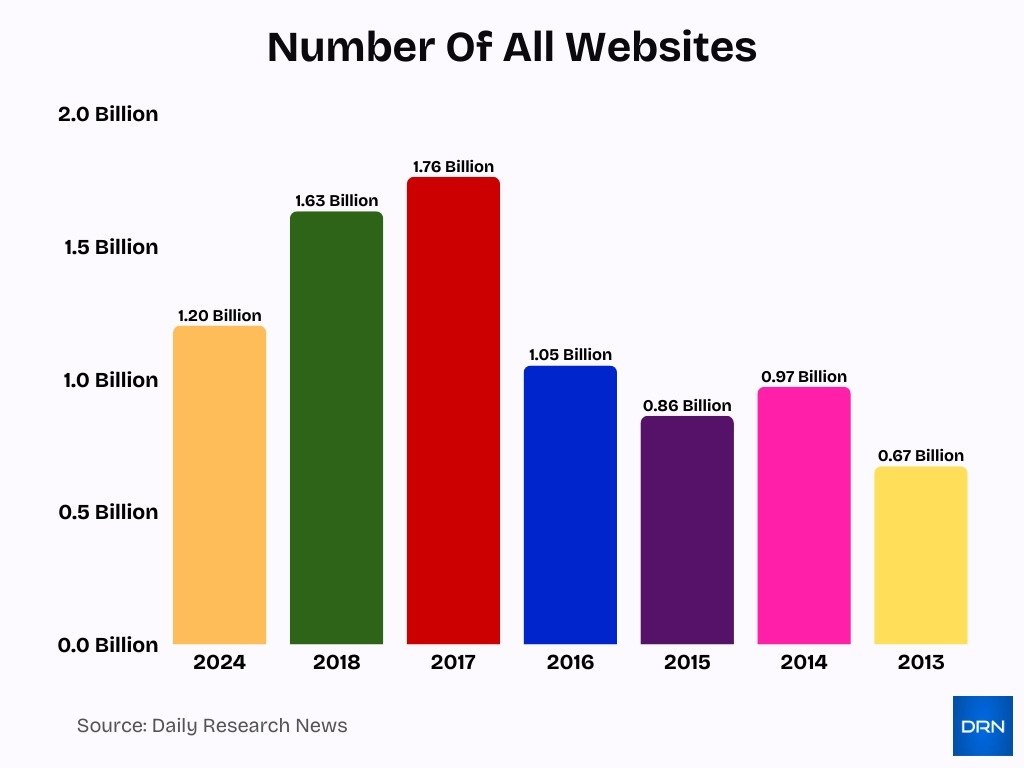
- In 2024, the global web is estimated to host 1.2 billion websites, indicating a rebound after several years of consolidation and decline.
- The peak recorded year in the dataset is 2017, with approximately 1.76 billion websites, highlighting a period of rapid website creation.
- In 2018, the total number decreased slightly to 1.63 billion websites, suggesting the beginning of a market correction driven by inactive or discontinued sites.
- A notable decline occurred in 2016, when the number stood at 1.045 billion websites, followed by a sharper drop to 863.10 million in 2015.
- Earlier years show steady growth, with 672.98 million websites in 2013 rising to 968.88 million in 2014, underscoring accelerating digital adoption during that period.
Active vs Inactive Websites
- Over 1.2 billion websites exist globally, with only 16% actively maintained in 2025.
- Approximately 193–199 million sites, or 17% of 1.1–1.2 billion total websites, remain active.
- 17.5% of 334 million domains, equating to 58.5 million, function as parked domains.
- Over 80% of websites stay inactive, existing as parked domains or broken links.
- Just 0.5% of U.S. websites attract over 10 million monthly visits, highlighting traffic concentration.
- Average websites draw 375,773 unique visitors monthly, though most see far less traffic.
- Around 200 million active sites represent only 17.83% of the 1.1 billion total websites.
- 177,372 new websites launch daily, fueling constant web lifecycle churn.

New Websites Created Daily
- Approximately 250,000 new websites launch every day in 2025.
- This equals nearly 175 new websites per minute.
- Daily launches fuel the continuous expansion of the web ecosystem.
- Niche and micro-sites represent a large share of new creations.
- Startups and small businesses drive a significant portion of daily site growth.
- Website builders and CMS platforms lower barriers to entry.
- Automation and templates accelerate new site deployment.
Most Visited Websites
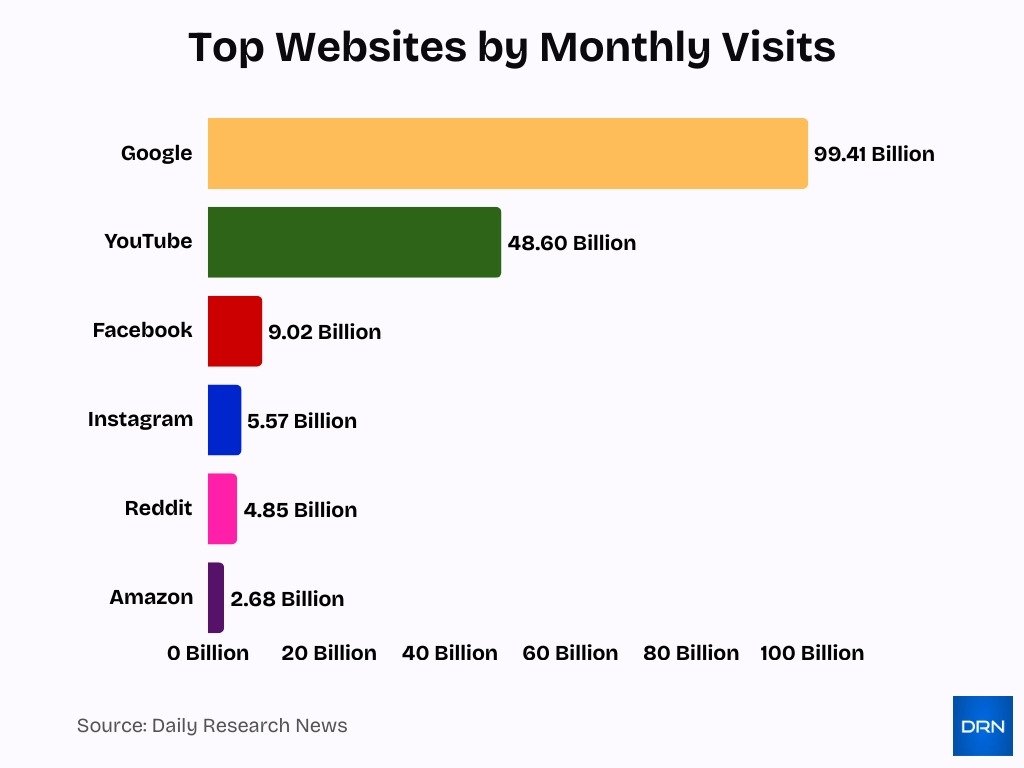
- Google.com attracts 99.41B monthly visits, leading global rankings.
- YouTube.com records 48.6B monthly visits, fueled by video streaming.
- Facebook.com sees 9.02B monthly visits for social networking.
- Instagram.com draws 5.57B monthly visits, strong on mobile devices.
- Reddit.com garners 4.85B monthly visits via community discussions.
- Amazon.com logs 2.68B monthly visits, topping ecommerce traffic.
- Top sites average 6.06 pages per visit, with x.com at 9.29.
- Average bounce rate across leaders stands at 44.11%.
Popular Website Categories
- Search engines command a 89.94% global market share in November 2025.
- Social media reaches 93.8% of worldwide internet users monthly.
- Ecommerce sites draw over 33% of the global population for online shopping.
- Video platforms like YouTube garner 48.6 billion monthly visits worldwide.
- News sites such as AP record 148 million monthly visits with strong growth.
- Reference sites, including Wikipedia, attract 4.42 billion monthly visits globally.
- Messaging apps like WhatsApp sustain 2.56 billion monthly visits daily.
- Community forums like Reddit see 4.85 billion monthly visits consistently.
Website Technology Market Share
- WordPress powers 43.4% of all websites worldwide in 2025.
- Among CMS-based sites, WordPress commands 61.3–64.3% market share.
- Shopify holds 6.2% of the CMS market, second to WordPress.
- Wix captures 5.8% of known CMS websites in 2025.
- Over 10,000 new WordPress sites launch daily on platforms like Hostinger.
- Open-source CMS like WordPress dominates with 63.5% vs proprietary under 1% each.
- WordPress market share doubled from 17.4% in 2013 to 43.2% in 2025.
- CMS platforms power 68.7% of all websites, reducing custom build needs.
- Shopify leads ecommerce with a 26–29% share among online stores.
Business Web Design Budget Allocation Patterns
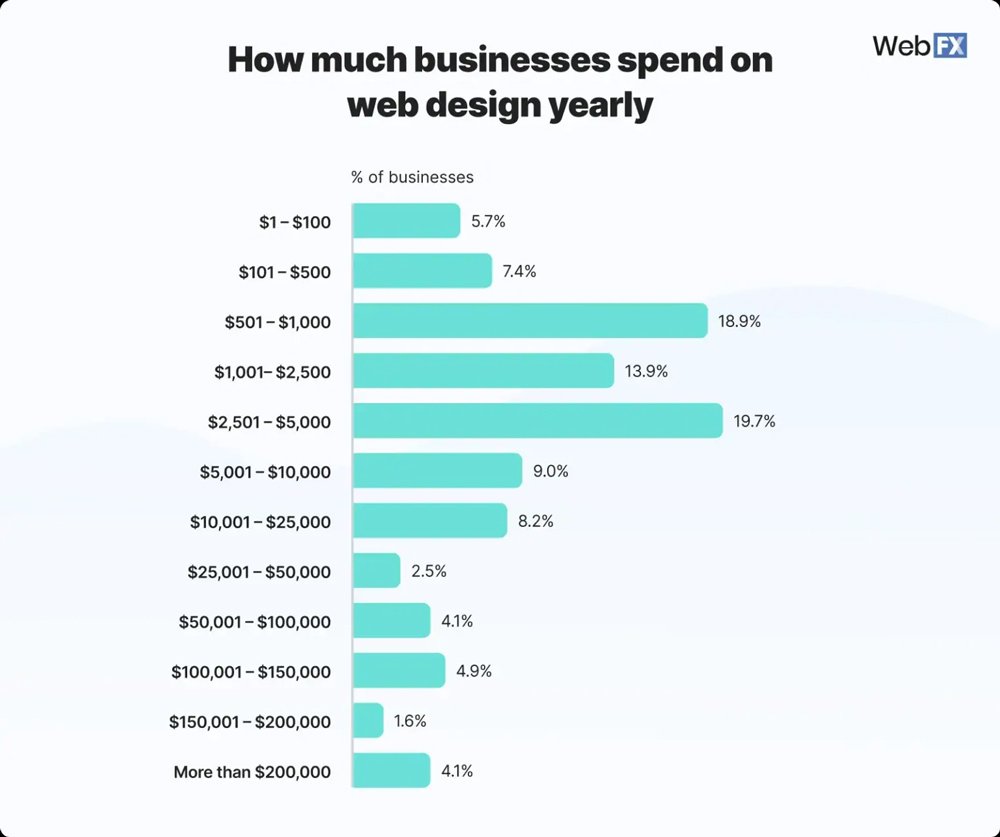
- Premium budget tiers, such as $25,001–$50,000, are allocated by only 2.5% of businesses.
- The most frequently selected spending category is $2,501–$5,000, which is preferred by 19.7% of businesses.
- Approximately 18.9% of companies dedicate $501–$1,000 to annual web design costs.
- Around 13.9% of businesses are positioned within the $1,001–$2,500 spending range.
- Nearly 9.0% of organizations set aside $5,001–$10,000 for web design each year.
- An estimated 8.2% of businesses commit budgets between $10,001–$25,000 toward web design services.
- Merely 5.7% of businesses limit their web design expenditure to as low as $1–$100.
- A small segment, totaling 4.1% of businesses, invests more than $200,000 annually in web design.
- Moderate-to-upper spending brackets such as $50,001–$100,000 (4.1%) and $100,001–$150,000 (4.9%) are observed less frequently among businesses.
- Only 1.6% of businesses indicate annual web design spending in the $150,001–$200,000 range.
- Lower budget commitments like $101–$500 represent 7.4% of the total responses from businesses.
CMS and WordPress Usage Statistics
- WordPress powers roughly 43–44% of all active websites globally.
- This represents hundreds of millions of live websites.
- WordPress controls over 60% of the CMS market.
- Adoption continues growing year over year among businesses.
- Millions of blog posts are published monthly via WordPress.
- The US hosts one of the largest WordPress user bases.
- Plugin and theme usage drives extensive customization.
- WooCommerce expands WordPress dominance in ecommerce.
- WordPress remains the preferred platform for most bloggers.
- Market trends suggest long-term relevance for WordPress.
Domain and Hosting Statistics
- Global web hosting market valued at $125.36B in 2025, projected to reach $355.81B by 2029.
- Over 762 million domains are registered worldwide as of 2025.
- Shared hosting commands 37.64% of the global web hosting market share.
- Linux powers 78.3% of web-facing servers in 2025.
- AWS hosts 50 million live websites as the largest provider.
- Total domain registrations hit 371.7 million by Q2 2025.
- Industry standard 99.9% uptime allows 43 minutes of monthly downtime.
- The green data centers market grows from $48.26B in 2025 to $155.75B by 2030.
- North America holds 39% share of the global web hosting market in 2025.
Overview of Website Traffic Source Distribution
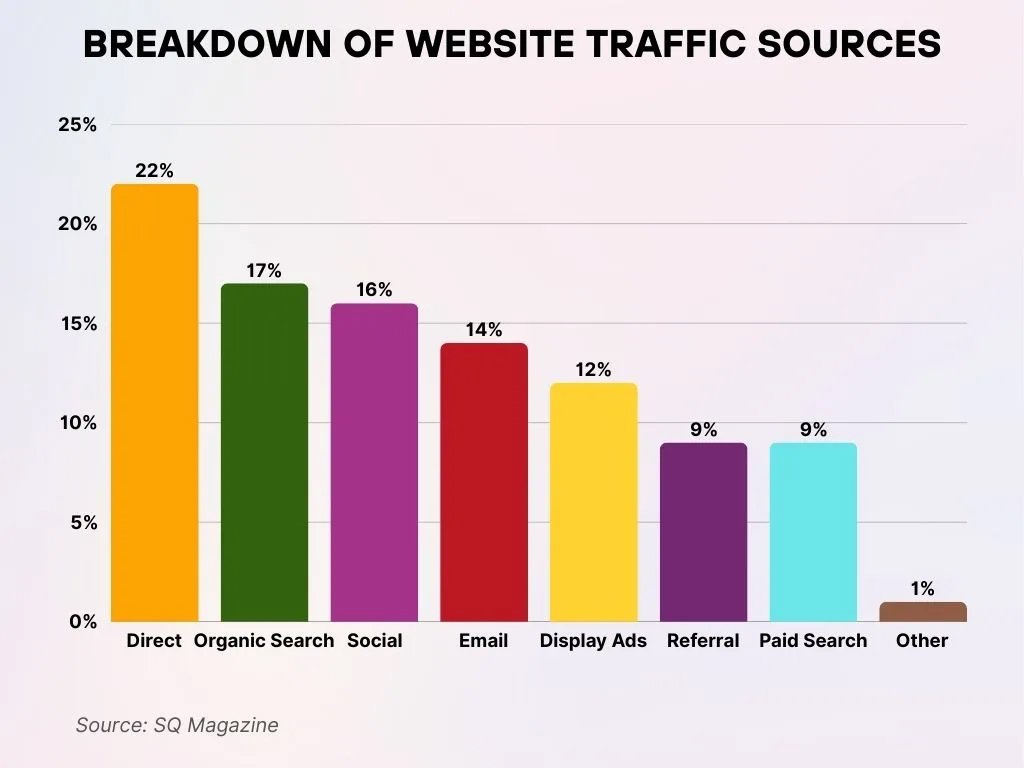
- Other sources remain minimal, totaling just 1%, and these may include offline campaigns or less common digital channels that contribute a very small share of overall traffic.
- Direct traffic continues to lead overall performance, accounting for 22% of all website visits, which includes users typing URLs directly or accessing the site through saved bookmarks.
- Organic Search delivers 17% of total traffic, clearly emphasizing the importance of SEO, strong keyword rankings, and sustained search engine visibility.
- Social media platforms contribute 16% of overall traffic, reflecting strong audience engagement from networks such as Facebook, Twitter, and Instagram.
- Email campaigns generate 14% of website traffic, demonstrating that a well-structured email marketing strategy continues to play a critical role in user acquisition.
- Display advertising accounts for 12% of traffic, indicating that banner ads and other visual advertising formats still drive a notable volume of clicks.
- Referral traffic represents 9% of total visits, consisting of users who arrive through external links placed on other websites.
- Paid search also contributes 9% of traffic, encompassing visitors driven by paid advertising placements across search engine platforms.
Desktop vs Mobile Website Traffic
- Mobile traffic accounts for 62–63% of global web traffic as of July 2025, surpassing desktop at 39.5%.
- Mobile devices hold 52.46% worldwide market share from Nov 2024–Nov 2025, exceeding desktop‘s 47.54%.
- Certain datasets report mobile traffic reaching 64.35% of all website visits in May 2025.
- Desktop sessions average 3 minutes 46 seconds, longer than mobile‘s 2 minutes 19 seconds.
- Tablets capture 3.2% of the global web traffic share in 2025.
- Desktop dominates 71% of B2B website traffic during 9–5 working hours.
- Ecommerce sites see 76.5% of traffic from mobile devices over the past year.
- Smartphone adoption propelled mobile from 0.7% in 2009 to over 60% today.
- Mobile-first sites cut bounce rates by 22% through responsive optimization.
Website User Demographics
- As of 2025, there are 5.35 billion internet users worldwide, equal to about 66% of the global population.
- Young people aged 15–24 show the highest internet usage, with global penetration around 79–77%, outpacing older age groups by roughly 12 percentage points.
- Gen Z users spend about 83% of their digital time on mobile, while Gen Alpha now spends over 90% of their screen time on mobile devices.
- Baby Boomers still lean toward desktop, with about 52% of their online time on desktop devices, despite rising mobile adoption.
- Mobile currently accounts for about 51.7% of global web traffic, while desktop holds around 46.9%, and tablets hold under 2%.
- Across major economies, about 96.9% of internet users aged 16+ use at least one social platform, with many social networks’ largest segments in the 18–34 age range.
- Reddit’s audience skews young, with 44% of U.S. users aged 18–29 and 31% aged 30–49, showing deep engagement from younger demographics.
- Internet usage among youth in Europe is especially high, with 98% of people aged 15–24 online, compared with a global average of 79% for that age group.
- In high‑income countries, about 93% of people use the internet, versus only 27% in low‑income markets, highlighting strong regional and economic divides.
- Among global internet users, those aged 25–34 form the largest single group at over one‑third, while users 65+ represent roughly 4–6% of the online population.
Website Engagement Metrics
- Across industries, around 46% of websites generate between 1,001–15,000 monthly unique visitors, representing a realistic reach band for typical sites.
- For many sites, sessions per user average around 1.4–1.8, indicating that a meaningful share of visitors return for at least a second visit.
- Most websites see overall bounce rates between 26% and 70%, with B2B sites averaging about 56% and B2C around 45%.
- Median average session duration for content and business sites commonly clusters around 2–3 minutes, signalling moderate but improvable engagement depth.
- Typical websites record about 4–5 pages per session, with eCommerce benchmarks near 4.9 (desktop) and 4.4 (mobile) page views.
- Many UX studies report median scroll depth near 50–60%, meaning users only view roughly half of a typical page before exiting.
- Traffic is now majority mobile in many markets, yet desktop visitors often show higher conversion and time-on-site than mobile users.
- Returning visitors commonly represent 20–40% of total sessions, and this cohort usually delivers disproportionately higher conversions.
- Average on-site CTR for internal links often falls below 2%, so even a 0.5–1 point lift can yield meaningful extra engagement.
- Improving engagement metrics such as +1 page per session or +20–30 seconds in session duration often correlates with higher conversion rates around the 2–3% mark.
Global Website Language Distribution in 2025
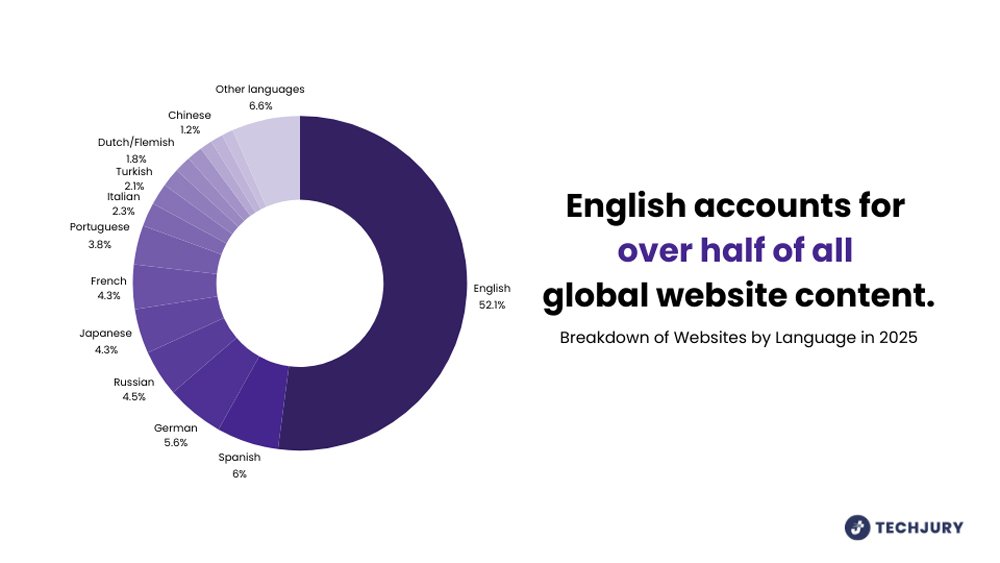
- English dominates the web, accounting for 52.1% of all global website content, making it the primary language of the internet by a wide margin.
- More than half of all websites are in English, exceeding the combined share of the next six most common languages.
- Spanish (6.0%) and German (5.6%) are the leading non-English languages, but each represents only about one-tenth of English’s share.
- Russian (4.5%), Japanese (4.3%), and French (4.3%) form a mid-tier group, each contributing a similar portion of global web content.
- Portuguese (3.8%) continues to have a notable online presence, reflecting strong usage across multiple continents.
- Italian (2.3%), Turkish (2.1%), and Dutch/Flemish (1.8%) maintain smaller but still significant shares of the global web.
- Chinese accounts for just 1.2% of website content, despite having one of the largest numbers of native speakers worldwide.
- Other languages combined make up 6.6%, highlighting the long-tail diversity of the internet beyond dominant global languages.
Conversion Rate Statistics
- The average website conversion rate across industries stands at 2.9%.
- Median landing page conversion rate reaches 6.6% across all sectors.
- Top-performing landing pages achieve over 11% conversion rates.
- Email traffic yields the highest 19.3% landing page conversion rate.
- B2B landing pages convert at 13.3%, outperforming B2C at 9.9%.
- Clear calls-to-action boost conversions by up to 202% via personalization.
- Faster load times improve conversions by 17% per second gained.
- Personalization lifts mobile conversion rates by up to 50%.
- Interactive content generates 2x more conversions than passive formats.
SEO and Organic Traffic Statistics
- Google commands an 89.62% global search market share as of March 2025.
- Organic search accounts for 53% of all website traffic in 2025.
- AI Overviews reduce website clicks by an average of 34.5%.
- 54.4% of global website traffic originates from mobile devices.
- Long-form content generates 77% more backlinks than short articles.
- Businesses in the local map pack receive 126% more traffic.
- Top-ranking pages have 3.8X more backlinks than positions 2–10.
- Multilingual websites boost conversion rates by an average of 70%.
- Nearly 90% of users abandon sites after a poor user experience.
Security and HTTPS Adoption Statistics
- HTTPS secures well over 80% of websites worldwide and accounts for over 90% of page loads in leading markets, according to recent browser telemetry and security reports.
- Cybercrime costs are expected to reach $10.5 trillion annually by 2025.
- Google treats HTTPS as a confirmed ranking signal.
- Non-HTTPS sites trigger browser “not secure” warnings, hurting trust.
- Web application firewall market grows at 17% CAGR to $25.78B by 2032.
- 80% of cyberattacks exploit unpatched vulnerabilities.
- GDPR compliance reduces web traffic by 15% long-term.
- SSL certificate market hits $234.5M in 2025, up 12% CAGR.
- 65% prioritize automated security monitoring for threats.
- 98% of U.S. internet traffic uses HTTPS in 2025.
Do Businesses Believe a Website is Essential?
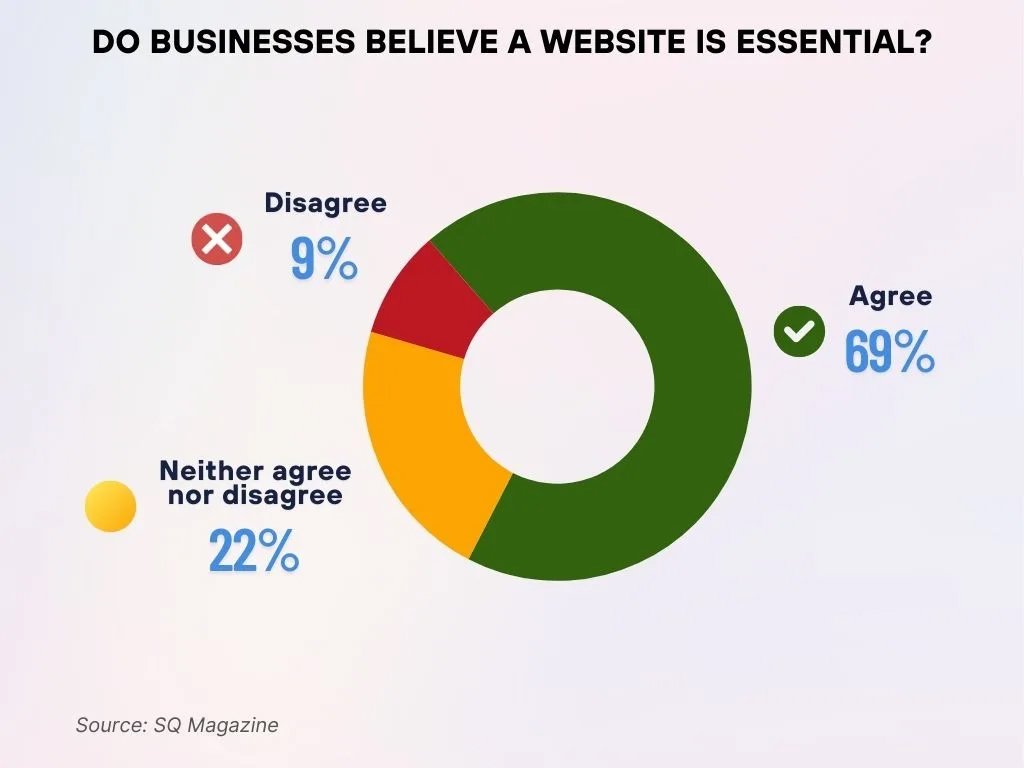
- Only 9% of respondents disagree, stating that a website may not be necessary for operating a business.
- A significant 69% of respondents agree that having a website is essential for the success and credibility of a business.
- Around 22% of people neither agree nor disagree, indicating a level of neutrality or uncertainty regarding the importance of a website.
Website Design and UX Statistics
- 94% of first impressions are design-related for websites.
- 53% of users abandon sites loading over 3 seconds to load.
- Responsive websites achieve 11% higher conversion rates.
- Poor functionality causes 42% of users to leave sites.
- Immersive AR/VR designs surge as top 2025 UX trends.
- Mobile-friendly navigation cuts bounce rates by 15%.
- Minimalist layouts are preferred by 63% of consumers.
- Data visualization boosts comprehension by 400%.
- Gamification increases engagement by 100-150%.
- Accessible sites serve 16% of the global disabled population.
Small Business Website Statistics
- 73% of US small businesses now have a website.
- 84% of visitors prefer mobile-friendly business sites.
- 81% of shoppers research online before purchasing.
- 31% avoid buying from businesses without websites.
- Small business sites average 1,000–15,000 monthly visitors.
- Website build costs range widely by complexity.
- Websites remain essential for credibility.
- Digital maturity continues rising among SMBs.
- Regional adoption varies by market.
- Websites support lead generation growth.
Future Trends in Website Statistics
- By 2026, 78% of organizations are expected to use AI in at least one business function, accelerating AI-driven web and product analytics adoption.
- Google’s AI Overviews have contributed to a 61% drop in organic CTR and 68% drop in paid CTR, reshaping how users click and scan website results.
- As of 2025, mobile devices generate about 64.35% of all website traffic, confirming the dominance of mobile-first usage patterns for web browsing.
- Around 20.5% of people globally now use voice search, with usage projected to keep rising as assistants become more accurate and context-aware.
- In 2025, 64.35% of website visits come from mobile, encouraging sites to adopt more interactive, app-like experiences to keep users engaged.
- About 78% of companies already use AI somewhere in their stack, pushing SEO teams to align strategies with AI ranking and understanding systems.
- Mobile currently drives nearly 60% of global website traffic, making robust security protocols for smartphones and tablets a critical web priority.
- The progressive web apps market is projected to grow from USD 5.23 billion in 2025 to USD 21.44 billion by 2033, signaling wider PWA adoption.
- Voice commerce spend is estimated at USD 81.8 billion in 2025, showing how voice-driven, personalized content flows directly into conversions.
- As of 2025, over 64% of website traffic is mobile, increasing demand for real-time analytics that can react to user behavior in seconds.
Frequently Asked Questions (FAQs)
There are about 1.2 billion websites on the internet as of 2025, with roughly 16–17% active.
Around 64.35% of global web traffic is generated by mobile devices in 2025.
Approximately 252,000 new websites are launched every day.
google.com has about 99.4–105.6 billion visits per month, and youtube.com has about 48–49 billion monthly visits.
Conclusion
Website performance and engagement metrics reveal a mature digital ecosystem, where speed, security, and user experience drive results. Data across SEO, UX, small business adoption, and emerging technologies shows that websites optimized for both users and search engines consistently outperform competitors. As AI, mobile dominance, and personalization reshape online behavior, these statistics provide a clear roadmap for building and sustaining effective digital presence.