


WordPress remains the backbone of a large portion of the web. Today, nearly half of all websites use WordPress in some form. For individuals and businesses alike, that means millions of blogs, corporate sites, and online stores rely on one common platform, making WordPress a powerful force in shaping how content and commerce reach users worldwide. In this article, we explore up-to-date statistics that highlight WordPress’s reach, dominance, and evolution, from global market share to CMS usage, adoption by countries, and more.
Editor’s Choice
- In 2025, 43.4% of all websites run on WordPress.
- Among websites that use a known CMS, WordPress controls about 60.5% to 62.7% of the market.
- More than 590 million websites worldwide use WordPress, powering roughly 43.2% of all sites and about 60.4% of the CMS market.
- According to recent data, there are over 30,000 WordPress themes available in the official directory.
- The WordPress ecosystem offers 70,000+ plugins (free and paid combined).
- As of 2025, WordPress remains the most popular CMS by a wide margin, outpacing competitors like Shopify, Wix, and Squarespace.
- The global reach of WordPress spans many countries, including the United States, India, Germany, the UK, France, and more, indicating widespread geographical adoption.
Recent Developments
- WordPress powers 43.4% of all websites as of late 2025, maintaining its dominant position.
- Among CMS-based sites, WordPress holds a 61.3–64.3% market share throughout 2025.
- Over 60,000 free plugins and 30,000 premium plugins fuel WordPress adaptability in 2025.
- The official repository offers nearly 14,000 free themes, plus 12,000 on ThemeForest as of 2025.
- WordPress 6.9, set for a December 2025 release, introduces enhanced security hardening and authentication.
- In the top 1M websites, WordPress claims a 29.13% share, signaling strong elite adoption.
- Over 522 million sites now run WordPress, up from 1.2 billion total websites in 2025.
- WooCommerce powers 25–35% of e-commerce sites via WordPress in 2025.
- The WordPress ecosystem includes 59,000 plugins and 13,000 themes, bolstering its resilience.
WordPress Market Share
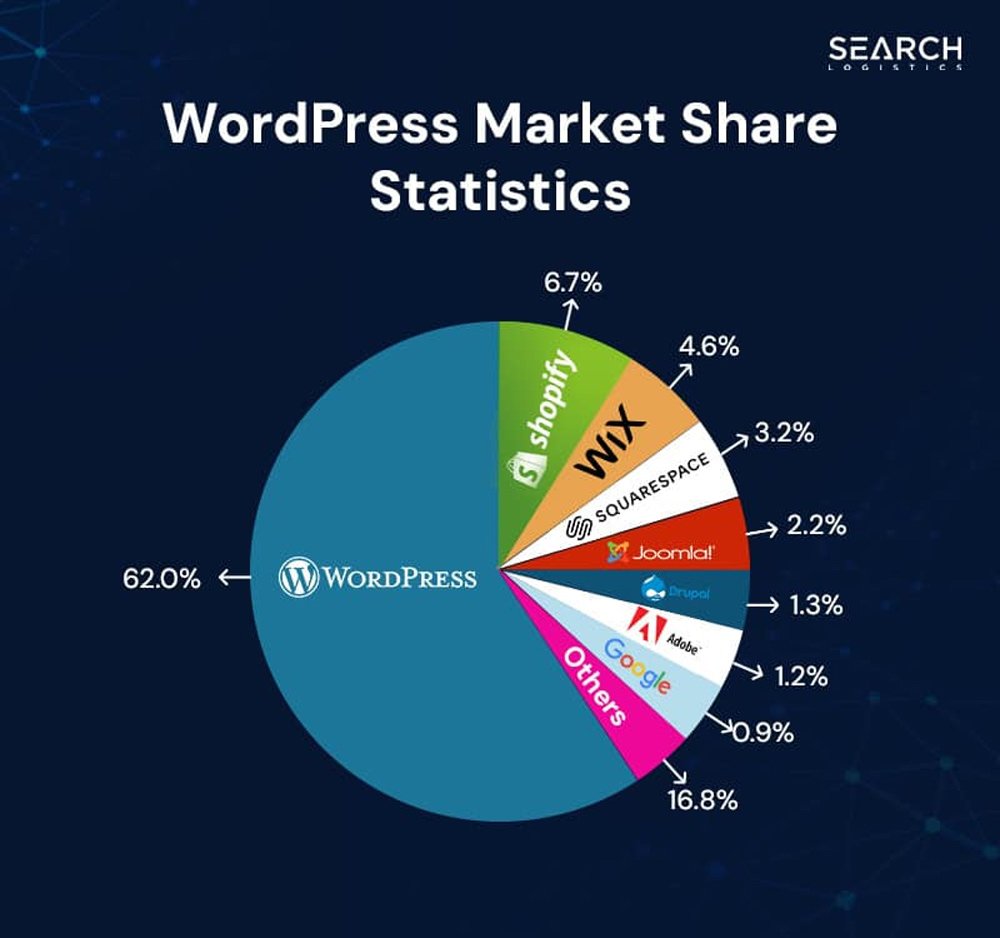
- WordPress leads the global CMS market with a massive 62% share, making it the dominant platform for website creation.
- Shopify holds 6.7%, positioning itself as the second most popular platform, especially strong in e-commerce.
- Wix captures 4.6%, appealing to users who prefer easy drag-and-drop website building.
- Squarespace accounts for 3.2%, known for its design-focused templates and creative-friendly features.
- Joomla! represents 2.2%, maintaining a presence among more technical users who want customization control.
- Drupal holds 1.3%, favored by developers and enterprise-level websites requiring advanced functionality.
- Adobe’s platform sits at 1.2%, reflecting its niche usage in specialized digital experience solutions.
- Google’s website tools account for 0.9%, largely used for simple, small-scale sites.
- The “Others” category makes up 16.8%, showing that while competitors exist, none come close to challenging WordPress’s market dominance.
Websites Powered by WordPress
- 43.2% of all websites worldwide are powered by WordPress in 2025.
- Over 590 million websites globally run on WordPress as of December 2025.
- WordPress holds a dominant 60.4% share of the CMS market.
- More than 70,000 plugins and 30,000 themes are available for WordPress sites.
- WooCommerce, a WordPress plugin, commands 33.05% of the e-commerce platform market.
- Among the top 1 million websites, WordPress powers 29.13%.
- 64.3% of all CMS platforms in use are WordPress.
- Approximately 500 new WordPress websites launch daily worldwide.
- 43.5% of the web, or over 529 million sites, actively use WordPress.
- WordPress drives 25% of all e-commerce sites via WooCommerce.

Top Websites Using WordPress
- 43.2% of all websites use WordPress as their CMS.
- 60.4% of sites with known CMS run on WordPress.
- 36.28% of the top 10,000 websites are powered by WordPress.
- 49.4% of the top 1,000 sites adopted WordPress in 2025.
- Hello, the Elementor theme is used by 19,229 top 1M sites at 11.59% share.
- Yoast SEO powers 82% of SEO plugins in the top 100K WordPress sites.
- Over 590 million websites globally are built on WordPress.
- 43.2% market share among top 10M sites, up from 35.4% in 2020.
Leading Nations Hosting WordPress Websites
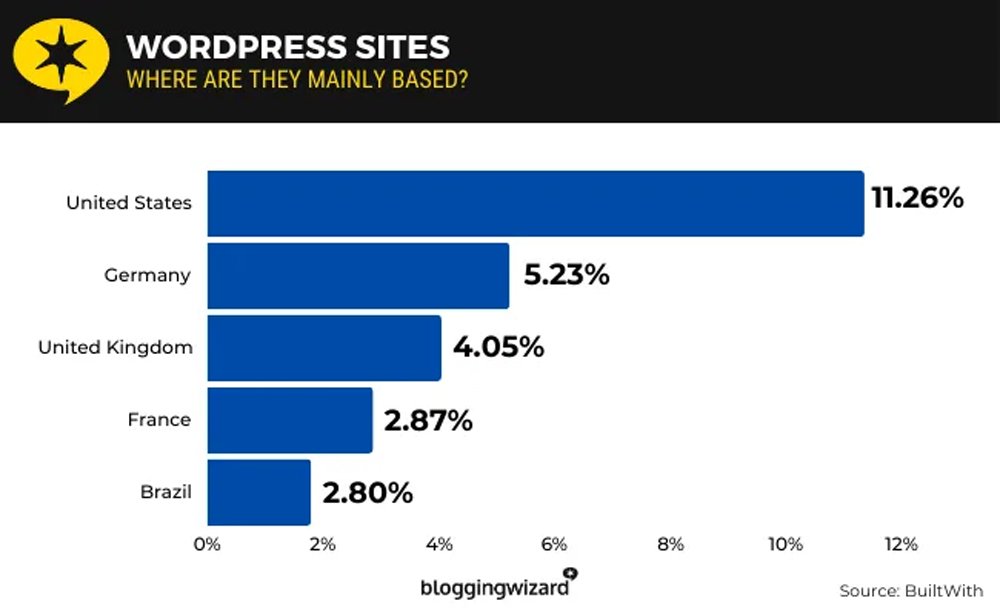
- The United States dominates as the primary hub for WordPress platforms, accounting for 11.26% of all sites and representing the largest global user base.
- Germany comes next with 5.23%, showcasing a strong level of adoption across Europe.
- The United Kingdom maintains a notable presence by hosting 4.05% of worldwide WordPress installations.
- France adds 2.87%, while Brazil closely matches with 2.80%, highlighting their active participation in the platform’s ecosystem.
- These top five countries collectively demonstrate the global popularity and wide geographic distribution of WordPress usage.
Growth and Historical Trends
- WordPress’ market share grew from 13.1% in 2011 to 43.6% of all websites by 2025.
- Over 810 million total WordPress sites exist worldwide in 2025.
- More than 10,000 new WordPress sites launch daily.
- 62.8% CMS market share held by WordPress among known systems in 2025.
- 81.2% of WordPress sites run the latest version 6.
- 59,000+ free plugins and 12,000+ free themes available in directories.
- Over 30,000 themes total, including a premium option, fuel ecosystem growth.
- 900+ companies contributed to WordPress core in recent years.
New WordPress Websites per Day
- Over 10,000 new WordPress sites emerge daily across global markets.
- Hostinger publishes more than 10,000 WordPress websites every day.
- 500+ new WordPress sites built daily, outpacing competitors like Shopify.
- WordPress accounts for 35% of all new websites created each day.
- Approximately 660 new WordPress websites launch daily worldwide.
- Over 500 WordPress sites are added daily versus 60-80 on platforms like Squarespace.
- Thousands of new WordPress installations occur daily, fueling CMS growth.
- 10,000 WordPress websites are published daily on Hostinger alone.
WordPress Plugins Statistics
- The official WordPress repository hosts nearly 59,000 free plugins in 2025.
- Including premium plugins, the total plugin ecosystem exceeds 60,000.
- More than 53 million WordPress sites use at least one plugin.
- Yoast SEO alone has over 5 million active installations.
- Plugin categories like e-commerce, SEO, page builders, performance, and security dominate.
- WooCommerce powers about 20.4% of WordPress sites, Elementor 16%, WPBakery 15.3%.
- Performance plugins remain widely adopted due to increased focus on user experience.
Most Popular WordPress Plugins
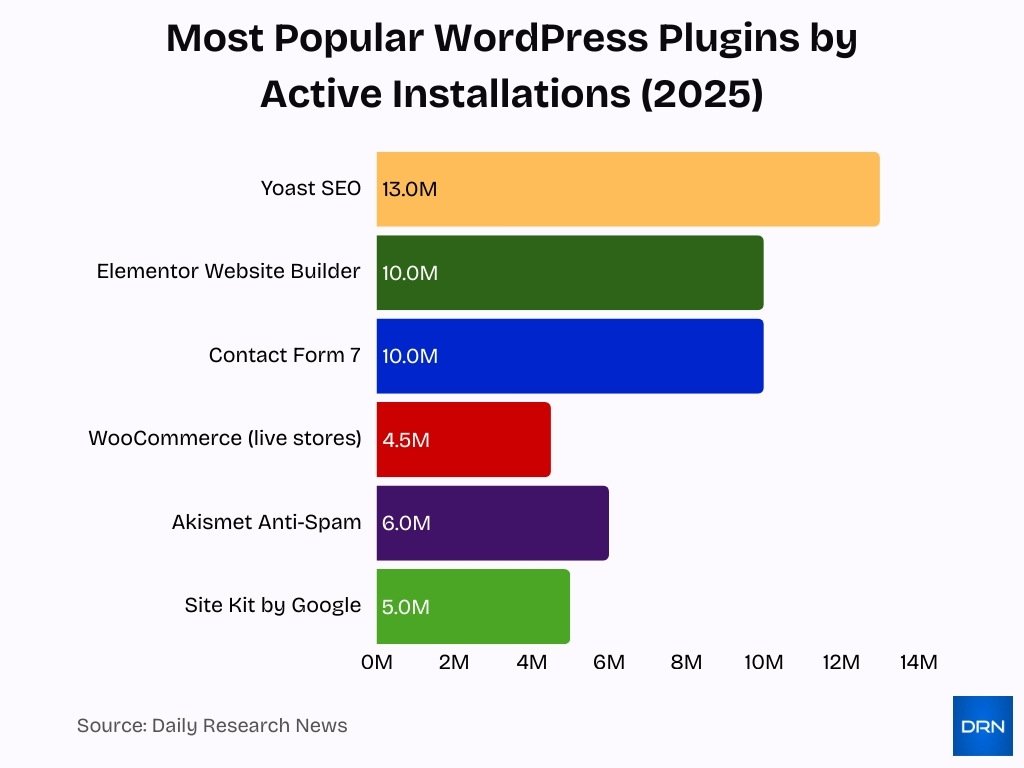
- Yoast SEO boasts over 13 million active installations as of late 2025.
- Elementor Website Builder exceeds 10 million active installs, powering millions of sites.
- Contact Form 7 maintains over 10 million active installations consistently.
- WooCommerce powers over 4.5 million live stores worldwide in 2025.
- Akismet Anti-Spam secures over 6 million WordPress sites from spam.
- Site Kit by Google reaches over 5 million active installs for analytics integration.
- Jetpack by Automattic supports millions with security and performance tools.
- The top 7 plugins account for a small concentration, dominating the majority of installations.
Average Plugins per WordPress Site
- An average self-hosted WordPress site has 25.2 installed plugins and 18.3 active plugins.
- Typical WordPress websites use an average of 12-15 plugins.
- Business WordPress sites commonly run 20-30 plugins or more.
- Advanced WordPress sites like WPBeginner operate with 62 active plugins.
- Over 440 million active plugins across approximately 24 million WordPress sites.
- Nearly 60,000 free plugins are available in the official WordPress repository.
- Self-hosted sites average 17.6 plugins with over 200 lines of code.
- Ecommerce WordPress sites often exceed 30 plugins for features like SEO and payments.
Average Pricing Distribution of WordPress Themes
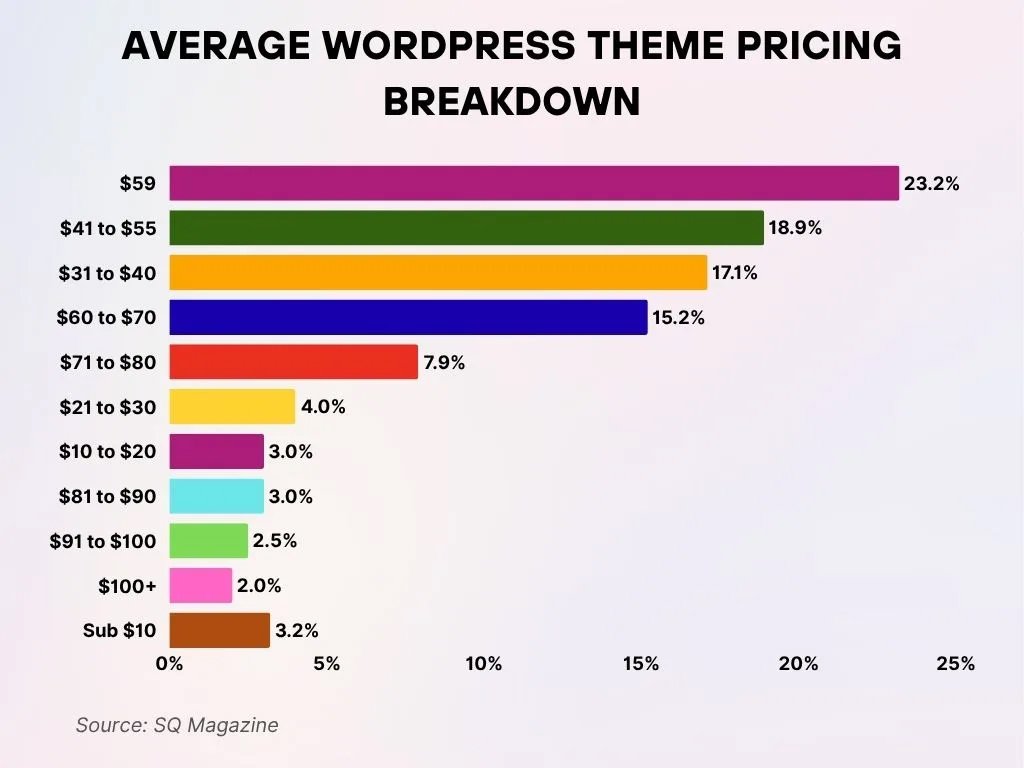
- The most typical WordPress theme price is $59, representing 23.2% of the market.
- Themes priced from $41 to $55 constitute 18.9%, providing mid-range selections for users.
- Themes within the $31 to $40 bracket account for 17.1%, attracting budget-focused buyers.
- About 15.2% of themes fall between $60–$70, often indicating premium layouts or features.
- A further 7.9% are in the $71 to $80 category, considered slightly higher-end.
- Lower-priced themes ranging from $21 to $30 hold a 4.0% market share.
- Themes costing $10 to $20 make up 3.0%, aimed at entry-level customers.
- Price groups of $81 to $90 and $91 to $100 represent 3.0% and 2.5%, respectively.
- High-end themes priced above $100 account for only 2.0% of total offerings.
- The sub-$10 category still captures 3.2%, highlighting the presence of ultra-budget choices.
Free vs Premium WordPress Themes
- WordPress.org lists nearly 14,000 free themes in 2025.
- Combined with marketplaces like ThemeForest, total themes exceed 26,000–30,000.
- Premium themes average $59 per license, with subscriptions at $145/year.
- 11,561 premium themes available on Envato Elements alone.
- Hello, Elementor powers 11.59% of top 1M sites, mostly free.
- Divi leads premium with a 6.24% share in the top sites.
- Free themes like Astra are used on 7.62% of the top million websites.
- GeneratePress holds 6.22% market share among high-traffic sites.
- Over 25% of themes target e-commerce, favoring premium options.
WooCommerce and eCommerce Statistics
- WooCommerce powers 4.53 million active online stores in 2025.
- WooCommerce’s global market share ranges from 20.1% to 33.4,% depending on methodology.
- Among the top 1 million ecommerce websites, WooCommerce holds 18.2% share.
- WooCommerce powers 9.2% to 12–13% of CMS-based websites.
- Some estimates say WooCommerce drives 1 in 3 online shops.
- WooCommerce downloads exceed 211 million cumulatively.
- WooCommerce remains the most popular WordPress e-commerce solution.
- Many small and midsize businesses choose WooCommerce for cost-effectiveness.
e-Commerce Sites Powered by WooCommerce
- WooCommerce powers about 4.5 to 4.6 million live stores.
- Over 3.5 million sites use WooCommerce checkout functionality.
- WooCommerce powers 4% to 5% of all internet websites.
- It ranks among the top 3 global e-commerce solutions.
- WooCommerce is particularly strong in cost-sensitive markets.
- Many content sites convert to stores using WooCommerce.
- Modular architecture enables stores to scale easily.
- Continuous growth confirms WooCommerce’s long-term viability.
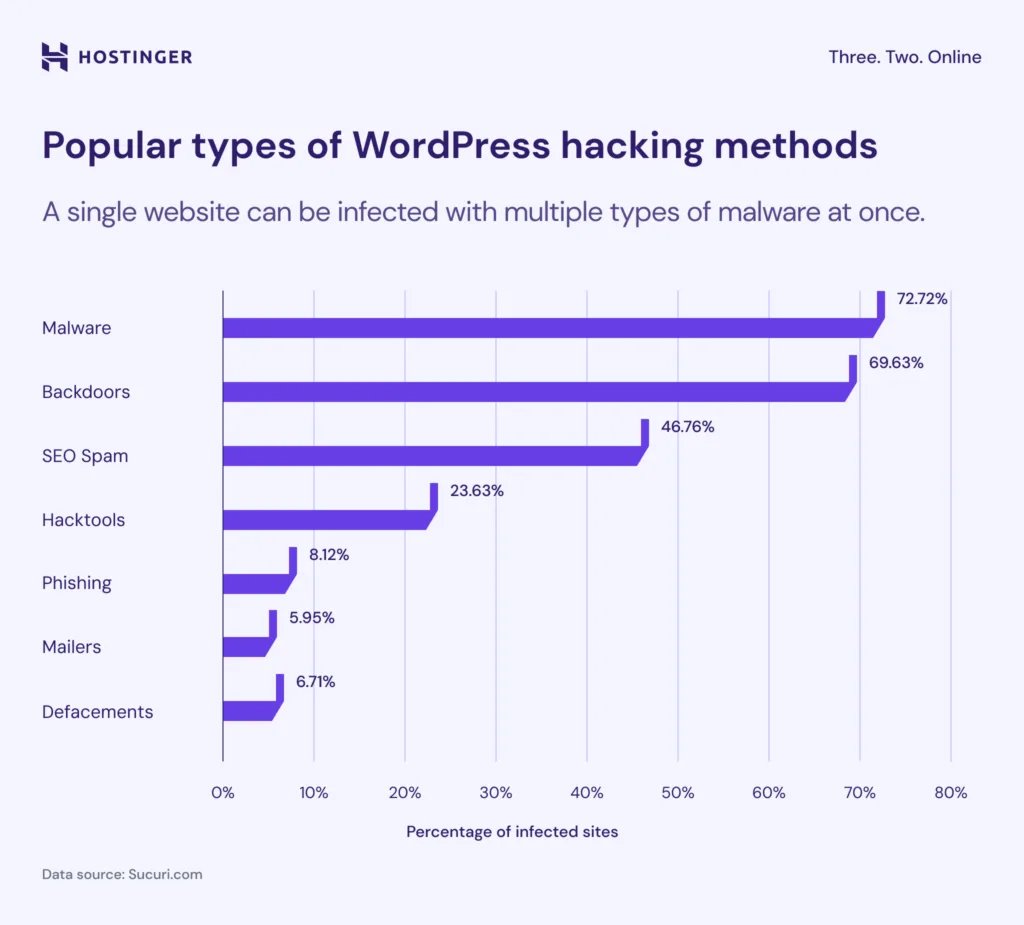
Most Common Methods Used to Hack WordPress Sites
- Malware remains the primary threat, impacting 72.72% of infected WordPress websites while compromising overall site security.
- Backdoors are detected in 69.63% of breached sites, enabling hackers to maintain continuous unauthorized access.
- SEO Spam affects 46.76% of cases, commonly deployed to manipulate search engine outcomes for malicious gain.
- Hacktools emerge in 23.63% of attacks, providing attackers with instruments to leverage site vulnerabilities.
- Phishing schemes influence 8.12% of incidents, aiming to extract user credentials or sensitive data.
- Mailers, which dispatch spam emails, appear in 5.95% of infections and contribute to unauthorized messaging activity.
- Defacements, which modify or vandalize website content, arise in 6.71% of documented hacking events.
WordPress Performance and Speed Statistics
- The average WordPress desktop load time is 2.5 seconds.
- Average mobile load time is 13.25 seconds, indicating optimization gaps.
- A 1-second delay can reduce conversions by ~7%.
- Slow WooCommerce sites often suffer from heavy plugins and unoptimized assets.
- Well-optimized WooCommerce stores can score above 95 on speed tests.
- Speed remains critical for both SEO and conversions.
- Performance-first hosting and optimization are now standard recommendations.
- Mobile performance is a major priority as mobile usage grows.
WordPress Security Statistics
- WordPress sites face 8.7 million attacks in just 48 hours.
- An average WordPress site is attacked every 22 minutes.
- 6,700 new vulnerabilities were identified in the WordPress ecosystem in the first n six months of 2025.
- Plugins cause 89–97% of all WordPress vulnerabilities.
- 41% of 2025 vulnerabilities are exploitable in real-life attacks.
- Over 1,000 WordPress sites were infected with JavaScript backdoors in 2025.
- 80% of users enable automatic updates for security.
- WooCommerce breach exposed 4.4 million customer records in 2025.
- 90% of security issues stem from plugins.
Frequently Asked Questions (FAQs)
43.2%–43.4% of all websites globally use WordPress in 2025.
WordPress holds about 60.5%–62.5% of the CMS market share among sites using a known CMS.
There are roughly 478 million websites worldwide powered by WordPress.
As of August 2025, 33.4% of all e-commerce websites globally use WooCommerce.
Conclusion
WordPress continues to shape much of the web’s structure, from content-driven blogs to large e-commerce stores. The combination of a wide theme marketplace, a deep plugin ecosystem, and tight integration with WooCommerce makes WordPress a flexible platform for users ranging from solo bloggers to global merchants.
At the same time, performance and security have moved to the forefront; site speed affects both user experience and conversions, while security, especially for commerce sites, demands consistent upkeep and caution.