Short-form video has reshaped digital media in the 2020s, and two platforms stand at the forefront: YouTube Shorts and TikTok. Each draws massive global audiences, influences culture, and powers video strategies for creators and brands. In marketing, advertisers are reallocating budgets toward short clips that drive awareness and conversions. In entertainment, creators achieve breakthrough fame through viral dances or explainers. Dive into detailed usage statistics that reveal where each platform stands today and how trends are evolving.
Editor’s Choice
- YouTube Shorts has surpassed 2 billion monthly active users globally in 2025, highlighting its scale.
- TikTok reached ~1.59 billion monthly active users in 2025, marking significant growth.
- Daily views on YouTube Shorts exceed ~200 billion worldwide.
- TikTok users spend ~58 minutes daily on the app.
- YouTube Shorts session lengths average ~14 min per user per day.
- In the U.S., YouTube reached ~164.5M Shorts users in 2025.
- 63% of U.S. adults use YouTube weekly, outpacing TikTok’s frequency.
- TikTok’s DAU range is ~875M–954M globally.
Recent Developments
- YouTube introduced dedicated Shorts search filters to improve discoverability.
- TikTok has expanded AI creative tools to help advertisers craft content.
- The maximum length for Shorts videos was increased to 3 minutes in late 2024.
- Streaming and short-form video are merging as TV screens become common viewing surfaces.
- Brands now treat short videos as core elements of digital ad strategies.
- Parental and account time-limit features are rolling out on mobile apps.
- Platforms are tweaking discovery algorithms to balance trend and relevance signals.
- TikTok’s reward programs now emphasize originality and watch time for creator payouts.
YouTube Shorts vs TikTok Overview
- YouTube Shorts originates within the larger YouTube ecosystem and is integrated with long-form video.
- TikTok remains a standalone short-form platform focusing exclusively on bite-sized vertical video.
- Shorts is available globally wherever YouTube operates.
- TikTok boasts a presence in 150+ countries, giving it broad international penetration.
- Shorts generally leans on YouTube’s recommendation system for discovery.
- TikTok’s feed is highly trend-driven, prioritizing fast cultural spread.
- Many creators post on both platforms to maximize reach.
- The platforms differ in monetization strategy, with TikTok investing in direct creator rewards.
YouTube Shorts vs TikTok Users in the US
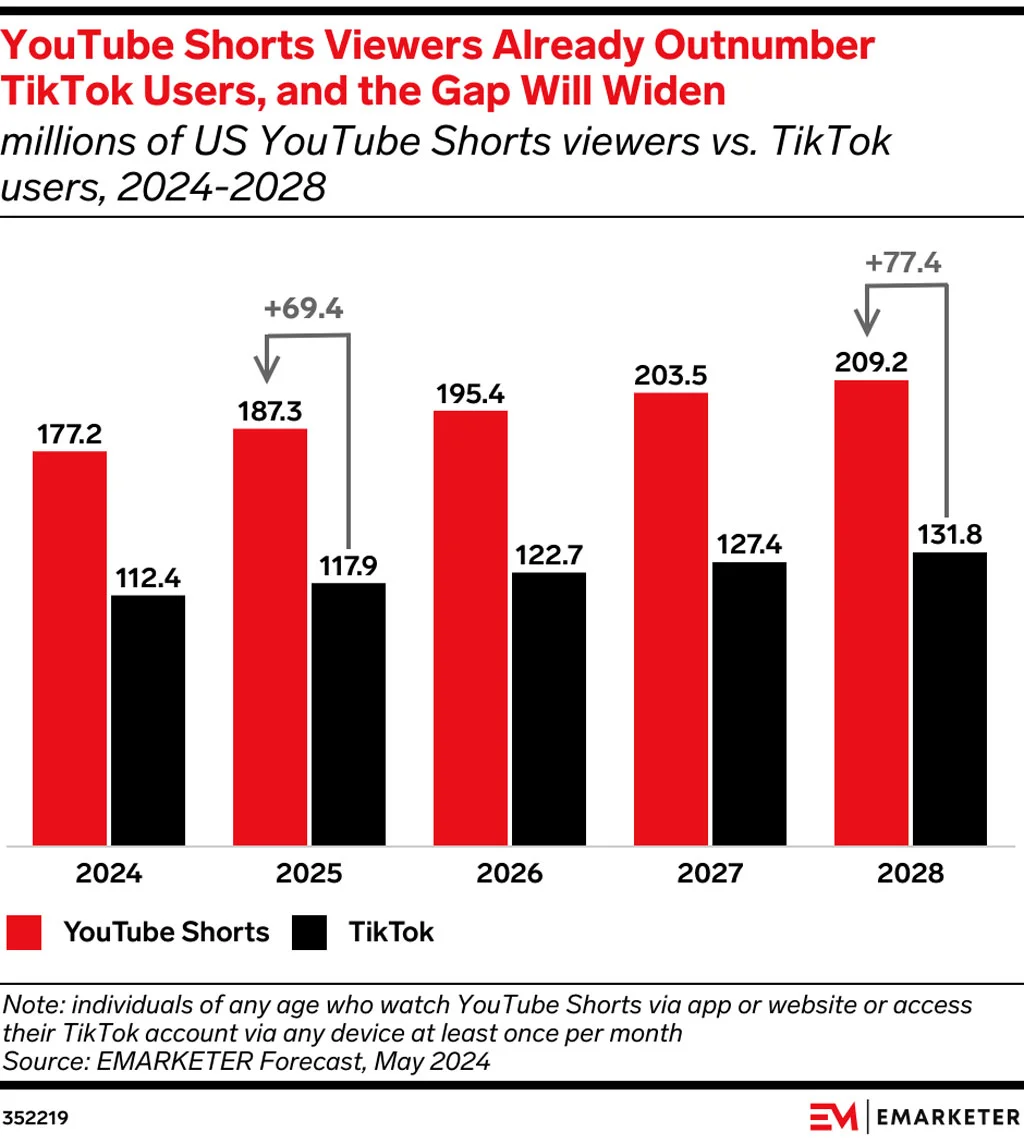
- YouTube Shorts leads in 2024 with 177.2 million users, significantly ahead of TikTok’s 112.4 million, creating a gap of 64.8 million users.
- In 2025, YouTube Shorts grows to 187.3 million users, while TikTok reaches 117.9 million, widening the gap to 69.4 million.
- By 2026, YouTube Shorts will expand further to 195.4 million users, compared to TikTok’s 122.7 million, maintaining a strong lead of 72.7 million.
- In 2027, YouTube Shorts surpasses 200 million users with 203.5 million, whereas TikTok records 127.4 million, pushing the difference to 76.1 million.
- By 2028, YouTube Shorts is projected to reach 209.2 million users, outpacing TikTok’s 131.8 million, with the gap peaking at 77.4 million.
- Over the 2024–2028 period, YouTube Shorts adds nearly 32 million new users, while TikTok grows by about 19.4 million, highlighting faster adoption for Shorts.
- The data shows a consistent upward trend for both platforms, but YouTube Shorts maintains a dominant position throughout the forecast period.
- The widening gap indicates that YouTube’s ecosystem advantage and discoverability are driving stronger long-term audience growth than TikTok in the US market.

Monthly Active Users Comparison
- YouTube Shorts: ~2 billion monthly active users (2025).
- TikTok: ~1.59 billion monthly active users (2025).
- YouTube overall: ~2.7 billion monthly users (2026).
- Shorts’ monthly users exceed TikTok by ~400 M users in 2025.
- TikTok’s MAUs continue to grow year-over-year.
- Many YouTube users toggle between Shorts and traditional videos daily.
- TikTok’s broader global reach often outpaces local regional platforms.
- Shorts benefits from YouTube’s mature user base across regions.
Daily Active Users Comparison
- TikTok reports approximately 1.1 billion daily active users (DAUs) globally in 2025, reflecting strong habitual usage.
- Industry estimates place TikTok’s DAUs between 875 million and 954 million in 2024, showing steady year-over-year growth into 2025.
- YouTube, across formats including Shorts, reaches 122+ million daily users in the U.S. alone.
- Google reported that YouTube Shorts generates over 200 billion daily views, indicating high daily activity even if DAU figures are not separated.
- TikTok users open the app an average of 19 times per day, highlighting the frequency of engagement.
- In the U.S., TikTok has roughly 150 million monthly users, with a large portion active daily.
- YouTube’s logged-in daily viewers globally exceed hundreds of millions, supported by Shorts’ integration into the main app.
- TikTok’s DAU/MAU ratio exceeds 60%, suggesting strong daily retention compared to many social platforms.
Short-Form Video Platforms Watch Rate Performance Comparison
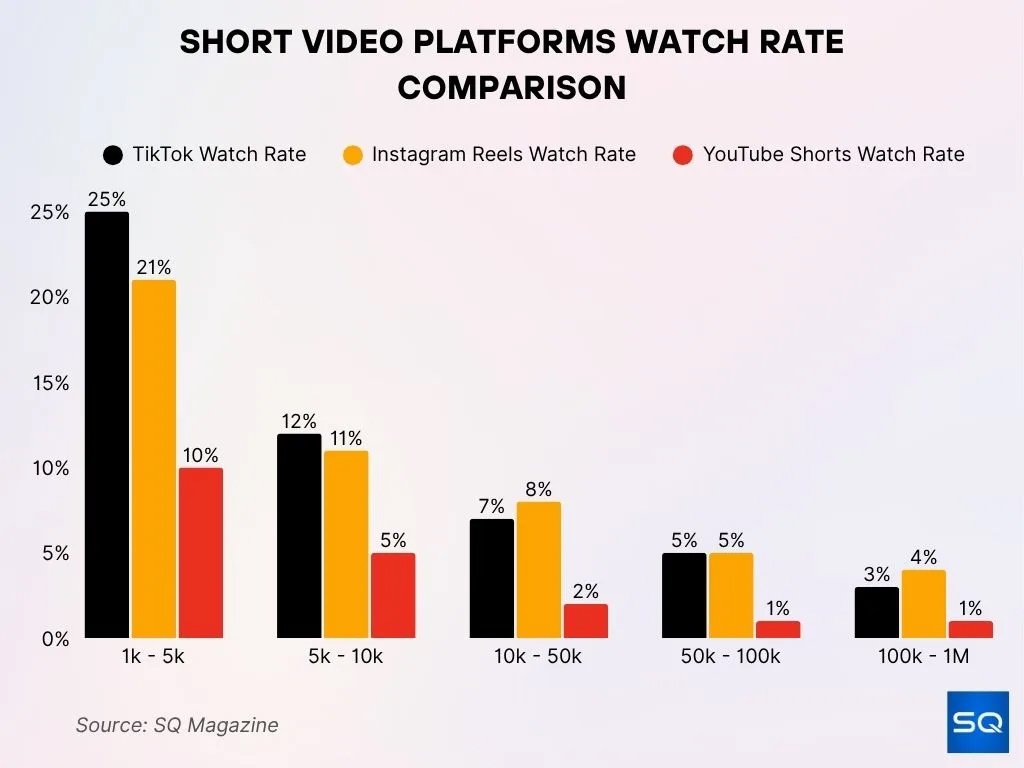
- TikTok records the highest watch rate across all follower ranges, peaking at 25% for creators with 1k–5k followers.
- Instagram Reels secures the second position, with a 21% watch rate in the 1k–5k followers category, slightly trailing TikTok.
- YouTube Shorts falls notably behind, achieving only a 10% watch rate for creators with 1k–5k followers.
- In the 5k–10k followers range, TikTok sustains its lead at 12%, followed by Instagram Reels at 11%, while YouTube Shorts reaches just 5%.
- For creators with 10k–50k followers, Instagram Reels (8%) slightly outperforms TikTok (7%), whereas YouTube Shorts remains low at 2%.
- Among larger accounts with 50k–100k followers, TikTok and Instagram Reels are tied at 5%, while YouTube Shorts records only 1%.
- For top-tier creators in the 100k–1M followers segment, Instagram Reels leads marginally at 4%, TikTok follows at 3%, and YouTube Shorts maintains 1%.
Global Penetration and Market Share
- TikTok operates in 150+ countries and supports more than 75 languages.
- YouTube is available in 100+ countries and supports over 80 languages.
- TikTok’s global social media market share stands near 20% among short-form platforms.
- YouTube remains the second-most visited website globally, strengthening Shorts’ distribution.
- In the U.S., 63% of adults use YouTube weekly, compared with a lower weekly penetration for TikTok.
- TikTok penetration is highest among Gen Z globally, often exceeding 70% in select markets.
- YouTube reaches over 90% of U.S. internet users aged 18–49, giving Shorts a broad cross-generational reach.
- TikTok’s ad reach in 2025 is estimated at 1.9 billion users, reflecting expanding global penetration.
Audience Demographics Comparison
- Approximately 60% of TikTok users are between the ages of 16 and 34, making it youth-skewed.
- Around 25% of TikTok’s U.S. audience is aged 10–19, reinforcing its teen appeal.
- YouTube reaches 95% of U.S. teens, making it nearly universal among younger audiences.
- Gender split on TikTok is roughly 54% female and 46% male globally.
- YouTube’s gender distribution remains more balanced at approximately 51% male and 49% female.
- TikTok shows strong adoption in Southeast Asia, where Gen Z users dominate platform growth.
- YouTube maintains higher penetration among users aged 35–49, compared to TikTok’s concentration under 35.
- Hispanic and Black audiences in the U.S. report above-average TikTok usage compared to other demographics.
US YouTube vs. TikTok Usage Trends by Generation
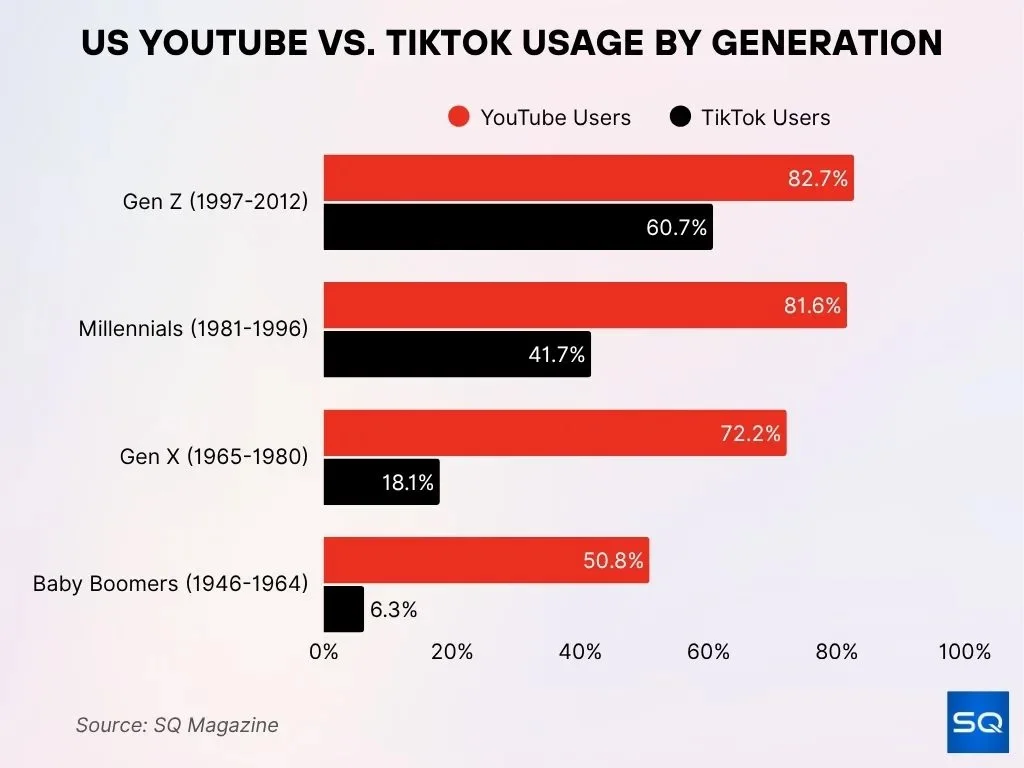
- Gen Z demonstrates the highest engagement, with 82.7% using YouTube and 60.7% using TikTok, reflecting strong adoption of short-form and long-form video platforms.
- Millennials follow closely in platform usage, with 81.6% active on YouTube and 41.7% on TikTok, highlighting balanced consumption across video formats.
- Gen X shows a strong preference for YouTube, with 72.2% usage compared to only 18.1% on TikTok, indicating lower adoption of short-video platforms.
- Baby Boomers record the lowest usage levels, with 50.8% using YouTube and just 6.3% on TikTok, reflecting limited engagement with social video content.
Regional Usage and Top Countries
- Indonesia leads TikTok markets with 157.6 million users.
- The United States has 136 million TikTok users, its biggest single market.
- Brazil reports over 105 million TikTok users, strong in Latin America.
- India had 200 million TikTok users before the 2020 ban.
- India dominates YouTube with 491 million users.
- U.S. counts 253 million YouTube users across all formats.
- Japan sees 39.2 million adult TikTok users, with high penetration.
- South Korea has 11.8 million adult TikTok users, a notable relative adoption.
- Europe totals over 200 million TikTok users, led by the UK, Germany, and France.
Time Spent per User per Day
- TikTok users spend an average of 58–60 minutes per day on the app globally.
- U.S. TikTok users average roughly 53.8 minutes daily in 2025.
- YouTube users overall spend about 48.7 minutes per day on the platform.
- Shorts-specific session time averages approximately 14–16 minutes daily per user.
- TikTok leads global social apps in time spent per user.
- Over 30% of TikTok users report using the app multiple times daily.
- YouTube viewing on connected TVs continues rising, contributing to total daily watch time.
- Short-form vertical video consumption has grown by double-digit percentages year-over-year.
Key Insights: Most Successful Shorts Categories
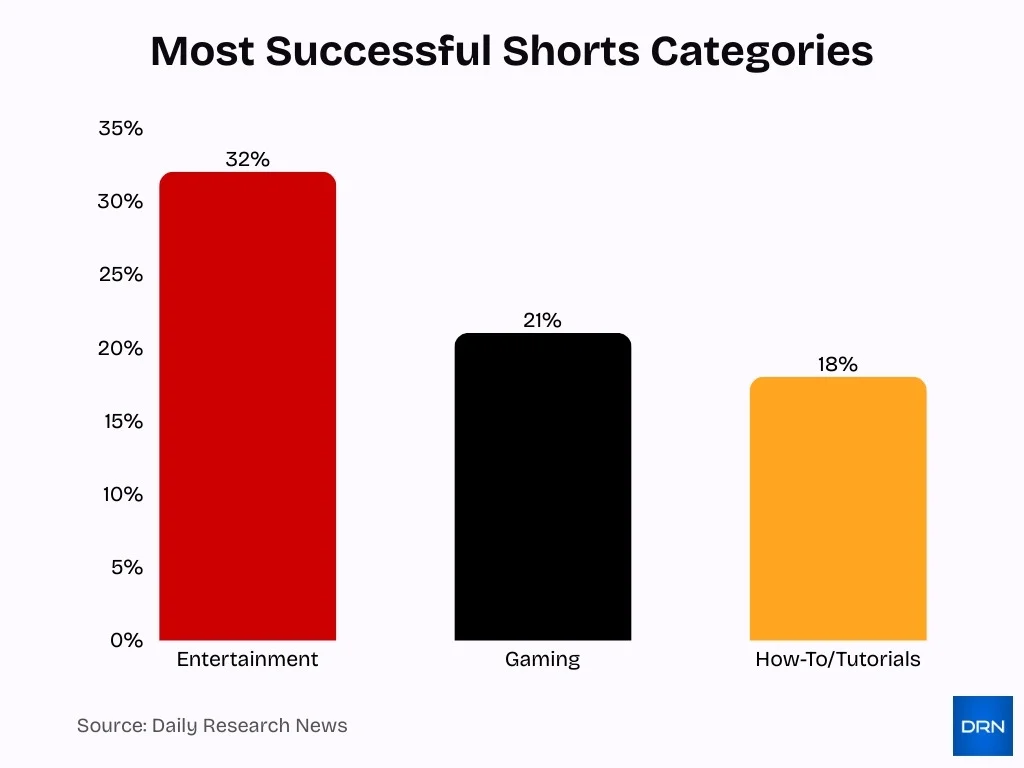
- Entertainment dominates short-form content performance, accounting for 32% of the most successful Shorts, making it the top-performing category.
- Gaming content ranks second, capturing 21% of successful Shorts, showing strong engagement among younger and tech-savvy audiences.
- How-To and Tutorials hold 18%, highlighting growing demand for practical, problem-solving content in short video formats.
- Together, Entertainment and Gaming contribute 53%, indicating that fun and interactive content drives more than half of top-performing Shorts.
- Educational-style Shorts (How-To/Tutorials) still represent nearly one-fifth (18%), proving that value-driven content remains highly relevant.
- The 14% gap between Entertainment (32%) and How-To/Tutorials (18%) reflects a strong audience preference for entertainment-first formats.
- Creators focusing on high-energy, engaging storytelling in Entertainment and Gaming are more likely to achieve higher visibility and reach.
- Brands and marketers can maximize performance by prioritizing Entertainment (32%), followed by Gaming (21%), while using Tutorials (18%) for trust-building and authority.
Total Daily Views Comparison
- YouTube Shorts generated 200+ billion daily views globally in 2025.
- TikTok users collectively watch billions of videos daily, though exact global view totals are not publicly disclosed.
- TikTok reported over 1 billion videos viewed daily in its early growth phase, with figures now significantly higher.
- YouTube overall sees more than 1 billion hours of video watched daily across formats.
- Shorts’ daily views grew from 30 billion in 2021 to 200 billion in 2025, marking a rapid expansion.
- TikTok videos under 30 seconds account for a significant share of total daily consumption.
- YouTube’s recommendation engine drives a majority of Shorts impressions through homepage and feed placements.
- Brands increasingly report higher impression volumes on Shorts compared to traditional YouTube ads.
Engagement Rate Comparison
- TikTok’s average engagement rate is 2.5%–5%, outpacing Instagram’s 0.5%.
- Micro-influencers on TikTok achieve 7.5%–17.96% engagement, far above platform averages.
- YouTube Shorts’ average engagement rate stands at 5.91%, with a 2.52% watch rate.
- TikTok micro-influencers (10k–50k followers) hit 12.4% engagement rates.
- Hashtag challenges like Guess’s #InMyDenim generated 10.5 million views and 5,500+ videos.
- TikTok videos average 58.3% completion rate, key to algorithmic boosting.
- Scotts #DoTheScottsSlide challenge amassed 2 billion views in two days.
- TikTok leads Shorts with 2.34% vs 0.91% engagement in brand comparisons.
- Accounts under 100k followers on TikTok see 7.5% engagement.
Teen Ad Engagement and Purchase Behavior on YouTube Shorts vs TikTok
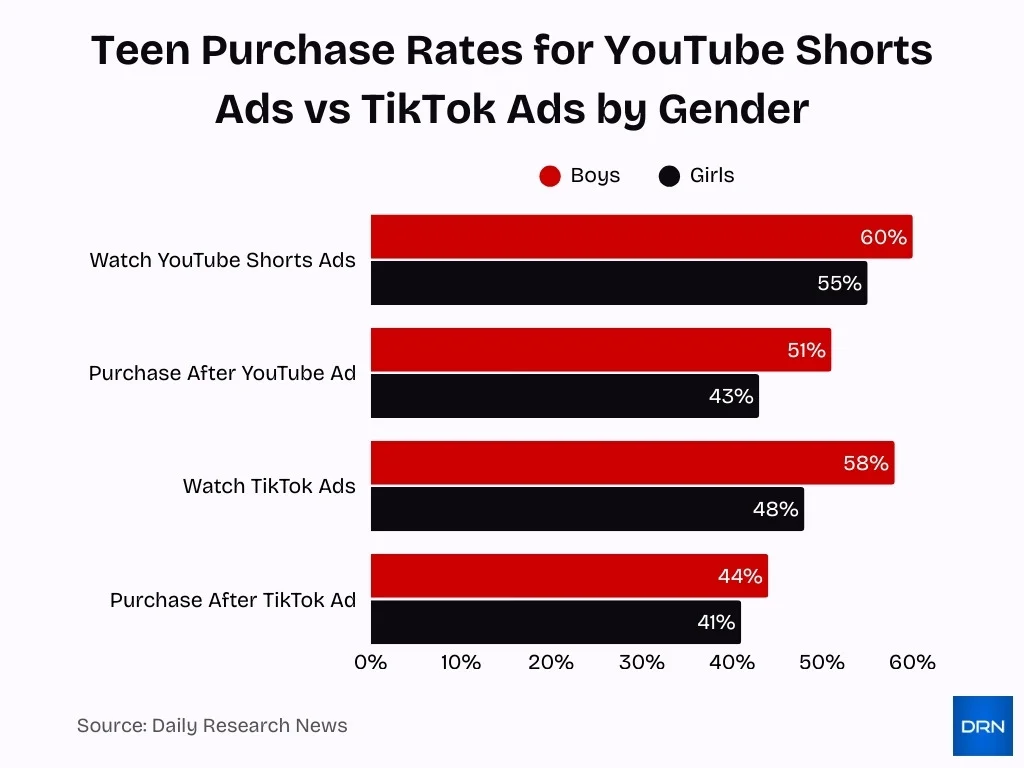
- 60% of boys and 55% of girls reported watching YouTube Shorts ads, making it the most-viewed short-video ad format among US teens.
- After viewing YouTube ads, 51% of boys and 43% of girls went on to make a purchase, showing stronger conversion rates than TikTok.
- TikTok ads were watched by 58% of boys and 48% of girls, slightly lower than YouTube Shorts across both genders.
- Purchase behavior after TikTok ads remained moderate, with 44% of boys and 41% of girls completing a transaction.
- YouTube Shorts outperformed TikTok in driving purchases, leading by 7 percentage points among boys (51% vs 44%) and 2 points among girls (43% vs 41%).
- Boys showed higher ad engagement and conversion rates than girls on both platforms, with gaps of 5 points on YouTube viewing and 10 points on TikTok viewing.
- The largest gender difference appeared in YouTube ad-driven purchases, where boys exceeded girls by 8 percentage points (51% vs 43%).
- Overall, short-form video ads strongly influence teen buying decisions, with over 40% of teens purchasing after exposure on both platforms.
- These findings highlight YouTube Shorts as a stronger performance channel for brands targeting Gen Z consumers aged 13–17.
- With a sample size of 1,000 US teens, the data provides statistically reliable insights into youth digital advertising trends.
Hashtags, Trends, and Challenges Usage
- #challenge hashtag amassed 382 billion views across 33.6 million posts on TikTok.
- #fyp hashtag accumulated over 100 trillion lifetime views as of October 2025.
- Branded hashtag challenges achieve an average 8.5% engagement rate from shares, comments, and likes.
- Over 50% of TikTok creators have participated in a hashtag challenge, boosting brand affinity.
- TikTok’s #ThisIsBliss challenge generated 6.6 billion views through user-generated content.
- ChipotleLidFlip challenge resulted in 336.6 million views and over one billion impressions.
- Brands using TikTok challenges see a 25% increase in Gen Z brand recall.
- TikTok has enforced a maximum of 5 hashtags per post since August 2025, optimizing engagement.
- Trending sounds on TikTok boost content reach by 47% compared to non-trending audio.
- Influencer-led TikTok challenges achieve engagement rates 11 times higher than traditional ads.
Algorithm Comparison: How TikTok, Reels, and Shorts Distribute Content
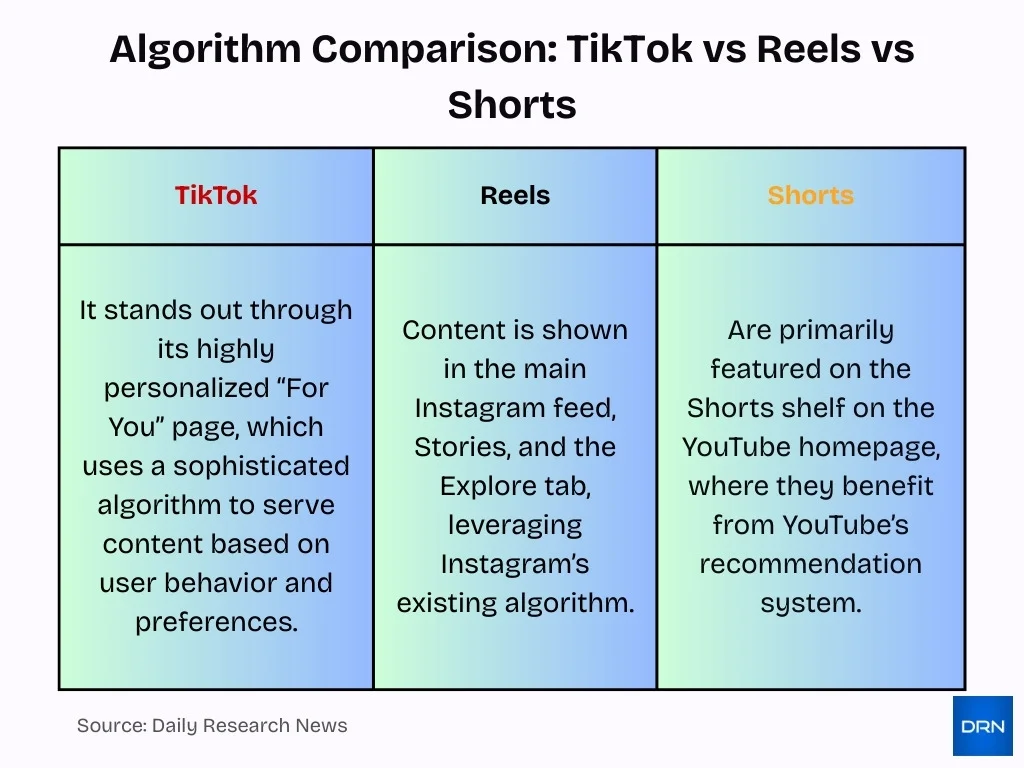
- TikTok stands out with its highly personalized “For You” page, driven by a sophisticated algorithm that analyzes user behavior, interactions, and preferences to deliver highly relevant content.
- Instagram Reels relies on Instagram’s existing algorithm, distributing content across the main feed, Stories, and the Explore tab to maximize visibility within the broader Instagram ecosystem.
- YouTube Shorts are primarily surfaced on the Shorts shelf on the YouTube homepage, where they benefit from YouTube’s powerful recommendation system built on long-form and short-form viewing data.
- Overall, TikTok prioritizes deep personalization, while Reels leverages cross-surface discovery, and Shorts integrates tightly with YouTube’s recommendation engine to drive reach and engagement.
Mobile vs Desktop and TV Usage
- Over 95% of TikTok usage happens on mobile devices, dwarfing desktop at under 5%.
- YouTube delivers 1 billion+ hours of content daily on connected TVs worldwide.
- In the U.S., YouTube TV reaches 150+ million monthly active viewers.
- 36% of YouTube watch time in 2025 occurs on TV screens versus mobile.
- Short-form video market grows at 25.6% CAGR, led by mobile dominance.
- TikTok desktop traffic hit 34.9%, up 2.3% year-over-year.
- YouTube Shorts on smart TVs doubled viewership in key markets like India.
- 12.4% of total U.S. TV time belongs to YouTube on televisions.
- TV viewing for YouTube now exceeds mobile and desktop in the U.S.
- Tablet/desktop claim growing 15-20% of Shorts impressions annually.
Revenue and Monetization for Creators
- TikTok launched the Creativity Program, rewarding creators based on video performance and watch time.
- TikTok’s Creator Fund previously committed $1 billion over three years to support creators.
- YouTube expanded revenue sharing to Shorts creators, allocating 45% of ad revenue to eligible creators.
- YouTube paid out over $70 billion to creators and partners from 2021 to 2023 across formats.
- TikTok creators often rely heavily on brand partnerships rather than platform payouts alone.
- Shorts monetization became widely available in 2023, increasing creator participation in 2024–2025.
- TikTok LIVE gifts and virtual tipping provide additional monetization streams.
- YouTube’s Super Thanks and channel memberships extend monetization beyond ad revenue.
Retention Rate Comparison for Short-Form Video Platforms
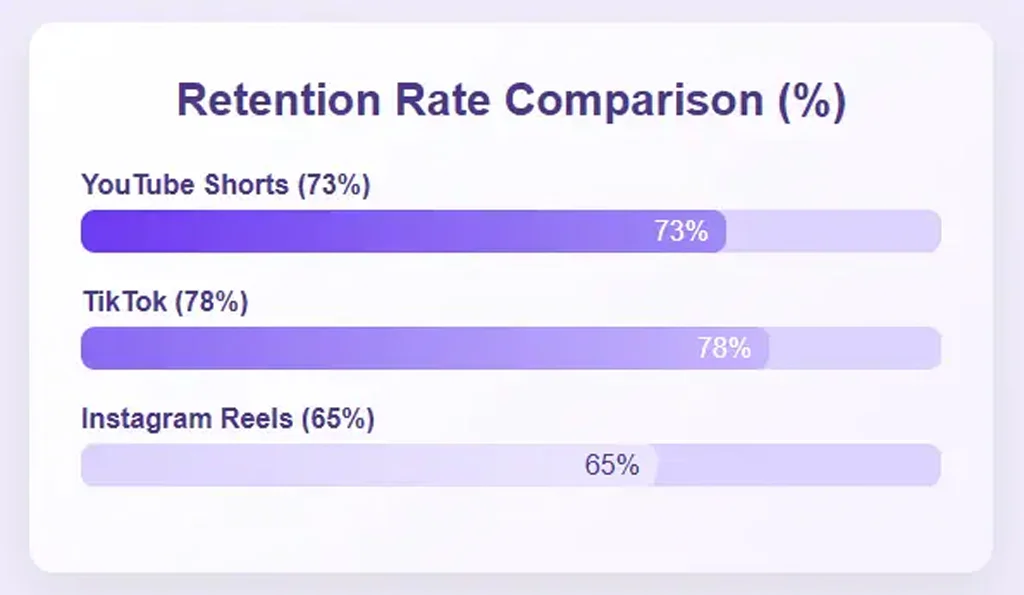
- TikTok leads the market with the highest retention rate of 78%, demonstrating exceptionally strong audience engagement and sustained viewer interest across short-form content.
- YouTube Shorts follows closely with a 73% retention rate, highlighting its competitive viewer retention and growing ability to keep users engaged.
- Instagram Reels ranks third with a 65% retention rate, indicating it is trailing behind both TikTok and YouTube Shorts in terms of long-term viewer retention and engagement.
Future Growth Projections and Trends
- Global short-form video ad spending is projected to exceed $100 billion by 2026.
- TikTok’s global ad revenue is forecast to surpass $20 billion in 2025.
- YouTube Shorts continues to scale beyond 200 billion daily views, signaling sustained momentum.
- Connected TV integration is expected to drive additional Shorts impressions in North America.
- TikTok’s U.S. user base remains above 150 million monthly users, maintaining strong advertiser interest.
- AI-driven content creation tools are accelerating video production across both platforms.
- Gen Z and Gen Alpha audiences increasingly favor short-form video over traditional TV.
- Cross-posting between TikTok and Shorts will likely remain standard practice for creators in 2026 and beyond.
Frequently Asked Questions (FAQs)
YouTube Shorts has 2.0+ billion monthly active users, while TikTok has approximately 1.59–1.6 billion monthly active users globally.
YouTube Shorts generates about 200 billion daily views, whereas TikTok’s daily global video views are in the billions but not precisely disclosed publicly.
The largest YouTube Shorts demographic, those aged 25–34, makes up about 21.5% of its user base.
TikTok generated an estimated $23 billion in revenue in 2024, with about 77% coming from advertising.
Conclusion
YouTube Shorts and TikTok dominate the short-form video landscape, yet they operate with distinct strengths. TikTok leads in daily engagement, trend velocity, and cultural impact. Meanwhile, YouTube Shorts leverages its massive ecosystem, TV reach, and integrated monetization model to scale rapidly. For advertisers, the choice often depends on demographic targeting and campaign goals. For creators, revenue structure and audience loyalty play larger roles.
As short-form video continues to expand, both platforms will shape how audiences consume content and how brands compete for attention.