

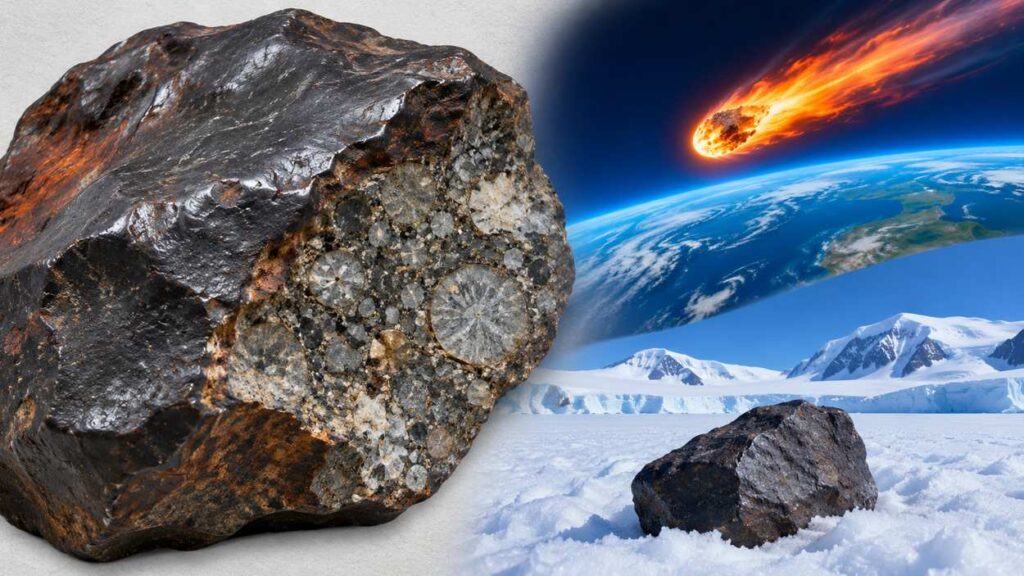
The Meteoritical Bulletin Database lists 78,941 valid meteorite names and 6,398 provisional names, according to the Meteoritical Society’s report in Elements. That count is the base for meteorite statistics. In 2025, the Nomenclature Committee of the Meteoritical Society approved 1,944 meteorites, and the year’s approvals include 15 observed falls.
Over 23,000 Antarctic meteorites have been collected since 1976, per the Smithsonian National Museum of Natural History. Of the meteorites approved in 2025, 1,053 were collected in Africa and 191 in Antarctica. The figures below come from the Society’s yearly summaries, NASA, two museums and a university. Each carries its report year, because the database grows every year.
Key Takeaways
- The Meteoritical Bulletin Database lists 78,941 valid meteorite names, plus 6,398 provisional names, in the Society’s latest report.
- The Nomenclature Committee approved 3,646 meteorites in 2024, against 1,944 in 2025.
- 15 observed falls sit among 2025’s approvals, or 0.77% of the 1,944 meteorites approved that year.
- Antarctica supplied 1,787 of the meteorites classified in 2022, but 191 of 2025’s approvals, while Africa supplied 1,053.
- 2025’s approvals include 86 lunar meteorites and 24 martian meteorites.
- Hoba, at 60 tons, heads the American Museum of Natural History’s list of the five largest meteorites.
Editor’s Choice
- Meteorites with a full classification write-up: 17,980 in the Meteoritical Bulletin Database.
- Antarctic meteorites collected since 1976: over 23,000, per the Smithsonian.
- Specimens in the National Meteorite Collection: more than 55,000.
- Meteoritic material falling on Earth each day: about 48.5 tons, scientists estimate, per NASA.
- Unique lunar meteorite groups as of January 2024: nearly 150, per NASA’s Johnson Space Center.
- Mass of the meteorites approved in 2022: 5.66 metric tons.
How Many Meteorites Have Been Found
- 78,941 valid meteorite names and 6,398 provisional names are listed in the Meteoritical Bulletin Database, including 17,980 with a full classification write-up, as of the Society’s latest report.
- In its 2023 report, the Society counted 71,633 approved meteorites in the database, 14,611 of them with a classification description.
- Between those two reports, the headline count was 7,308 higher, although the older report counted approved meteorites and the newer one counts valid meteorite names.
- The Smithsonian’s National Meteorite Collection includes more than 55,000 specimens of more than 20,000 distinct meteorites.
- The Society’s Nomenclature Committee (NomCom) reports that it continues to receive a high rate of new meteorite submissions each year.
- The previous report counted 77,301 valid names, so the count of valid names rose by 1,640 between the two latest reports.
| Society report | Meteorites listed | Label used in the report | With a classification write-up |
|---|---|---|---|
| 2026 | 78,941 | valid meteorite names | 17,980 |
| 2025 | 77,301 | valid meteorite names | 16,833 |
| 2024 | 73,953 | approved meteorites | 15,653 |
| 2023 | 71,633 | approved meteorites | 14,611 |
Source: The Meteoritical Society, Nomenclature Committee reports in Elements, 2023 to 2026
How many meteorites have been found?
The Meteoritical Bulletin Database lists 78,941 valid meteorite names and 6,398 provisional names, according to the Meteoritical Society. Each count is a snapshot taken when the report was written, so the live total keeps moving.
About This Data
- Compiled from 19 sources: 12 Meteoritical Society news posts and reports, 1 published Meteoritical Bulletin record, 3 NASA pages, 2 museum pages and 1 university page.
- Publication dates run from 2016 to November 2026.
- Only official, museum, peer-reviewed and university data qualified.
- Figures are reviewed on a rolling basis and updated when the sources publish new editions.
Meteorite Statistics by Year: Meteorites Approved per Year
- In 2024, the Nomenclature Committee of the Meteoritical Society approved 3,646 meteorites. The 2021 entries of the Meteoritical Bulletin Database total 2,802, published in Meteoritical Bulletin No. 110 in 2022.
- The Nomenclature Committee approved 3,094 meteorites in 2022. The Society called it “the highest number of new meteorites in a calendar year since the annual Meteoritical Bulletin began being phased with calendar years in 2016.”
- Using the news announcement’s 3,094 for 2022, 2024’s total then passed 2022’s by 552 meteorites.
- The 3,094 meteorites of 2022 total 5.66 metric tons of material, half of which is from the Jikharra 001 eucrite-melt breccia (2.5 metric tons).
- In its Elements report published in 2024, the Society gave the 2022 entries as totaling 3,904 meteorites, while its news announcement gave 3,094.
- Meteoritical Bulletin no. 113, then in preparation, was described as containing 3,635 meteorites approved in 2024, and the following report gave 3,646.
- 2,396 of the 3,646 meteorites approved in 2024 were non-Antarctic, and 1,916 of the 2,487 approved in 2023 were non-Antarctic.
View the data
Recent Developments
- November 2, 2026: The 88th Annual Meeting of the Meteoritical Society took place from August 9 to 14, 2026, in Frankfurt am Main, Germany. 464 participants from 40 nations registered, the Society reported.
- August 2026: The meeting received 511 abstracts, presented as 305 oral and 206 poster presentations.
- August 2026: Reception guests at the meeting watched a partial solar eclipse; an 89% partial solar eclipse was observed during the reception.
- August 2026: One special session honored the Antarctic Search for Meteorites (ANSMET) program under the title Meteorite Collection and Recovery: A Celebration of 50 Years of ANSMET.
- October 29, 2026: The 92nd Annual Meeting of the Meteoritical Society will be held in Boulder, Colorado in 2030, the Society announced.
- October 13, 2026: A University of Chile repository of Atacama finds holds a curated collection of 65 meteorites. Its work identified potential paired fragments from at least nine possible common fall events.
- October 1, 2026: The Global Meteor Network (GMN) observes meteors and fireballs using more than 1,600 video cameras across 45 countries. A Society-funded project used GMN observations to investigate the flux and origins of meteorite-dropping fireballs reaching Earth.
Observed Meteorite Falls vs Finds
- The 1,944 meteorites approved in 2025 include 15 observed falls, or 0.77% of the year’s approvals.
- 2024’s approvals include 17 falls, or 0.47% of the 3,646 approved that year.
- The 2020 bulletin also lists 17 falls, including Cavezzo, Flensburg and Novo Mesto.
- The 11 falls among 2022’s approvals included Golden and Great Salt Lake.
- Although the majority of meteorites that fall to Earth are stony, most of the meteorites discovered long after they fall are irons, according to NASA.
- Irons are heavier and easier to distinguish from Earth rocks than stony meteorites.
- These counts cover falls approved each year, not every fall on record.
View the data
How many meteorites fall to Earth each year?
The Society counts approved observed falls, not every meteorite that lands: Meteoritical Bulletin No. 110, which covers 2021 and was published in 2022, includes 10 approved falls. The counts were 17 for 2024 and 15 for 2025. Far more reaches the sky. Tens of thousands of meteorites enter our planet’s atmosphere each day, but most are the size of a grain of rice or smaller, according to the Smithsonian.
How Much Meteoritic Material Reaches Earth
- Scientists estimate that about 48.5 tons (44,000 kilograms) of meteoritic material falls on Earth each day, according to NASA.
- Most meteorites found on Earth come from shattered asteroids, although some come from Mars or the Moon, NASA says.
- In theory, small pieces of Mercury or Venus could have also reached Earth, but none have been conclusively identified.
- NASA’s figure measures the mass of all incoming material, while the Smithsonian counts objects entering the atmosphere, so the two are not combined.
| Measure | Figure | What is counted | Source |
|---|---|---|---|
| Meteoritic material falling on Earth each day | about 48.5 tons (44,000 kilograms) | Mass of material | NASA |
| Meteorites entering the atmosphere each day | Tens of thousands | Objects, most the size of a grain of rice or smaller | Smithsonian |
| Mass of the meteorites approved in 2022 | 5.66 metric tons | Approved meteorites | Meteoritical Society |
Source: NASA Science, Smithsonian National Museum of Natural History and The Meteoritical Society, 2023 to 2026
Meteorite Injuries and Notable Impacts
- Ann Hodges of Sylacauga, Alabama, was severely bruised by an 8-pound stony meteorite that crashed through her roof in November 1954.
- It was the first documented case of a person being injured by an extraterrestrial object in the United States, according to NASA.
- In 2013, a house-sized meteoroid entered the atmosphere above Chelyabinsk, Russia, at over 11 miles (18 kilometers) per second. It blew apart 14 miles (23 kilometers) above the ground.
- The Smithsonian describes the Chelyabinsk space rock as about 17 meters (56 feet) across and counts more than 200 pieces found.
- Arizona’s Barringer Meteorite Crater, also called Meteor Crater, was formed by the impact of a piece of iron-nickel metal approximately 164 feet (50 meters) in diameter.
| Event | When | Key figure | Source |
|---|---|---|---|
| Ann Hodges injury, Sylacauga, Alabama | November 1954 | 3.6-kilogram stony meteorite | NASA |
| Chelyabinsk fireball, Russia | 2013 | More than 1,600 people injured | NASA |
| Chelyabinsk fireball energy | 2013 | Around 440,000 tons of TNT equivalent | NASA |
| Meteor Crater, Arizona | 50,000 years old | About 1 kilometer across | NASA |
Source: NASA Science, Meteors and Meteorites facts, 2026
Worth noting: At Chelyabinsk, the explosion released the energy equivalent of around 440,000 tons of TNT. It generated a shock wave that blew out windows over 200 square miles (518 square kilometers), NASA reports. More than 1,600 people were injured in the blast, mostly due to broken glass.
Has anyone been hit by a meteorite?
Ann Hodges of Sylacauga, Alabama, was severely bruised by a stony meteorite that crashed through her roof in November 1954. It was the first documented case of a person being injured by an extraterrestrial object in the United States. At Chelyabinsk in 2013, more than 1,600 people were injured, mostly due to broken glass, according to NASA.
Meteorites by Type
- NASA lists three major types of meteorites: the irons, the stonys and the stony-irons.
- Ordinary chondrites made up 1,336 of the 1,944 meteorites approved in 2025, a share of 68.7%.
- The 2025 approvals also include 106 carbonaceous chondrites, 8 of them ungrouped.
- Smaller 2025 classes include 15 Rumuruti chondrites, 13 mesosiderites, 12 angrites and 10 enstatite chondrites. The chart below and this list leave out several other 2025 classes, so their counts do not add up to the 1,944 approved that year.
- In 2024, 2,964 of the 3,646 approved meteorites were ordinary chondrites, a share of 81.3%.
- Howardite-eucrite-diogenite (HED) meteorites: 218 HED meteorites were among 2024’s approvals.
View the data
By the numbers: Ordinary chondrites accounted for 1,336 of the 1,944 meteorites the Meteoritical Society approved in 2025, while lunar meteorites numbered 86 and martian meteorites 24. Moon and Mars rocks together made up a small share of that year’s list, which is part of what makes each new one notable.
What is the most common type of meteorite?
Ordinary chondrites made up 1,336 of the 1,944 meteorites approved in 2025, 1,123 more than the next class listed, HED meteorites. In 2024 they numbered 2,964 of 3,646, and the 2020 bulletin counted 2,336 of 2,790.
Ordinary Chondrites Approved by Year
- 2,964 ordinary chondrites were among the meteorites approved in 2024.
- The 2020 bulletin counted 2,336 ordinary chondrites and 131 carbonaceous chondrites, including 8 ungrouped ones.
- 2022’s approvals included 123 carbonaceous chondrites, 4 of them ungrouped.
- 2023’s included 127 carbonaceous chondrites, 6 of them ungrouped.
- 2024’s included 158 carbonaceous chondrites, 7 of them ungrouped.
- A class breakdown for 2021 was not available for this compilation, so that year is left out of the series.
View the data
Meteorites by Continent
- In 2022, 1,787 of the classified meteorites were from Antarctica, or 57.8% of that year’s 3,094 approvals.
- Antarctica’s share fell to 9.8% of 2025’s approvals, from 191 meteorites collected there.
- Of the meteorites approved in 2025, 1,053 were collected in Africa, 479 in South America and 196 in Asia.
- 13 came from North America, 9 from Europe and 2 from Oceania.
- In 2023, 968 were from Africa, 836 from South America and 572 from Antarctica.
- The 2020 bulletin lists 763 meteorites from Africa and 297 from South America.
- The Society’s yearly summaries group locations by continent, so country counts are not given here.
View the data
Antarctic Meteorites
- Over 23,000 Antarctic meteorites have been collected since 1976, according to the Smithsonian.
- NASA’s Johnson Space Center (JSC) reports that, as of 2016, the total number of samples recovered is ~22,000.
- The collection is among the largest in the world, and features samples from the Moon, Mars, and asteroids.
- Washington University in St. Louis counts ~44,000 named meteorite stones found in Antarctica from 1976 to 2018, where record keeping has been superb.
- Antarctic meteorite EET 79001 is an 8 kg (17 lb) martian meteorite.
- The three totals use different units (meteorites, samples and named stones) and different end dates, so they are shown side by side, not reconciled. The NASA count dates from 2016, which makes it the oldest figure here.
| Antarctic count | Figure | Unit | Source |
|---|---|---|---|
| Collected since 1976 | Over 23,000 | Meteorites | Smithsonian |
| Permanently transferred to the Smithsonian | Over 20,000 | Meteorites | Smithsonian |
| Recovered, as of 2016 | ~22,000 | Samples | NASA JSC |
| Sent to roughly 600 scientists | Over 19,000 | Meteorite samples | NASA JSC |
| Found 1976 to 2018 | ~44,000 | Named meteorite stones | Washington University in St. Louis |
Sources: Smithsonian National Museum of Natural History, NASA Johnson Space Center and Washington University in St. Louis (2016 to 2024)
Where are most meteorites found?
More meteorites have been discovered in Antarctica than anywhere else on Earth, according to the Smithsonian. The 2025 approvals lean elsewhere: of the meteorites approved in 2025, 1,053 were collected in Africa, 54.2% of the year’s total, against 191 in Antarctica.
Martian and Lunar Meteorites
- 86 lunar meteorites and 24 martian meteorites were among 2025’s approvals.
- The 2020 bulletin counted 41 Martian meteorites and 35 lunar meteorites.
- As of January 2024 there are nearly 150 unique lunar meteorite groups officially classified as lunar. 16 are from the US Antarctic meteorite collection and 6 from the Japanese Antarctic meteorite collection, per NASA’s Lunar Meteorite Compendium.
- The others are from hot desert localities in Africa, Australia, and the Middle East.
- The total mass of all known lunar meteorites is about 1,159 kg (2,555 lbs). That is about 1.3% of the mass of all stony meteorites, according to Washington University in St. Louis.
- As of December 31, 2024, that mass is about 5.4 times the mass of the rocks larger than 1 cm collected on the Apollo missions.
- The NASA and Washington University figures date from 2024, so they trail the Society’s newest annual counts by more than a year.
View the data
Key finding: Of the ~44,000 named meteorite stones found in Antarctica from 1976 to 2018, 0.10% are from the Moon and 0.07% are martian. For northern Africa, the numbers are 3.2% lunar and 1.9% martian, per Washington University in St. Louis. The greater proportions for the Sahara Desert are largely an artifact of nonrandom sampling and naming.
How many Martian and lunar meteorites are there?
NASA’s Lunar Meteorite Compendium counted nearly 150 unique lunar meteorite groups as of January 2024. 2025’s approvals include 86 lunar and 24 martian meteorites, and, as Washington University in St. Louis notes, different stones from a single lunar meteorite fall are given individual names. An all-time martian total is not among the figures compiled here, so none is given.
Largest Meteorites by Mass
- Hoba, 60 tons, was found in Grootfontein, according to the American Museum of Natural History.
- At 34 tons, Ahnighito is the largest meteorite on display in any museum.
- The original meteorite, called Cape York, was initially around 200 tons, at least six times the size of Ahnighito, before it broke apart in the atmosphere.
- Jikharra 001, a eucrite-melt breccia of 2.5 metric tons, accounts for half of the 5.66 metric tons of meteorites approved in 2022.
- Six other meteorites approved in 2022 are over 50 kg, including Orotukan, a 555 kg ungrouped iron.
| Rank | Meteorite | Mass (tons) | Where found |
|---|---|---|---|
| 1 | Hoba | 60 | Grootfontein |
| 2 | Chaco (fragment of Campo del Cielo) | 37 to 39 | Chaco Gualamba, Chaco, Argentina |
| 3 | Ahnighito | 34 | West Greenland, Greenland |
| 4 | Bacubirito | 24 | Sinaloa, Mexico |
| 5 | Armanty | 22 | Xinjiang, China |
Source: American Museum of Natural History, Top Five Largest Meteorites, 2026
What is the largest meteorite ever found?
Hoba, at 60 tons and found in Grootfontein, heads the American Museum of Natural History’s list of the five largest meteorites. Chaco follows at 37 to 39 tons. Cape York was initially around 200 tons, at least six times the size of Ahnighito, before it broke apart in the atmosphere.
Conclusion
The Meteoritical Bulletin Database lists 78,941 valid meteorite names as of the Society’s 2026 report, and the Society approved 1,944 meteorites in its latest annual count, 15 of them observed falls. Read each annual total alongside its regional split, because the mix of collecting areas changes from one year to the next.
The Meteoritical Society’s July 2026 announcement of the 1,944 meteorites approved in 2025 points readers to Meteoritical Bulletin No. 114 for the details. The 92nd Annual Meeting of the Meteoritical Society will be held in Boulder, Colorado in 2030.
References
- 1944 Meteorites Approved in 2025
- 3646 Meteorites approved in 2024
- 2487 Meteorites Approved in 2023
- Nomenclature Committee Approves 3094 Meteorites in 2022
- The Meteoritical Bulletin, No. 109 (Meteoritics & Planetary Science, 2021)
- The Meteoritical Society, Society News, Elements vol. 22 no. 3 (2026)
- The Meteoritical Society, Society News, Elements vol. 21 no. 3 (2025)
- The Meteoritical Society, Society News, Elements vol. 20 no. 3 (June 2024)
- The Meteoritical Society, Society News, Elements vol. 19 no. 3 (2023)
- Antarctic Meteorite Collection
- Meteorites: Messengers From Outer Space
- Meteors and Meteorites: Facts
- Ahnighito
- Lunar Meteorite Compendium
- Lunar meteorites
- Report of the 88th Annual Meeting in Frankfurt am Main, Germany
- A comprehensive survey of meteorite flux to Earth using the Global Meteor Network
- Classification and Curation of Atacama's Ordinary Chondrites
- 2030 Meteoritical Society Meeting to be held in Boulder, Colorado, USA
