

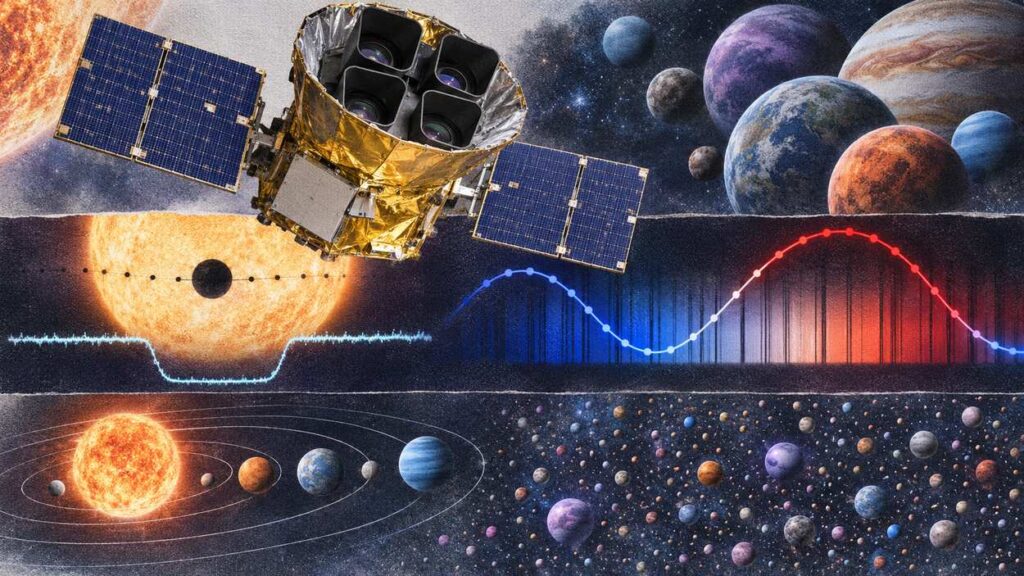
The NASA Exoplanet Archive lists 6,464 confirmed exoplanets as of November 9, 2026, the headline figure for exoplanet statistics. Those planets orbit in 4,857 planetary systems. The transit method is credited with 4,797 of them and radial velocity with 1,205.
A backlog sits behind the total, and the Transiting Exoplanet Survey Satellite (TESS) mission holds most of it. 4,815 TESS Project Candidates are yet to be confirmed. That is 4.7 times the 1,024 confirmed TESS planets. Discovery years are lopsided too: 1,504 planets are credited to 2016 and 872 to 2014. Each total below carries its date, since the archive keeps adding new planets.
Key Takeaways
- The NASA Exoplanet Archive counts 6,464 confirmed exoplanets as of November 9, 2026.
- The confirmed planets sit in 4,857 systems, and 1,082 of those systems have more than one known planet, according to the NASA Exoplanet Archive.
- Transit is credited with 4,797 confirmed planets, 74.2% of the archive total.
- 1,504 planets are credited to the discovery year 2016 and 872 to 2014, 36.8% of all confirmed planets between them.
- Kepler is credited with 2,787 confirmed planets, K2 with 550 and TESS with 1,024, per the NASA Exoplanet Archive.
- 4,815 TESS Project Candidates are yet to be confirmed, 4.7 times the confirmed TESS count, per NASA archive data.
Editor’s Choice
- Radial velocity discoveries: 1,205 confirmed planets.
- Microlensing discoveries: 292 confirmed planets.
- Planets credited to 2026 so far: 374, counted on November 9, 2026.
- Confirmed planets with a measured radius: 4,838.
- Planets credited to the W. M. Keck Observatory: 194.
- Planets credited to the European Space Agency (ESA) Gaia Satellite: 15.
- Archive total on October 8, 2026: 6,445 confirmed planets.
How Many Exoplanets Are There
- The archive lists 6,464 confirmed exoplanets in its summary counts on its Exoplanet and Candidate Statistics page on November 9, 2026, spread across 4,857 systems.
- NASA defines an exoplanet as any planet beyond our solar system, and some free-floating exoplanets, called rogue planets, are untethered to any star.
- NASA’s exoplanet hub says it has confirmed more than 6,000 exoplanets, out of the billions that it believes exist.
- The archive’s confirmed counts come from its Planetary Systems table, and its TESS Project Candidate counts from ExoFOP, the Exoplanet Follow-up Observing Program.
- Many planets have been detected using multiple methods, and the method tables count each planet by the technique its discovery is attributed to.
- Kepler, K2 and TESS candidate lists add 1,977, 975 and 4,815 objects yet to be confirmed.
| Archive count (November 9, 2026) | Number |
|---|---|
| Confirmed exoplanets | 6,464 |
| Planetary systems | 4,857 |
| Confirmed planets discovered by Kepler | 2,787 |
| Confirmed planets discovered by K2 | 550 |
| Confirmed planets discovered by TESS | 1,024 |
| Kepler Project Candidates yet to be confirmed | 1,977 |
| K2 candidates yet to be confirmed | 975 |
| TESS Project Candidates yet to be confirmed | 4,815 |
Source: NASA Exoplanet Archive, Exoplanet and Candidate Statistics, November 2026
How many exoplanets are there?
The NASA Exoplanet Archive counts 6,464 confirmed exoplanets as of November 9, 2026, orbiting in 4,857 systems. NASA’s exoplanet hub rounds the figure to more than 6,000. Another 4,815 TESS Project Candidates have not yet been dispositioned as a confirmed planet or false positive.
About This Data
- Compiled from 12 sources: 5 NASA Exoplanet Archive pages, 6 NASA Science pages and 1 University of Tokyo press release.
- Publication dates run from August 2025 to November 2026, and archive counts were read on November 9, 2026.
- Only official agency data, archive records and a university release on a peer-reviewed paper qualified.
- Figures are reviewed on a rolling basis and updated when the archive publishes new counts.
Exoplanets Discovered per Year
- 1,504 confirmed planets are credited to the discovery year 2016, and 872 to 2014.
- Those two years hold 36.8% of the archive total.
- 374 planets are credited to 2026, against 246 in 2025, 260 in 2024 and 367 in 2022, with the 2026 count running only to November 9.
- 564 planets are credited to 2021.
- The series starts with 2 planets credited to 1992, and 93 planets are credited to 2010 and 141 to 2011.
- Discovery years up to 2025 account for 6,090 confirmed planets.
View the data
Key finding: The archive credits 1,504 confirmed planets to 2016 and 872 to 2014, and the transit method alone accounts for 1,432 of the 2016 planets. Two discovery years supply more than a third of the census, so a simple yearly average hides how uneven the record is.
How many exoplanets are discovered per year?
The archive credits 246 confirmed planets to 2025, 260 to 2024 and 323 to 2023. The 2026 count stands at 374 with weeks of the year still to run. A recent year adds a few hundred planets, well below the 2014 and 2016 counts.
Recent Developments
- November 5, 2026: The archive added thirteen planets, including TOI-1355 b, which orbits one of the hottest known Main Sequence planet host stars.
- October 15, 2026: Six planets joined the archive, including Elias 2-24 b, which is less than a million years old.
- October 8, 2026: 70 new planets lifted the archive’s total to 6,445, and 1,000 planets had now been discovered with data from TESS.
- September 18, 2026: The University of Tokyo reported that TOI-1355 b orbits its star in around two Earth days and will not be observable after around 2033.
- September 16, 2026: NASA said astronomers had confirmed Elias 2-24 b as the youngest known planet, and its release quotes the researchers saying the previous record holders are all more than 5 million years old.
- September 11, 2026: Six new planets brought the archive’s total confirmed planet count to 6,366.
Exoplanets by Discovery Method
- Transit is credited with 4,797 confirmed planets and radial velocity with 1,205.
- Transit discoveries make up 74.2% of all confirmed planets, and radial velocity 18.6%.
- Microlensing accounts for 292 planets and imaging for 98.
- Smaller methods add 9 planets by orbital brightness modulations, 8 by pulsar timing variations, 6 by astrometry, 2 by pulsation timing variations and 1 by disk kinematics.
- NASA notes that hot Jupiters were among the first planet types found.
- A transit is a small eclipse: the planet dims a sliver of its star’s light, much as the Moon blocks the Sun in a solar eclipse, and that geometry lies behind all 4,797 transit finds, most of the archive’s confirmed planets.
View the data
By the numbers: The archive credits transit with 4,797 confirmed planets, radial velocity with 1,205 and microlensing with 292. Transit and radial velocity together account for 92.9% of the archive’s confirmed planets. The census reflects how planets were found as much as which planets exist.
What is the most common way to find exoplanets?
The archive credits 4,797 confirmed planets to the transit method, 74.2% of all confirmed planets. Radial velocity is credited with 1,205 and microlensing with 292. Many planets were detected by more than one method, and each is counted under the technique its discovery is attributed to.
Discovery Methods by Year Since 2021
- 457 transit planets are credited to 2021, against 77 by radial velocity.
- 2026 has 290 transit planets and 46 radial velocity planets so far, counted on November 9, 2026.
- Radial velocity was credited with 115 planets in 2022 and 29 in 2024.
- Microlensing was credited with 51 planets in 2022 and 29 in 2026.
- Imaging reached 11 planets in 2024.
- In 2020, transit was credited with 164 planets and radial velocity with 46.
- In 2016, transit accounted for 1,432 planets, 95.2% of that year’s total.
View the data
Exoplanets by Mission and Observatory
- Kepler is credited as the discovery facility for 2,787 confirmed planets, TESS for 1,024 and K2 for 550.
- Kepler and K2 together account for 51.6% of all confirmed planets.
- La Silla Observatory is credited with 311 planets, and the ESA Gaia Satellite with 15.
- TESS launched on April 18, 2018, and its status is extended mission.
- The Kepler space telescope was NASA’s first planet-hunting mission, and with K2 it spent nine years in deep space.
- Kepler discovered the first confirmed planetary system with more than one planet transiting the same star, Kepler-9.
View the data
How many exoplanets has TESS found?
The archive lists 1,024 confirmed planets discovered by TESS as of November 9, 2026. The archive marked 1,000 planets discovered with data from TESS on October 8, 2026. Another 4,815 TESS Project Candidates have not yet been dispositioned as a confirmed planet or false positive.
How many exoplanets did Kepler find?
The archive credits Kepler with 2,787 confirmed planets and K2 with 550. Another 1,977 Kepler Project Candidates are yet to be confirmed. NASA calls K2 the second act of Kepler, an extended mission. It says the most common planet size Kepler found lies between the size of Earth and Neptune.
Candidate Planets Awaiting Confirmation
- 4,815 TESS Project Candidates are yet to be confirmed, 4.7 times the confirmed TESS count.
- The archive has integrated 8,151 TESS Project Candidates, and ExoFOP lists 8,175 on the current date.
- On October 8, 2026, 4,823 TESS Project Candidates were waiting to be confirmed.
- Kepler Project Candidates total 4,717, a count that includes planets that have been confirmed or validated.
- K2 has 975 candidates yet to be confirmed.
- NASA’s TESS sky map marks more than 5,000 candidate planets that are awaiting verification, in a release dated May 13, 2026.
| Candidate list (November 9, 2026) | Count | What the archive counts |
|---|---|---|
| TESS Project Candidates yet to be confirmed | 4,815 | not yet dispositioned as a confirmed planet or false positive |
| TESS Project Candidates integrated into the archive | 8,151 | transit-like events, false positives included |
| TESS Project Candidates at ExoFOP | 8,175 | current-date count |
| Kepler Project Candidates | 4,717 | includes confirmed or validated planets |
| Kepler Project Candidates yet to be confirmed | 1,977 | candidates not yet confirmed |
| Kepler candidates and confirmed planets combined | 4,781 | union of the confirmed and candidate tables |
| K2 candidates yet to be confirmed | 975 | candidates not yet confirmed |
Source: NASA Exoplanet Archive, Exoplanet and Candidate Statistics, November 2026
Worth noting: The archive counts TESS Project Candidates as transit-like events that appear to be astrophysical in origin, including false positives as identified by the TESS Project. A candidate list is a queue for follow-up observers, and some entries on it will never become planets.
Exoplanets by Size and Mass
- 4,838 confirmed planets have a measured radius, 2,211 a measured mass and 1,111 a minimum mass (m sin i).
- Radius data covers 74.8% of confirmed planets, and measured mass 34.2%.
- 2,095 planets fall between 2 and 6 Earth radii, against 1,149 between 1.25 and 2 Earth radii and 561 at 1.25 Earth radii or smaller.
- NASA says the most common size of planet Kepler found, a world between the size of Earth and Neptune, does not exist in our solar system.
- NASA describes super-Earths as more massive than Earth but lighter than Neptune, and mini-Neptunes as smaller than Neptune and bigger than Earth.
View the data
The mass bins put 828 planets above 300 Earth masses and 116 at 3 Earth masses or less. The radius and mass bins describe different subsets of planets, so the two charts are separate views and should not be read as one group.
View the data
Multi-Planet Systems
- 3,775 systems have one known planet, 726 have two and 226 have three.
- 1,082 systems hold more than one known planet.
- 2,689 confirmed planets orbit in systems with more than one planet, 41.6% of the archive total.
- 3 systems have 7 known planets and 1 has 8.
- NASA says the Kepler-11 system included six planets, and that Kepler found nature often produces jam-packed planetary systems.
View the data
Why Exoplanet Statistics Differ Between Sources
- The archive classifies an object as a planet when its mass, or minimum mass, is equal to or less than 30 Jupiter masses, under its published planet inclusion criteria.
- The planet must not be free floating, and follow-up observations must make a false positive unlikely.
- The results must be peer reviewed and accepted for publication in the astrophysical literature.
- The archive notes that numerous exoplanet catalogs each have their own criteria, so users may notice different numbers.
- The archive reached 5,000 planets in March 2022 and 6,000 on September 17, 2025.
- NASA reported over 6,270 confirmed exoplanets in its TESS release of May 13, 2026.
- The free-floating rule leaves out the rogue planets NASA describes, so the archive total covers planets bound to a star.
| Date | Archive confirmed planet count |
|---|---|
| March 2022 | 5,000 |
| August 28, 2025 | 5,989 |
| September 17, 2025 | 6,000 |
| September 11, 2026 | 6,366 |
| October 8, 2026 | 6,445 |
| November 9, 2026 | 6,464 |
Source: NASA Exoplanet Archive news, 2025 and 2026; Exoplanet and Candidate Statistics, November 2026
How many exoplanets are in the habitable zone?
The NASA Exoplanet Archive counts 361 candidates and confirmed planets in the Kepler field in the habitable zone. It sets that zone at an equilibrium temperature between 180 and 310 kelvin, or an insolation between 0.25 and 2.2 times Earth’s flux.
Not all of these planets were detected or discovered by Kepler. The habitable-zone label is a temperature and starlight filter, and it says nothing about whether any of these worlds hosts life.
Conclusion
The NASA Exoplanet Archive’s count stands at 6,464 confirmed exoplanets, with 4,797 of them credited to the transit method. 4,815 TESS Project Candidates are still yet to be confirmed. That queue is the likeliest source of the next additions, though some candidates will prove to be false positives.
Every addition still has to meet the archive’s criteria, including peer-reviewed publication and a mass equal to or less than 30 Jupiter masses. Any exoplanet total, this one included, is best read with its date and the catalog’s rules beside it.
References
- Exoplanet and Candidate Statistics
- Planetary Systems Composite Parameters Table
- Exoplanet Criteria for Inclusion in the Exoplanet Archive
- 2026 Exoplanet Archive News
- 2025 Exoplanet Archive News
- Exoplanets - NASA Science
- What is an Exoplanet? Planet Types
- TESS (Transiting Exoplanet Survey Satellite)
- Kepler / K2
- Newfound Baby Planet Smashes Record for Youngest Known World
- NASA Planet-Hunting TESS Reveals Dazzling Night Sky
- Time’s running out to catch giant planet’s strange orbit - The University of Tokyo
