

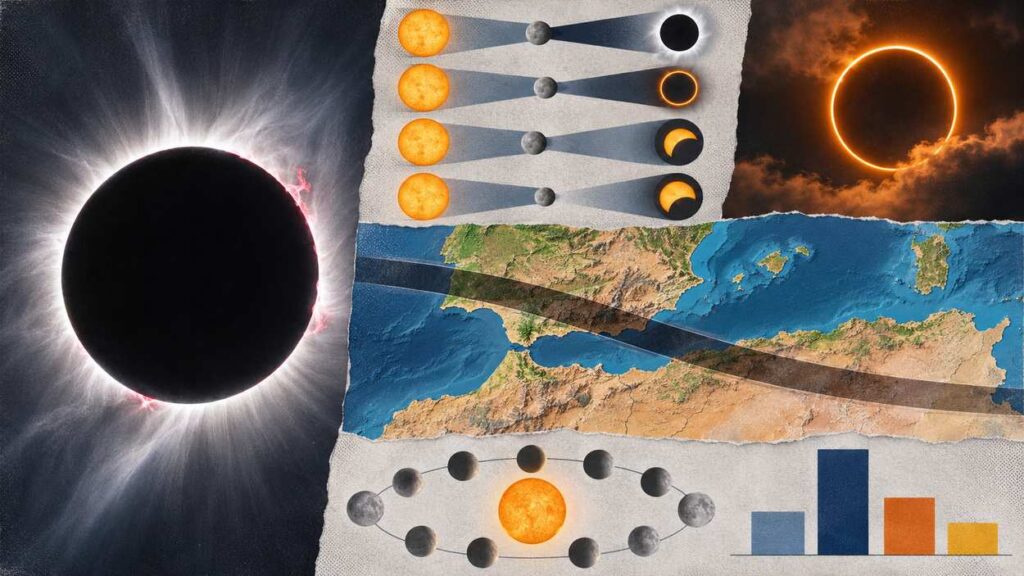
NASA’s catalog counts 224 solar eclipses in the 21st century: 77 partial, 72 annular, 68 total and 7 hybrid. Those counts anchor the solar eclipse statistics below. There are a minimum of two and a maximum of five solar eclipses in every calendar year, according to the NASA Goddard Space Flight Center’s eclipse catalog.
Totality at any single place is far rarer than the yearly count suggests. NASA’s Scientific Visualization Studio (SVS) divides 5000 years by an average of 13.66 eclipses per pixel to get an average of 366 years between eclipses. The next total solar eclipse falls on Aug. 2, 2027, visible from southern Spain and northern Africa, and its central duration in NASA’s catalog is 6 minutes 23 seconds.
Key Takeaways
- Total eclipses make up 30.4% of the 224 solar eclipses of 2001 to 2100, against 26.7% of the 11,898 solar eclipses from 2000 BCE to 3000 CE.
- Over the 5000 year period, 3,625 years, or 72.5%, have two solar eclipses.
- NASA’s SVS heatmap gives an average of 366 years between eclipses at particular places.
- The 2027 Aug 02 total eclipse has a central duration of 6 minutes 23 seconds and belongs to Saros 136, the same series as the 2009 Jul 22 eclipse.
- From 4000 BCE to 8000 CE, the longest total solar eclipse will occur in 2186 and will last 7 minutes 29 seconds.
- After 2024, the next total solar eclipse visible from any point in the contiguous United States will occur in 2044.
Editor’s Choice
- Solar eclipses from 2000 BCE to 3000 CE: 11,898.
- Solar eclipses from 2001 to 3000: 2,388.
- Years with five solar eclipses in the 5000 year period: 25.
- Total or hybrid eclipse paths on NASA’s heatmap: 3,742.
- Length of one Saros cycle: 6585.3223 days.
- Width of the path of totality: typically averages 60 to 70 miles.
Solar Eclipse Statistics by Type Over Five Millennia
- During the five millennium period 2000 BCE to 3000 CE, Earth will experience 11,898 solar eclipses, by NASA’s count.
- Total eclipses number 3,173, or 26.7% of all eclipses in the period.
- Annular and total eclipses can be further classified as central with two limits, central with one limit, or non-central with one limit.
- Hybrid eclipses are all central with two limits.
- The list uses eclipses calculated by Fred Espenak and Jean Meeus and published in 2006 as the Five Millennium Canon of Solar Eclipses.
| Eclipse type | Number | Percent |
|---|---|---|
| All eclipses | 11,898 | 100.0% |
| Partial | 4,200 | 35.3% |
| Annular | 3,956 | 33.2% |
| Total | 3,173 | 26.7% |
| Hybrid | 569 | 4.8% |
Source: NASA Five Millennium Catalog of Solar Eclipses, 2000 BCE to 3000 CE
About This Data
- Compiled from 16 sources: 15 NASA pages and 1 National Park Service page.
- The NASA pages are 7 from the Goddard Space Flight Center’s eclipse site, 5 from NASA Science and 3 from the Scientific Visualization Studio.
- Catalog figures are calculations from the 2006 Five Millennium Canon, and 3 of the 5 NASA Science pages carry 2026 dates.
- Only government science agency data qualifies; figures are reviewed on a rolling basis and updated when sources publish new editions.
Solar Eclipses per Year
- There are a minimum of two and a maximum of five solar eclipses in every calendar year.
- Over the 5000 year period, 3,625 years, or 72.5%, have two solar eclipses.
- Only 25 years in the 5000 year period, or 0.5%, have five.
- In NASA’s list of years with five solar eclipses, 1935 is followed by 2206.
- Over the 5000 year period, there are 43 years containing two eclipses in the same calendar month.
- The time when the Sun, the Moon and Earth are aligned is known as eclipse season, which happens twice a year, according to NASA.
- The National Park Service says a total solar eclipse actually takes place approximately every 18 months, but the total effect can only be seen in places located on the totality path, which typically averages 60 to 70 miles.
View the data
How often do solar eclipses happen?
Solar eclipses happen a minimum of two and a maximum of five times in every calendar year, according to NASA. Years with two eclipses make up 72.5% of the 5000 year period. A total eclipse takes place approximately every 18 months, according to the National Park Service, though each one is seen only along its narrow path.
Is the solar eclipse on Feb 17, 2026?
Yes, and it has already passed. NASA’s decade table lists an annular eclipse on 2026 Feb 17, with its annular path over Antarctica and a partial eclipse across southern Argentina & Chile and southern Africa. The next annular solar eclipse NASA lists is on Feb. 6, 2027, visible in parts of South America and Africa.
Recent Developments
- August 12, 2026: A total solar eclipse darkened skies over Greenland, Iceland, and Spain.
- August 12, 2026: NASA’s event page lists a partial solar eclipse that day for parts of the northern US (from Alaska to North Carolina), most of Canada, much of Europe, and northwestern Africa.
- August 21, 2026: NASA shared views of the August solar eclipse from the ground, the air and space, after its researchers and photographers were along the eclipse path to study the corona.
- August 21, 2026: NASA said that over the coming months, scientists will analyze the observations and images captured during the solar eclipse of August 2026.
- September 28, 2026: As of its update that day, NASA’s Future Eclipses page lists an annular solar eclipse on Feb. 6, 2027 and a total solar eclipse on Aug. 2, 2027.
Solar Eclipses in the 21st Century by Type
- During the 21st century, Earth will experience 224 solar eclipses.
- Total eclipses number 68, or 30.4% of the century’s eclipses.
- Annular eclipses number 72, or 32.1%, and annular and total eclipses can be classified as either central or non-central.
| Eclipse type | Share of eclipses (%) |
|---|---|
| Partial | 34.4 |
| Annular | 32.1 |
| Total | 30.4 |
| Hybrid | 3.1 |
Source: NASA Catalog of Solar Eclipses, 2001 to 2100
How Eclipse Type Shares Compare Across Periods
- Total eclipses make up 30.4% of the 2001 to 2100 catalog, against 26.7% across 2000 BCE to 3000 CE and 27.2% of the 2,388 eclipses of 2001 to 3000.
- Hybrid eclipses make up 3.1% of the 21st century, against 4.8% over five millennia and 2.4% in 2001 to 3000.
- The total share for 2001 to 2100 sits 3.7 percentage points above the five-millennium share.
- Partial eclipses take 35.5% of the 2001 to 3000 catalog.
View the data
Key finding: NASA’s catalog for the 21st century counts 68 total eclipses among 224, a share of 30.4%, above the 26.7% share across the 11,898 eclipses of 2000 BCE to 3000 CE. The gap describes this century’s mix of types, not a trend: the 2001 to 3000 catalog puts totals at 27.2%.
How Often a Total Solar Eclipse Returns to One Place
- Across NASA’s heatmap, the average number of eclipses seen by a pixel is 13.66, which produces an average of 366 years between eclipses.
- That number is almost exactly halfway between the estimates of 360 by Russel et al. in their 1926 astronomy textbook and 375 by Jean Meeus in a 1982 paper.
- The National Park Service says that on average, the same spot on Earth only gets to see a solar eclipse for a few minutes every 375 years.
- Not a single one of the 14.6 million points sampled by the map goes unvisited by at least one eclipse.
- More total eclipses happen in the northern hemisphere than in the southern, and eclipses are more likely in the summer.
- Each pixel location ended up experiencing anywhere from one to 35 eclipses.
- The map draws the paths of the 3742 eclipses classified in the Canon as either total or hybrid.
View the data
Worth noting: NASA’s Scientific Visualization Studio says it’s tempting to make statements about particular locations based on the map, but that wouldn’t be valid. Across the entire map, the average is 366 years between eclipses, while each pixel location ended up experiencing anywhere from one to 35 eclipses. Counts at individual places range from one to 35, so the average describes the whole map, not any one place.
How often is a 100% solar eclipse?
At particular places, NASA’s map gives an average of 366 years between eclipses, based on the paths of the 3742 eclipses classified in the Canon as either total or hybrid. The National Park Service says the same spot on Earth only gets to see a solar eclipse for a few minutes every 375 years, on average.
Years With Two, Three or Four Eclipses This Century
- NASA counts 82 years with two eclipses in 2001 to 2100.
- Two-eclipse years make up 82% of the century’s years.
View the data
Upcoming Annular and Total Solar Eclipses, 2027 to 2030
- NASA lists an annular solar eclipse on Feb. 6, 2027, visible in parts of South America and Africa.
- A total solar eclipse on Aug. 2, 2027 will be visible in southern Spain, North Africa (including Morocco, Algeria, Tunisia, Libya, and Egypt), Saudi Arabia, and Yemen.
- That eclipse has a central duration of 6 minutes 23 seconds and belongs to Saros 136.
- For total and annular eclipses, the Central Duration gives the length of the eclipse as seen from the central line at greatest eclipse.
| Date | Type | Central duration | Where the eclipse is central |
|---|---|---|---|
| 2027 Feb 06 | Annular | 7 min 51 sec | Chile, Argentina, Atlantic |
| 2027 Aug 02 | Total | 6 min 23 sec | Morocco, Spain, Algeria, Libya, Egypt, Saudi Arabia, Yemen, Somalia |
| 2028 Jan 26 | Annular | 10 min 27 sec | Ecuador, Peru, Brazil, Suriname, Spain, Portugal |
| 2028 Jul 22 | Total | 5 min 10 sec | Australia, New Zealand |
| 2030 Jun 01 | Annular | 5 min 21 sec | Algeria, Tunisia, Greece, Turkey, Russia, northern China, Japan |
| 2030 Nov 25 | Total | 3 min 44 sec | Botswana, South Africa, Australia |
Source: NASA Goddard Space Flight Center, Solar Eclipses 2021 to 2030
When is the next total solar eclipse?
The next total solar eclipse is on Aug. 2, 2027, visible in southern Spain, North Africa, Saudi Arabia, and Yemen, according to NASA. NASA describes it as a much longer total solar eclipse than the one in August 2026, and its central duration is 6 minutes 23 seconds.
Total Solar Eclipses Visible From the United States
- After 2024, the next total solar eclipse visible from any point in the contiguous United States will occur in 2044, and totality will only be visible from North Dakota and Montana.
- The next total solar eclipse that will travel across the lower 48 states from coast to coast is in 2045.
- Calculations show that it will take about a thousand years for every geographic location in the lower 48 states to be able to view a total solar eclipse, according to NASA.
- On Aug. 2, 2027, a partial eclipse will be visible in northern Maine.
- The 2045 Aug 12 eclipse has a central duration of 6 minutes 6 seconds and is also in Saros 136.
| Date | Type | Central duration | Path of totality |
|---|---|---|---|
| 2033 Mar 30 | Total | 2 min 37 sec | eastern Russia, Alaska |
| 2044 Aug 23 | Total | 2 min 4 sec | Greenland, northern Canada, Montana, North Dakota |
| 2045 Aug 12 | Total | 6 min 6 sec | southern US, Haiti, Dominican Republic, Venezuela, Guyana, French Guiana, Suriname, Brazil |
Source: NASA Goddard Space Flight Center, Solar Eclipses 2031 to 2040 and 2041 to 2050
Long Total Solar Eclipses From 2001 to 2204
- NASA’s catalog of long total solar eclipses lists 2009 Jul 22 at 6 minutes 39 seconds, 2027 Aug 02 at 6 minutes 23 seconds and 2045 Aug 12 at 6 minutes 6 seconds, each in Saros 136.
- The next entry after 2045 Aug 12 is 2096 May 22, at 6 minutes 7 seconds in Saros 139.
- The 2186 Jul 16 eclipse in Saros 139 reaches 7 minutes 29 seconds, and the 2204 Jul 27 eclipse has a central duration of 7 minutes 22 seconds.
| Date | Saros | Central duration |
|---|---|---|
| 2009 Jul 22 | 136 | 6 min 39 sec |
| 2027 Aug 02 | 136 | 6 min 23 sec |
| 2045 Aug 12 | 136 | 6 min 6 sec |
| 2096 May 22 | 139 | 6 min 7 sec |
| 2114 Jun 03 | 139 | 6 min 32 sec |
| 2132 Jun 13 | 139 | 6 min 55 sec |
| 2150 Jun 25 | 139 | 7 min 14 sec |
| 2168 Jul 05 | 139 | 7 min 26 sec |
| 2186 Jul 16 | 139 | 7 min 29 sec |
| 2204 Jul 27 | 139 | 7 min 22 sec |
Source: NASA Goddard Space Flight Center, Long Total Solar Eclipses 2001 to 3000
By the numbers: NASA’s long eclipse catalog places 2009 Jul 22 (6 minutes 39 seconds), 2027 Aug 02 (6 minutes 23 seconds) and 2045 Aug 12 (6 minutes 6 seconds) in the same Saros series, number 136. Any two eclipses separated by one Saros cycle share very similar geometries, and a Saros series returns to about the same geographic region every 3 saroses (54 years and 34 days).
Longest and Shortest Eclipses of the 21st Century
- The 2009 Jul 22 total eclipse ran 6 minutes 39 seconds on the central line, the longest total of the century in NASA’s extremes table below.
- Across a far longer span, the shortest total solar eclipse happened in 919 CE and lasted just 9 seconds.
- Total solar eclipses last anywhere from 10 seconds to about 7.5 minutes, according to NASA.
| Extreme, 2001 to 2100 | Date | Duration |
|---|---|---|
| Longest annular | 2010 Jan 15 | 11 min 8 sec |
| Shortest annular | 2085 Dec 16 | 19 sec |
| Longest total | 2009 Jul 22 | 6 min 39 sec |
| Shortest total | 2068 May 31 | 1 min 6 sec |
| Longest hybrid | 2013 Nov 03 | 1 min 40 sec |
| Shortest hybrid | 2067 Dec 06 | 8 sec |
Source: NASA Catalog of Solar Eclipses, 2001 to 2100
The Saros Cycle and Eclipse Recurrence
- One Saros is equal to 223 synodic months, or 6585.3223 days.
- 239 anomalistic months and 242 draconic months are also equal to this same period, to within a couple hours.
- The shifting of each successive eclipse path is by ~120º westward.
- NASA’s decade tables give the Saros cycle as a period of approximately 18 years 11 days.
| Month type | Months in one Saros | Days |
|---|---|---|
| Synodic | 223 | 6585.3223 |
| Anomalistic | 239 | 6585.5375 |
| Draconic | 242 | 6585.3575 |
Source: NASA Goddard Space Flight Center, Eclipses and the Saros
Solar Eclipse Types Defined
- A solar eclipse happens when the Moon passes directly between the Sun and Earth.
- When the Moon completely blocks the Sun, it is called a total solar eclipse, and when the Moon only blocks part of the Sun, it is called a partial eclipse.
- An annular eclipse happens when the Moon blocks all of the Sun except for a small ring around the edge.
- Hybrid eclipses are also known as annular/total eclipses, both total and annular along different sections of the umbral path.
- NASA’s guidance reads: “Except for the fleeting moments of totality during a total solar eclipse, observers should always use eclipse glasses or an alternative safe solar viewing method.”
What is the longest solar eclipse ever?
In the span of 12,000 years from 4000 BCE to 8000 CE, the longest total solar eclipse will occur in 2186 and will last 7 minutes 29 seconds, according to NASA. That eclipse is a prediction, not a past event. Its path will sweep across Colombia, Venezuela, and Guyana. The longest annular eclipses run longer: NASA’s 2001 to 2100 extremes table lists 11 minutes 8 seconds for the 2010 Jan 15 annular eclipse. Across the five millennia from 2000 BCE to 3000 CE, NASA’s catalog puts the longest annular eclipse on Dec. 7, 150 CE, at 12 minutes 23 seconds.
Conclusion
NASA’s catalog puts 224 solar eclipses in the 21st century, 68 of them total, and every calendar year has a minimum of two and a maximum of five. At any one place, NASA’s heatmap gives an average of 366 years between eclipses.
The next total solar eclipse arrives on Aug. 2, 2027, over southern Spain and North Africa, while the contiguous United States waits until 2044 for its next total solar eclipse. NASA said on Aug. 21, 2026 that scientists would analyze the observations of the Aug. 12, 2026 eclipse over the following months. Many short-period comets also return on a predictable schedule, and our comet statistics list return dates for notable comets.
References
- Five Millennium Catalog of Solar Eclipses: -1999 to +3000
- Catalog of Solar Eclipses: 2001 to 2100
- Long Total Solar Eclipses: 2001 to 3000
- Solar Eclipses: 2021 to 2030
- Solar Eclipses: 2031 to 2040
- Solar Eclipses: 2041 to 2050
- Future Eclipses
- Eclipse FAQ
- Types of Solar Eclipses
- Cosmic Coincidence?
- 5000 Years of Total Solar Eclipses
- Total Solar Eclipse on August 12, 2026
- NASA Shares Views of August Solar Eclipse from Ground, Air, Space
- Chasing Eclipses with NASA Pilots
- Map of the August 12, 2026, Total Solar Eclipse
- Eclipses and the Saros
